Intel CEO Lip-Bu Tan recently disclosed the company's latest process roadmap at the J.P. Morgan TMT Conference, announcing that the 14A process node is expected to enter risk production in 2028 and enter the high-volume mass production stage in 2029.
By then, Intel will not only adopt the 14A process internally on a large scale, but will also open it to foundry customers to support large-volume wafer production based on High-NA EUV (high numerical aperture extreme ultraviolet lithography) exposure. Chen Liwu said that this time point is very close to the A14 node that TSMC is expected to launch, and the two parties will compete head-on in the "Angstrom Era" semiconductor manufacturing process.
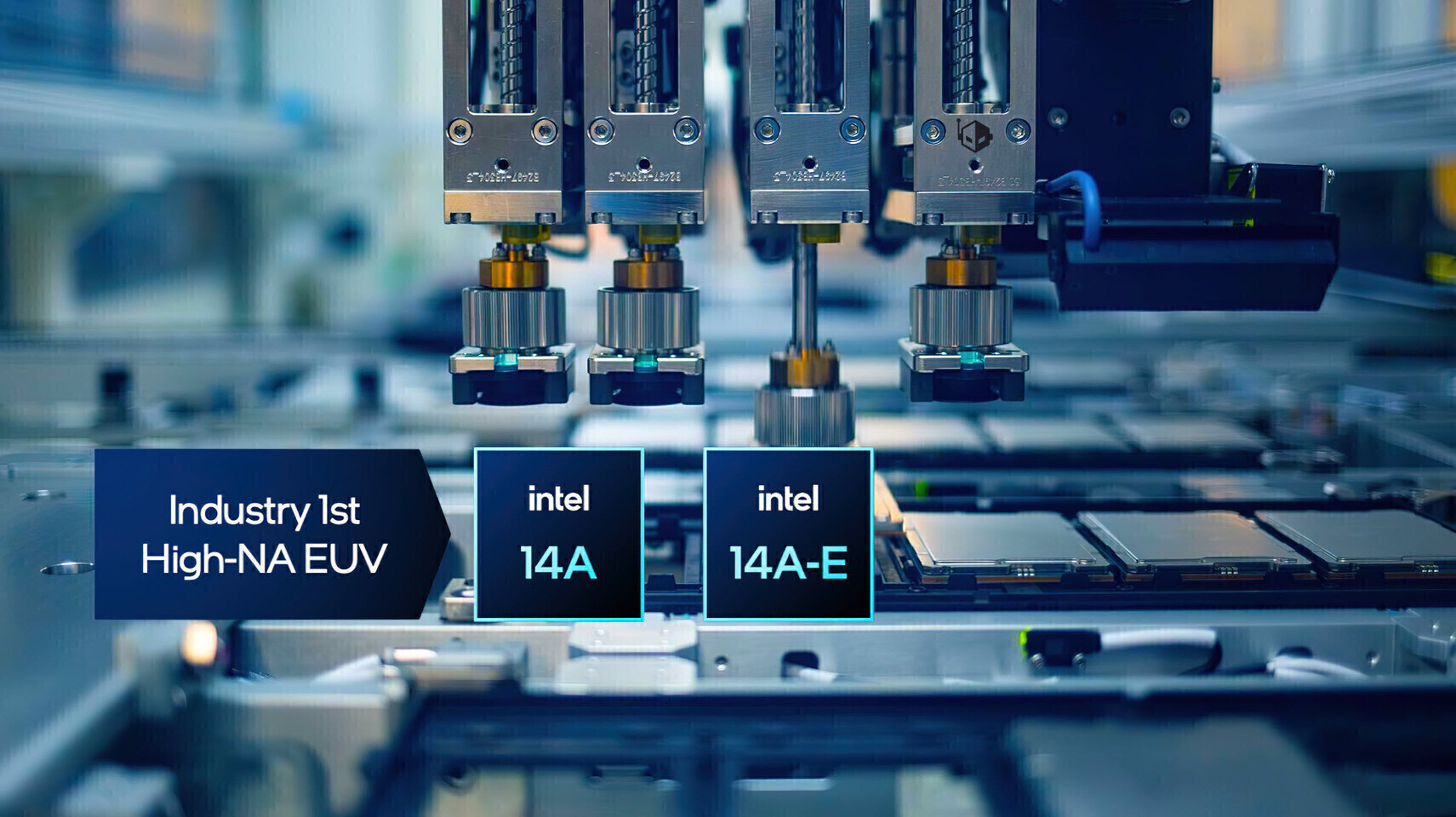
According to Intel, compared with the previously bumpy 18A node, the R&D progress of 14A is significantly smoother, the early yield performance is better, and the manufacturing process is relatively simplified, which helps to improve overall production efficiency and predictability. 14A will become the world's first mass-production process node to actually introduce ASML's high-NA EUV lithography machine. This type of equipment is regarded as the most complex and advanced chip manufacturing tool to date. The current 14A process design kit (PDK) has been advanced to version 0.5. Intel is expected to provide customers with version 0.9 PDK, which Chen Liwu calls the "Holy Grail", in October this year. By then, chip design companies can complete product finalization, design convergence and production capacity planning.
When talking about longer-term planning, Intel also publicly confirmed for the first time that the 10A and 7A nodes will be included in the official roadmap and will continue to be promoted as subsequent evolution products. Chen Liwu pointed out that after completing the trial production and verification of 14A, the company will accelerate the process development of 10A and 7A and build a continuously evolving process technology route to meet the needs of its own processors and accelerator products, while providing long-term predictable process options for future foundry customers. For large chip customers, when choosing a foundry, they often focus on its planning and execution capabilities for future multi-generation nodes. Intel hopes to establish a long-term commitment and attraction similar to that of TSMC in this regard, so that customers can consider Intel foundry as one of the core options when evaluating future products.