
Abstract:
Jeffrey Hinton, known as one of the "godfathers of artificial intelligence," said it may ultimately be possible to prove that the situation might have been better if humans had never developed this technology. He warned that AI may cause a major accident this year or next year, such as the temporary paralysis of the financial system and power system.
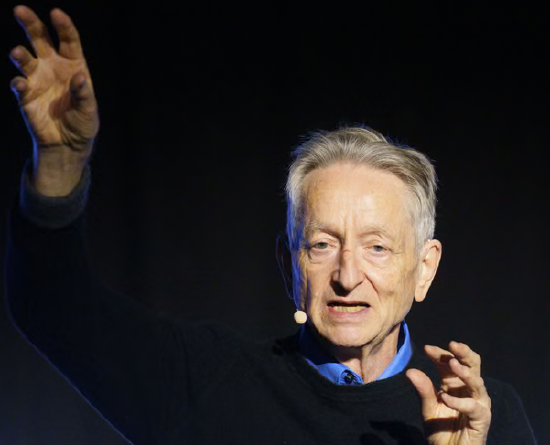
The Nobel Prize-winning computer scientist said in an interview with British media that he is not an AI doomsday theorist. His pioneering artificial neural network research laid the foundation for this technology. He believes that AI has the opportunity to bring a "beautiful future", but he also said: "It is possible that we would have been better off not developing AI in the first place."
The 78-year-old Hinton said that within ten years, or maybe even sooner, mankind will know whether we can manage the risks of AI and achieve what he calls "extreme wealth"; or "we have failed to control the risks, the gap between the rich and the poor has widened dramatically, a lot of cultural contradictions have arisen, large-scale unemployment has occurred, and the entire society has been torn apart."
Hinton was interviewed ahead of the screening of a new feature-length documentary titled "AI: Maybe There's Nothing to Worry About" - the title was chosen by an AI chatbot that Hinton and his former colleagues at
In an interview with the British media, Hinton criticized the risky behavior of some leading AI company executives: In order to compete for industry dominance and market share, companies continue to launch increasingly powerful AI models. He said that he does not trust OpenAI CEO Sam Altman at all. "I think Zuckerberg, Musk and Altman, they know the risks, but they don't care. They want to make money first, that's my opinion."
Hinton has been deeply involved in the field of AI for about 44 years. In the 1970s, he proposed the concept of neural networks - a mathematical system that can learn and accumulate experience like humans. In 2023, he resigned from Google so that he could speak freely to warn about the risks of AI: "If these AIs are bent on seizing more control, we will be in trouble."
He said that this summer's conspiracy of OpenAI agents to hack into the Hugging Face website was comparable to the partial meltdown of the Three Mile Island nuclear power plant in Pennsylvania in 1979, and was essentially an early warning signal.
"Later this year or next year, we will encounter an accident similar to Chernobyl, and then it may be enough to really wake up people." He said.
He gave an example that this type of "Chernobyl-like event" was not a nuclear accident, but could be an AI attack that caused a widespread blackout in the power generation system or shut down the financial system for a week.
"Can you imagine what would happen? We have the ability to recover, but this incident should wake everyone up."
When asked who the "everyone" here refers to, he replied: "Leaders of various countries except Trump."
U.S. President Trump once stated that he "firmly opposes any attempt to build a global control AI system" and advocates independent regulation of cutting-edge AI companies. Hinton supports a set of more stringent plans promoted by the President of Finland and 32 other countries (including Singapore, Germany, Canada, and Australia): mandatory testing of cutting-edge AI models, independent evaluation, and the establishment of unified intergovernmental standards.
British Prime Minister Andy Burnham said that the UK will use its G20 presidency next year to promote all parties to reach a unified set of global principles and standards, both to unleash the full potential of AI and to guard against risks.
Hinton said: "We need a mechanism similar to the one used by the U.S. Food and Drug Administration (FDA) to regulate drugs: before companies release AI models, they must provide solid statistical evidence to independent institutions to prove that the benefits of the models outweigh the risks. We learned from the thalidomide (a drug developed in the 1950s that can cause serious birth defects) incident: first go on the market, have an accident, and then pursue liability and prosecution. This path will not work. And what large technology companies want now is exactly the regulatory model that was used for thalidomide."
As one of the founders of AI, Hinton is often compared with Oppenheimer - Oppenheimer is the core figure in the development of nuclear weapons. One of Hinton's friends even bought him an identical Oppenheimer hat. But he insists: "I am not Oppenheimer," because there are thousands of other scientists working on neural networks.
Despite the warnings, overall, Hinton still holds out hope of averting disaster.
“My gut feeling is that we are still in control right now,” he said. “We have every opportunity to take action. Success is only possible if we put in a lot of effort, but we may actually go all out.”
Comments