
Abstract:
According to the Daily Telegraph, a latest study released by the British Vehicle Leasing Association (BVRLA) based on 47.4 million MOT annual inspection data shows that the reliability of high-mileage electric vehicles is significantly better than that of fuel vehicles with the same mileage, and as the driving mileage increases, this gap continues to widen. After more than 120,000 miles, the probability of a gasoline vehicle breaking down is nearly 47% higher than that of an electric vehicle, which is nearly half, directly breaking the common perception that "electric vehicles have more problems after being driven for a long time."
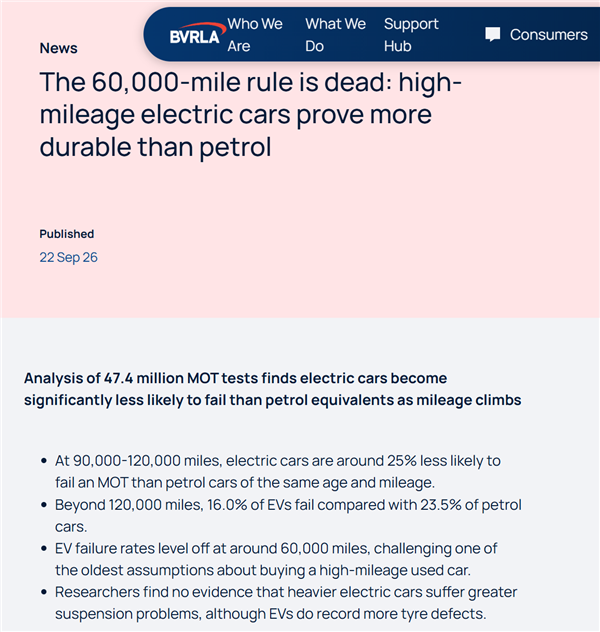
It is reported that MOT is a mandatory annual vehicle safety test in the UK, covering all vehicles on the road. The data volume is huge and statistically representative.
The 47.4 million MOT test records analyzed by BVRLA this time is the largest empirical study on the long-term reliability of electric vehicles to date.
The data shows a clear trend.
In the low mileage stage, the failure rate of electric vehicles and fuel vehicles is almost the same, or even slightly higher. In the range of 20,000 to 40,000 miles, the MOT failure rate of electric vehicles is 12%, and that of gasoline vehicles is 11.7%. The two are basically at the same level.
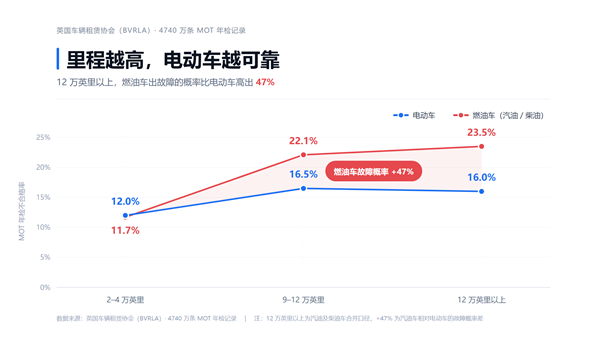
But starting from 60,000 miles, the curve diverges. The failure rate of electric vehicles stabilizes, forming a plateau at around 16%, while the failure rate of gasoline and diesel vehicles continues to rise, reaching 23.5% after 120,000 miles.
In the range of 90,000 to 120,000 miles, the failure rate of electric vehicles is 16.5%, and that of gasoline vehicles is 22.1%. Electric vehicles are about 25% lower than gasoline vehicles. The higher the mileage, the greater the gap.
Converted into relative probability, gasoline vehicles are 47% more likely to break down than electric vehicles. In other words, the failure rate of an old electric car that has traveled more than 120,000 miles is nearly half that of a gas-powered car of the same age and with the same mileage.
In fact, this result is also highly consistent with the working principle of electric vehicles.
Internal combustion engine vehicles have hundreds of moving parts,
including pistons, crankshafts, valves, transmission gears, etc. As mileage accumulates, mechanical wear and tear inevitably leads to an increase in failure rates.
Electric vehicles are driven by electric motors, with significantly fewer moving parts and no traditional fault sources such as oil aging, timing chain wear, and clutch ablation.
Although there is attenuation in the battery and electronic control system, the overall failure curve is much flatter than that of the internal combustion engine. BVRLA chief executive Toby Poston said the data "shatters assumptions about the reliability of used electric vehicles".
However, it is worth noting that previous academic research conclusions are inconsistent.
A study based on British MOT data published in a sub-journal of "Nature" in 2025 pointed out that the reliability of early batches of electric vehicles was lower than that of fuel vehicles, but in recent years the gap has been rapidly narrowing and reversing.
For consumers, the practical significance of this research lies in the used car market. For a long time, one of the core reasons for the low residual value of used electric vehicles has been buyers’ concerns about battery degradation and long-term reliability.
However, this research report proves that there is no need to worry too much about performance degradation when it comes to electric vehicles.
Comments