
Abstract:
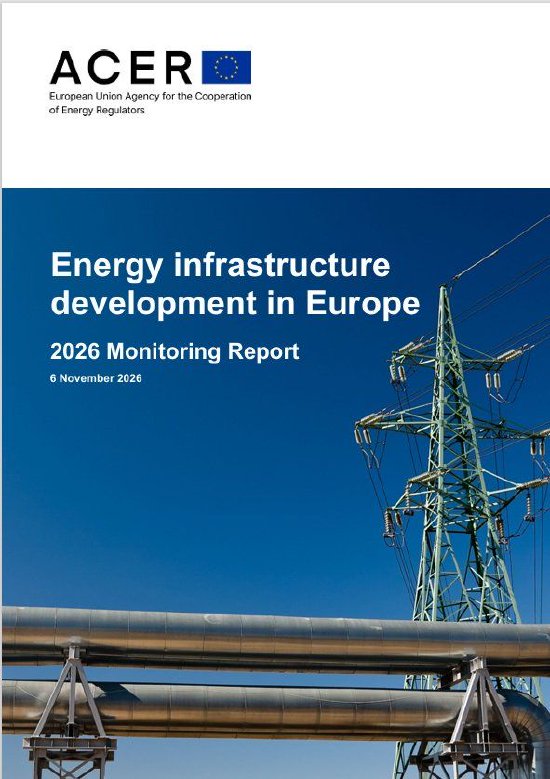
The European Agency for the Cooperation of Energy Regulators (ACER) released the "European Energy Infrastructure Development Monitoring Report 2026" on November 6, pointing out that with the expansion of grid investment and the rise in infrastructure construction costs, by 2050, the grid costs borne by EU consumers may increase by 50% to 100% compared with current levels. At the same time, grid construction delays and transmission congestion continue to push up energy system operating costs, while declining natural gas demand will also increase the burden of pipeline network fees for remaining users.
Power grid investment continues to expand, and residents’ power grid costs have increased significantly
The report shows that from 2019 to 2025, the annual capital expenditure of EU power transmission system operators increased by 193%, from approximately 10.4 billion euros to 30.5 billion euros. Annual capital expenditure on distribution systems will also increase by 51% from 2021 to 2024, from 23.5 billion euros to 35.3 billion euros.
Among the 18 countries that provide investment forecasts, 15 countries expect the scale of power grid investment in 2030 to exceed the level in 2025, with an average increase of 134%. Among them, the Netherlands expects investment in 2030 to be nearly five times that of 2025; Estonia, Latvia and Cyprus expect investment to decline.
In addition to the expansion of investment scale, rising equipment and engineering construction costs are also pushing up power grid expenditures. ACER estimates that from 2018 to 2024, the unit investment cost of European power infrastructure has increased by about 50% cumulatively, and the prices of some equipment have increased even more.
The above costs have been gradually passed on to consumers. From 2019 to 2025, the average EU household grid bill increased by 40%, from 60 euros to 84 euros per megawatt hour, and currently accounts for about 28% of household electricity bills. From 2023 to 2025 alone, grid charges for household and industrial users will rise by 14% and 38% respectively.
Delays in power grid construction and transmission congestion add to cost pressures
The report points out that the speed of EU power grid construction is still difficult to meet the growing demand for power transmission. About 40% of the EU's key power transmission projects have experienced delays, with the average project implementation cycle reaching 12 years. ACER estimates that an overall delay of one year in key transmission projects will cause a net economic welfare loss of approximately 4 billion euros.
Insufficient transmission capacity also drives up power system operating costs. In 2025, EU transmission system operators will spend approximately 5.4 billion euros to alleviate grid congestion, an increase of more than 25% compared with 2024. Over the same period, congestion revenue generated from cross-regional electricity trading reached 9.2 billion euros, approximately seven times that of 2019.
The report cites research from the European Commission's Joint Research Center and points out that if grid expansion continues at the current pace, Europe's annual grid congestion management costs may exceed 100 billion euros by 2040, about 20 times the current level.
ACER also pointed out that as of 2025, about 60% of available congestion revenue is still retained for future use, totaling about 12.5 billion euros, and has not been used in a timely manner to alleviate cross-border grid congestion or reduce network usage fees.
Demand for natural gas falls, and network costs are shared by fewer users
Unlike the continued growth in investment in the power industry, European natural gas infrastructure is facing pressure from declining demand and reduced pipeline network utilization.
The report shows that EU natural gas consumption in 2025 will still be 16% lower than the average level from 2017 to 2021. To achieve energy transition goals, natural gas demand will need to fall further in the future.
As natural gas consumption and user base shrink, the fixed maintenance and operating costs of the existing pipeline network need to be borne by fewer users. Between 2020/2021 and 2024/2025 natural gas years, EU natural gas transmission rates will increase by approximately 40% on average.
ACER warned that if natural gas consumption continues to decline and the size of the existing pipeline network fails to adjust accordingly, remaining users may bear increasingly higher bills. This also means that Europe’s energy transition not only requires increased grid investment, but also needs to solve the cost recovery problem of existing natural gas infrastructure.
ACER recommends controlling the impact of energy infrastructure construction on consumer costs by improving the efficiency of existing power grid utilization, improving infrastructure investment planning, shortening the approval cycle for key projects, and improving cost-sharing mechanisms across countries and between different users.
Comments