
Abstract:
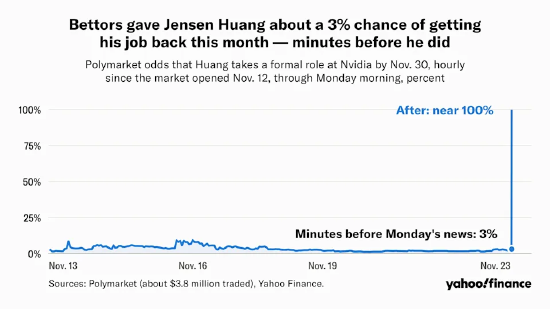
It only took Nvidia’s board of directors 12 days to make the decision to revoke Huang’s dismissal. In the same week three years ago, OpenAI replaced Ultraman Sam, and it took less than five days to complete the same reset. Few expected the news of Huang's reinstatement. On Monday morning, just a few minutes before Nvidia issued an official reinstatement announcement, the prediction market Polymarket was betting that the probability of Huang Jensen's reinstatement this month was only about 3%. Five minutes after the announcement, the probability shot up to 99%.
The board of directors unanimously passed a resolution to immediately reinstate Huang Jensen as president, CEO and director, and Colette Kress returned to the position of chief financial officer. Harvey Jones, chairman of the board of directors, said: "The board of directors believes that Huang Renxun is the right person to lead Nvidia." Nvidia's stock price soared by more than 30%.
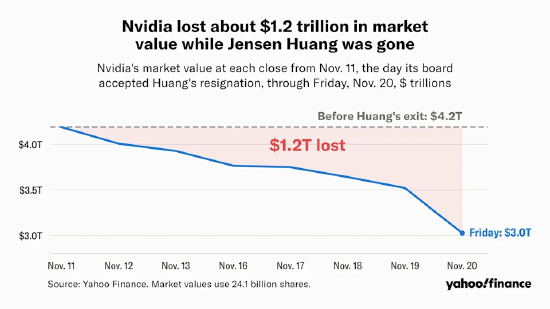
Huang Renxun’s short-term resignation came at a heavy cost
From the close of trading on November 11 (the board of directors accepted Huang Renxun's resignation) to last Friday, Nvidia's market value evaporated by approximately US$1.2 trillion. During this period, Nvidia's old GPU prices also bucked the trend and rose.
Silicon Valley has played out similar dramas before. On a Friday afternoon in November 2023, OpenAI fired Altman; Microsoft offered him an olive branch on Sunday; more than 700 of OpenAI's approximately 770 employees threatened to follow him and leave. By Tuesday evening, Ultraman was back at OpenAI.
Ultraman posted on the X platform: "I love OpenAI. Everything I have done in the past few days is to preserve this team and our mission."
Although it was not initiated by me, there is also a wave of public support for Huang Renxun. A petition titled "Stand with Jen-Hsun Huang" has collected more than 100,000 signatures, and Elon Musk also signed. More than 5,000 of the signatures claim to be from internal NVIDIA employees. The petition calls for "due process, not mob trials."
The key force that promoted Ultraman's return was Microsoft; and it was the White House that promoted Huang Renxun's reinstatement.
The board of directors stated that high-level officials of the U.S. government gave opinions and based on this judgment, Huang Jen-Hsun did not pose a national security risk, which became the key to him getting a second chance.
But there is one difference between Huang Renxun's return and Ultraman: when Ultraman returned, the board of directors had completed a major shake-up; Huang Renxun was still facing the original board of directors. At the same time, Huang Renxun established a new National Security and Export Control Committee, started the recruitment of a chief compliance officer, and also accepted independent investigations into reports of being targeted by overseas intelligence agencies.
It took 12 years for Steve Jobs to return to Apple
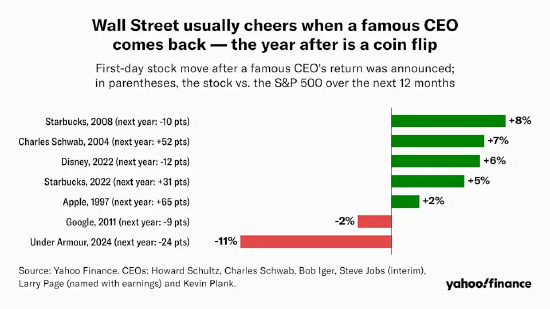
Steve Jobs left Apple in September 1985 and returned as interim CEO in September 1997. On the first day of his return, Apple's stock price rose 2%; in the following year, Apple's stock price outperformed the S&P 500 Index, with excess returns reaching 65 percentage points.
The return of most well-known founders will start with acclaim from Wall Street, but their performance in the following year will be mixed. Nvidia's 30% increase before the market is more than three times the largest increase on the first day of the return of several other CEOs in the statistical chart below.
Academic research: The actual performance of "home-based CEOs" is not optimistic
A study by the MIT Sloan School of Management counted 167 CEOs who were re-elected from S&P 1500 companies from 1992 to 2017. Research has found that during the tenure of such CEOs, the average annual performance of the company's stock price is about 10% lower than that of the first CEO. In industries with rapid technological iterations, the gap will be even greater. In the sample, founder CEOs accounted for 4% of all CEOs, but accounted for as high as 44% of the “returning CEOs” group.
Huang Renxun's next schedule is still tight: he will participate in a closed-door inquiry in the House of Representatives on December 1, and has agreed to attend a public hearing of the Senate Banking Committee.
Jobs later viewed his experience of being kicked out of Apple as a gift.
He said in his 2005 Stanford University graduation speech: "I didn't realize it at the time, but it turned out that being fired from Apple was the best thing that ever happened to me."
Comments