
Abstract:
Quad9, the world's top public DNS service provider, recently published a blog announcing that it will stop providing recursive DNS resolution and malicious domain name blocking services to users in France starting from November 24, 2026. This change only affects users in France, users in other parts of the world can continue to use the public DNS resolution service provided by Quad9.
Reject France’s request to block pirated event websites:
This decision stems from a French court requiring Quad9 to block multiple domain names suspected of illegally broadcasting sports events. Quad9 refused to modify the DNS resolution results returned to users. The service provider believed that it was only a neutral technical service provider and had no obligation to implement such regional blocks.
In France and Italy, there are numerous copyright issues caused by piracy of live broadcasts of football sports events. The measures that relevant copyright parties can take are mainly to require local telecommunications companies to block pirated domain names on the backbone network, and to require public DNS service providers to block pirated domain names at the resolution level.
Quad9, Cloudflare and Google have all been sued in France and Italy due to DNS issues, but both Quad9 and Cloudflare believe that they are technology neutral, and blocking pirated domain names at the resolution level has little practical significance (because users can continue to access them by hanging up a VPN or changing DNS).
Quad9 also admits that it does not have the ability to achieve precise shielding:
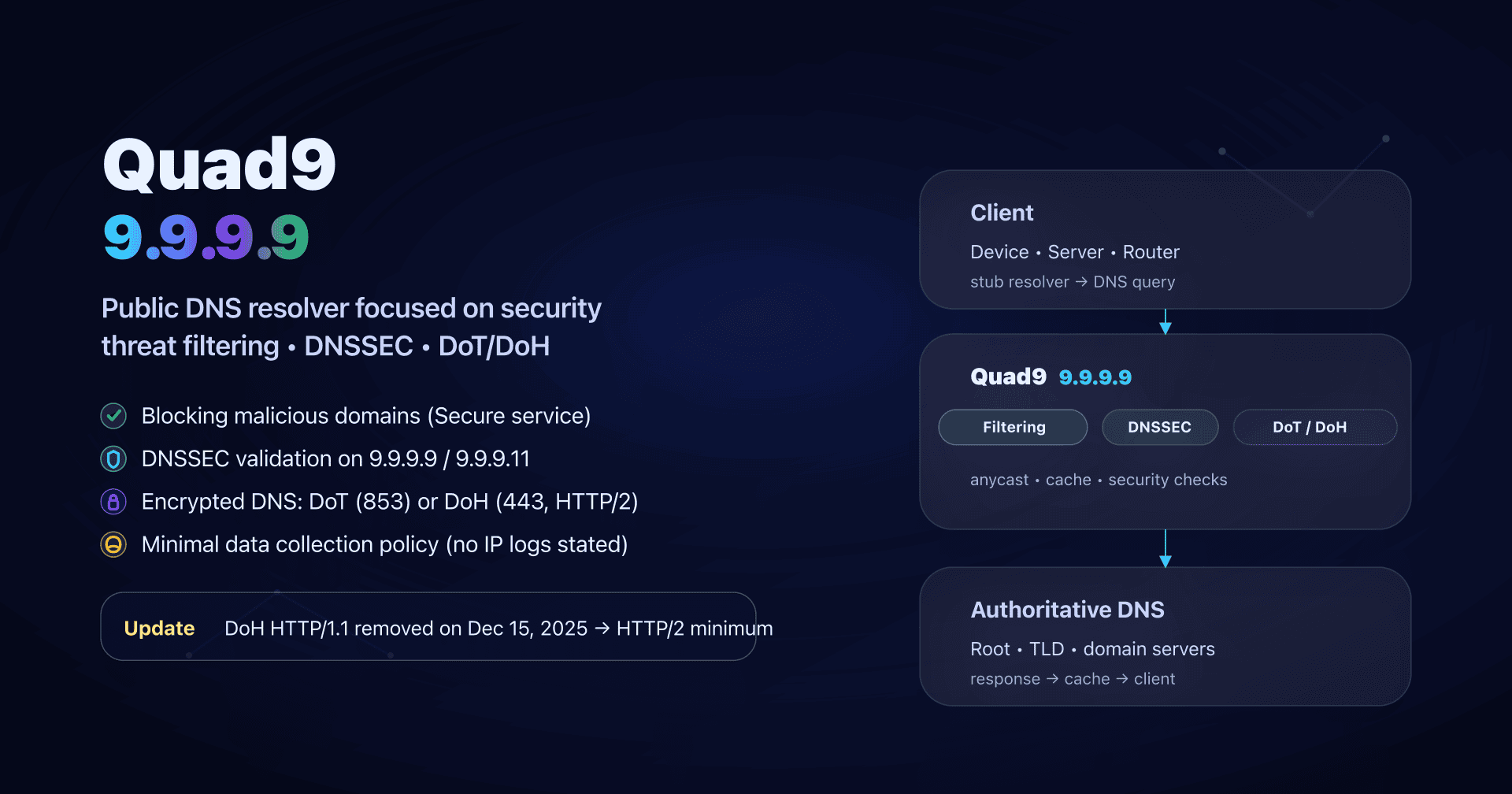
Quad9 is a non-profit foundation registered in Switzerland that provides free public DNS resolution services. Its main addresses include 9.9.9.9 and 149.112.112.112. The default service also blocks known malware and phishing domain names.
The service provider stated that the service it provides does not require registration, nor does it establish a corresponding database between users and jurisdictions. Therefore, it does not have the ability to determine whether each DNS query belongs to a French user. At best, it can only determine the location based on GeoIP.
The French court even proposed a global blocking solution, requiring Quad9 to globally block pirated domain names. This would restrict users from using Quad9 to query related websites in other countries or regions. Quad9 refused to adopt this approach. The service provider believed that the French judgment should not change the DNS results obtained by global users.
Comments