In a groundbreaking discovery that has rocked the field of neutrino astronomy, scientists using the KM3NeT telescope have detected an ultra-high-energy neutrino with an energy 16,000 times greater than the most powerful collision at the Large Hadron Collider.
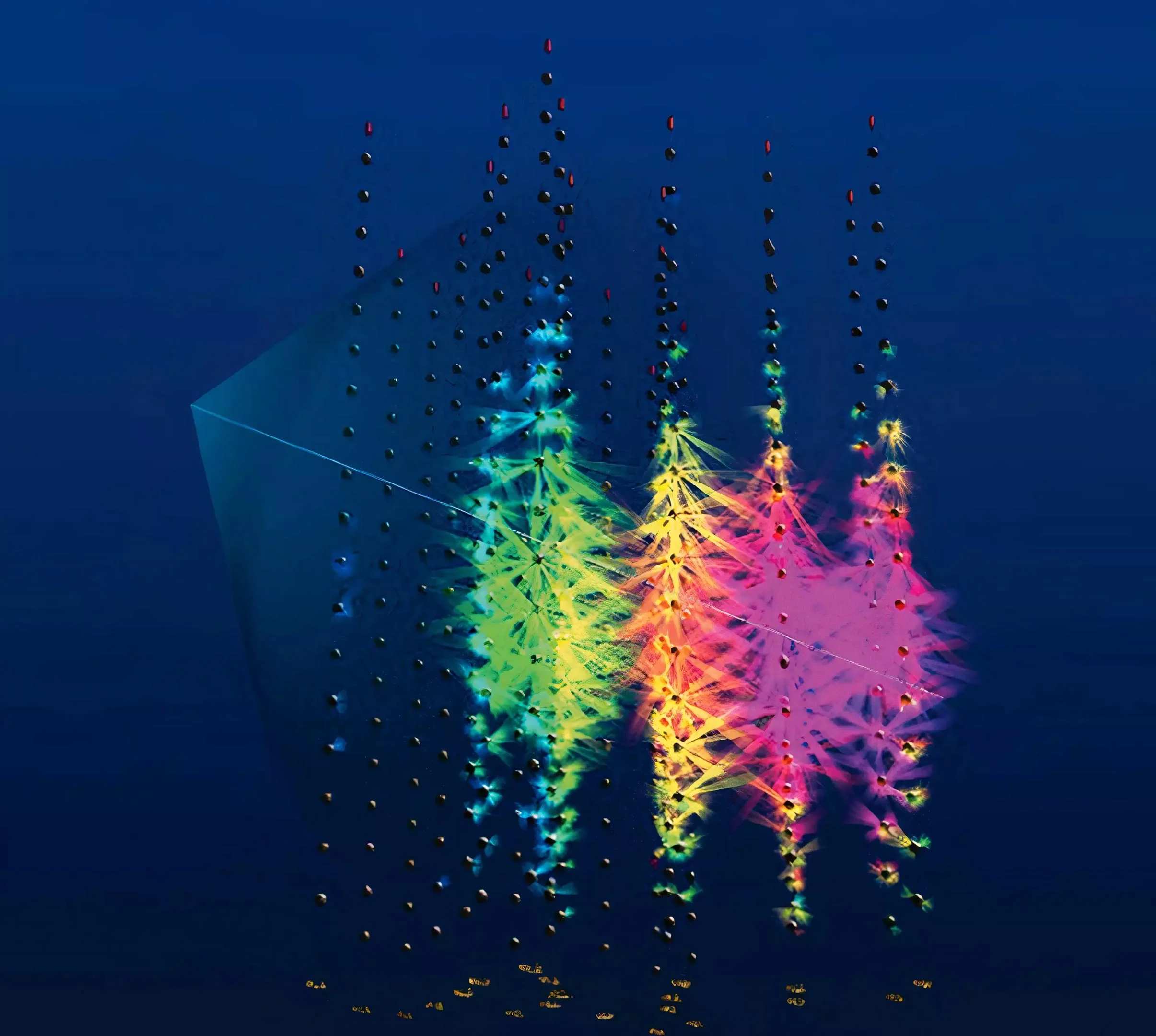
Visual effects of ultra-high-energy neutrino events observed by KM3NeT/ARCA. The colors represent the light seen by the "eyes" on each module, with different colors representing different observation times. The nearly horizontally reconstructed trajectory of the particle is shown as a line from left to right. Image source: KM3NeT cooperation group
These elusive "ghost particles" offer a glimpse into the universe's most extreme events, which may originate from supermassive black holes or catastrophic supernovae. Detection of such neutrinos, possibly cosmogenic neutrinos, may reveal new secrets about the fundamental forces that accelerate cosmic rays and shape the universe. However, more detection is needed to determine its true origin and confirm its importance.
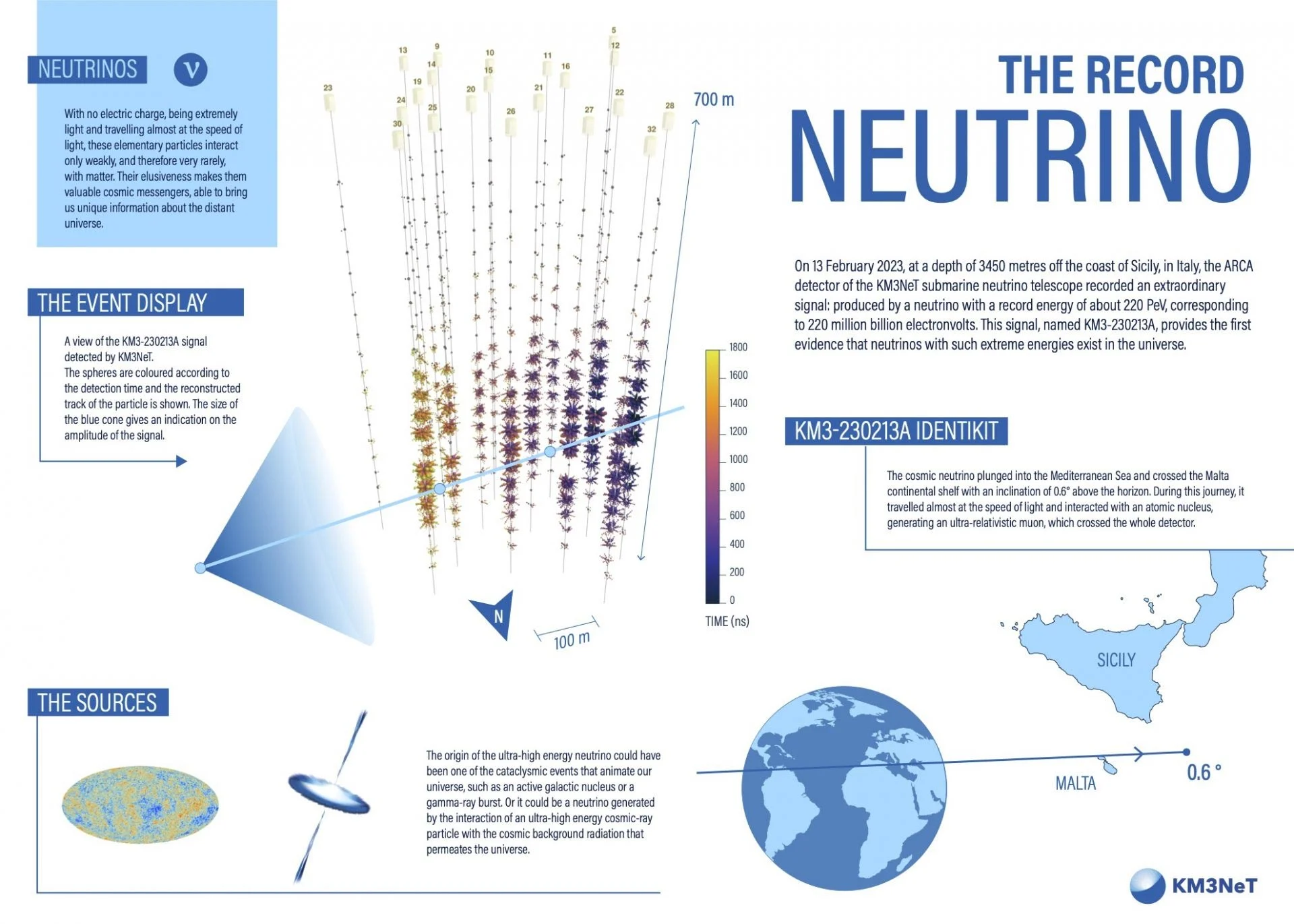
On February 13, 2023, an international team of scientists composed of astronomers from the Max Planck Institute for Radio Astronomy in Bonn, Germany, used the KM3NeT telescope to detect a neutrino with record energy. The one-kilometer-diameter deep-sea observatory captured a signal 16,000 times more energetic than the strongest particle collision ever produced by CERN's Large Hadron Collider.
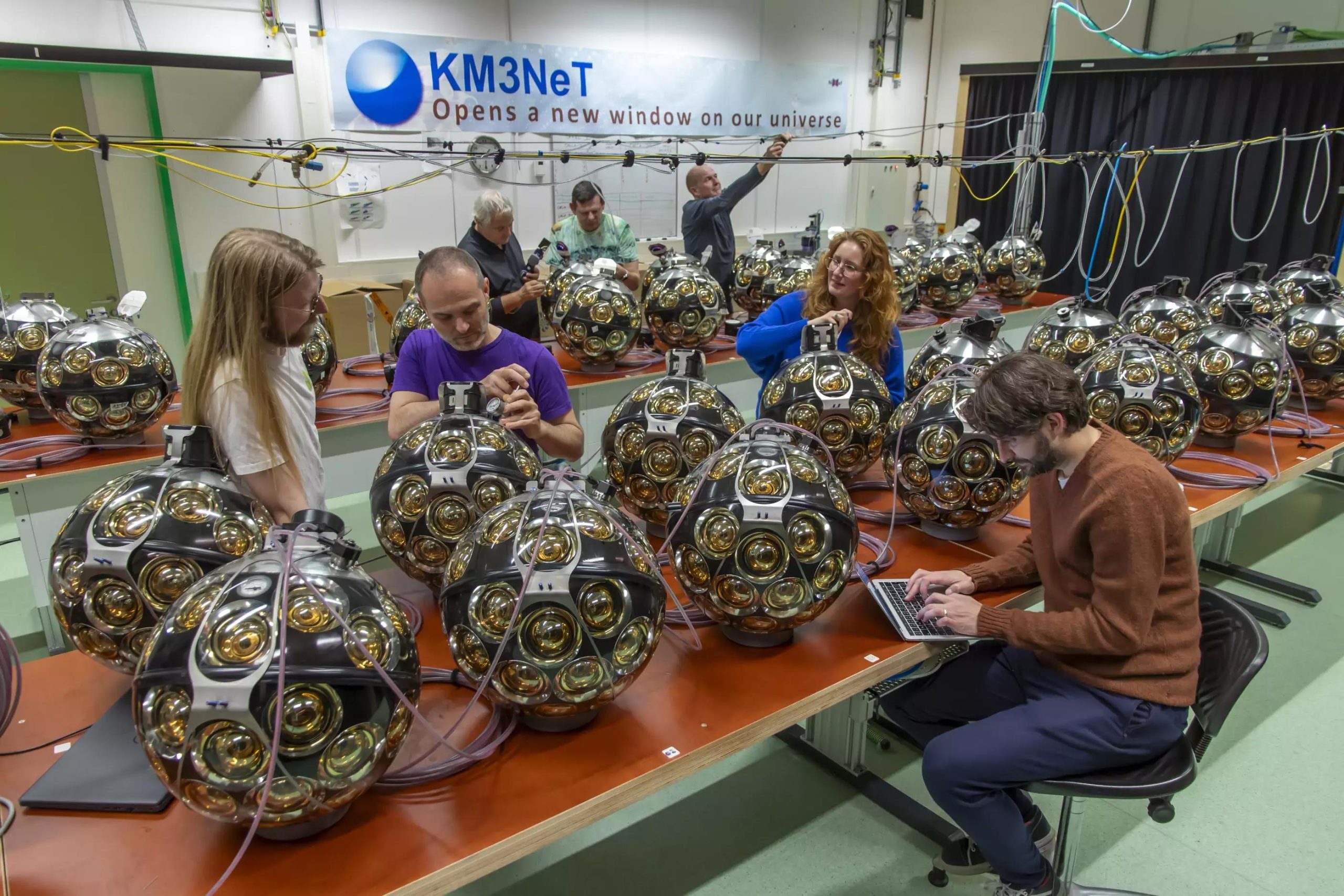
A set of digital optical modules that later became part of the KM3Net neutrino telescope in the Mediterranean Sea. Image source: KM3NeT Cooperation Organization
Neutrinos are among the most elusive particles in the universe. They have almost no mass, no electric charge, and rarely interact with matter. "They are special cosmic messengers, revealing the secrets of the most energetic phenomena in the universe," said Rosa Coniglione, then deputy spokesperson for KM3NeT.
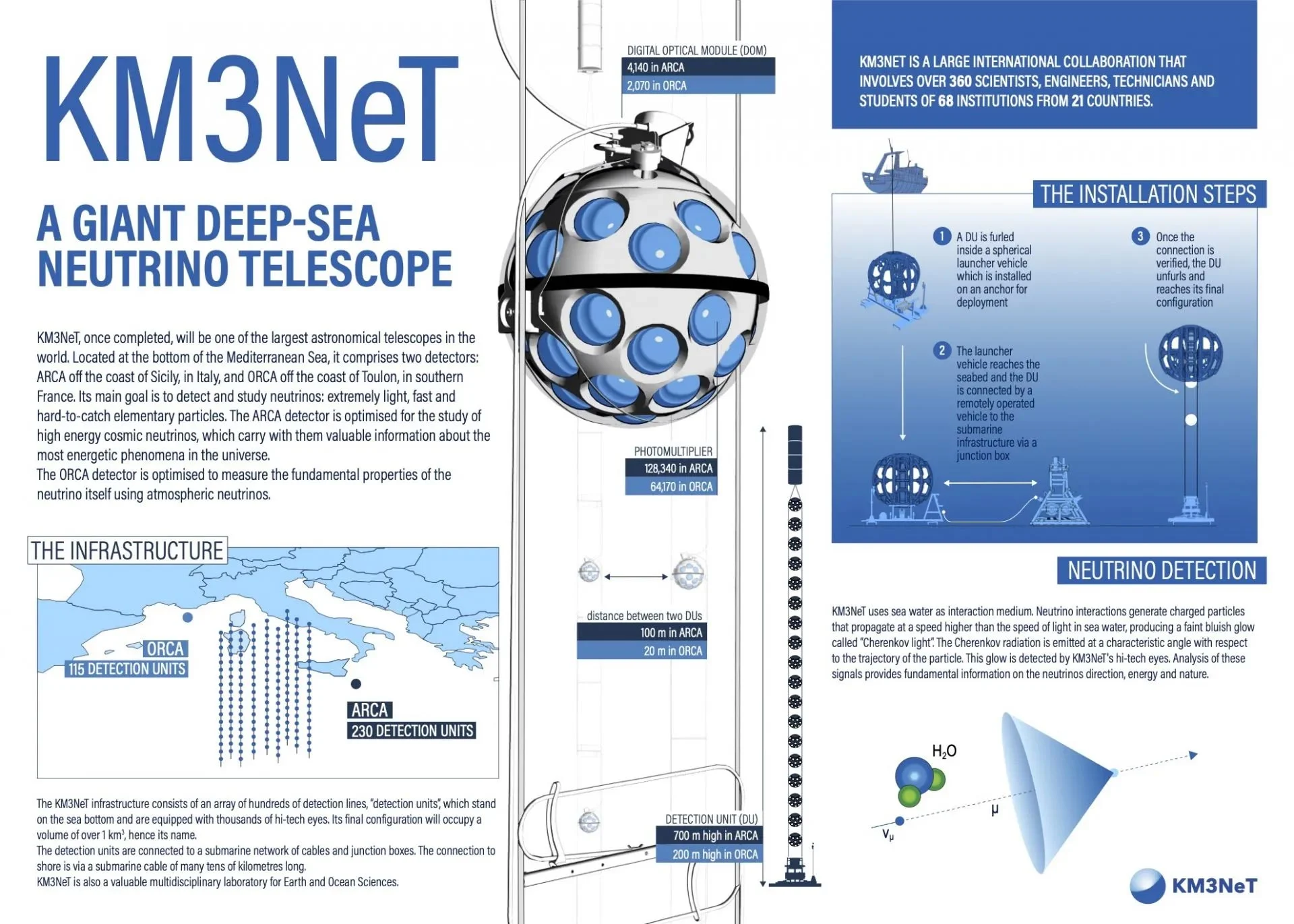
Because neutrinos pass through most matter undetected, KM3NeT relies on seawater as the detection medium. Soon, the observatory will be several cubic kilometers in size, which will greatly increase its sensitivity. When a high-energy neutrino interacts with an atomic nucleus in water, it produces a muon—a heavier cousin of the electron that carries a negative charge. Muons travel extremely fast and produce a cone of light known as Cherenkov radiation, similar to the sonic boom produced by a supersonic jet.
The KM3NeT telescope is designed to detect this light. The telescope is composed of 230 vertical wires, each containing 18 spherical optical modules, shaped like pearls on a necklace. Inside each module are 31 photomultiplier tubes that amplify even the faintest flash of light from all directions. These instruments allow scientists to track elusive neutrinos and reveal their origins, revealing some of the most powerful cosmic events in the universe.
KM3NeT is currently detecting neutrinos from extreme astrophysical events, exploring previously unknown energy ranges. “The first detection of neutrinos in the range of several hundred PeV opens a new chapter in neutrino astronomy,” said Paschal Coyle, KM3NeT spokesperson at the time of the detection and a researcher at the French National Center for Scientific Research IN2P3. 1 gigaelectronvolt (PeV) is equivalent to 10^15 or 1 quadrillion electron volts.
The central question is where the high-energy particles that hit the Earth and react in its oceans or atmosphere come from.
"By adding observations from other telescopes, we are trying to connect the acceleration of cosmic rays, the production of neutrinos and the role of supermassive black holes in shaping these energy phenomena," said Yuri Kovalev of the Max Planck Institute for Radio Astronomy.
In addition to supermassive black hole environments, supernova explosions are also candidates for powerful cosmic particle accelerators. The high-energy neutrinos measured so far may come directly from such an accelerator, or they may be the first detection of cosmogenic neutrinos.
Cosmogenic neutrinos may be produced when other cosmic particles react with the faint light of the cosmic microwave background, creating high-energy neutrinos. However, its origin remains uncertain as only one event with an energy of several hundred PeV has been measured so far. To learn more, researchers need to detect more such events.
High-energy particles from space are nothing new
A slightly smaller neutrino telescope of the same design, Antares, also measured high-energy neutrinos from space. In addition, there are many other creative experiments that have captured particle bombardments from space. For example, the Pierre Auger Observatory in Argentina also measured Cherenkov radiation. In this case, however, the initiators among cosmic particles are protons, which hit the Earth's atmosphere and trigger a cascade of secondary particles in the atmosphere. The muons produced in this process were detected not in seawater, but in more than 1,600 water tanks scattered across the Argentine Pampas.
Compiled from /ScitechDaily