A powerful solar eruption recently triggered warnings of a rare "severe geomagnetic storm" on Earth, with the U.S. Naval Research Laboratory capturing a coronal mass ejection barreling towards us at 1,700 kilometers per second. This solar radiation from Earth can wreak havoc on satellites, GPS systems and even power grids.
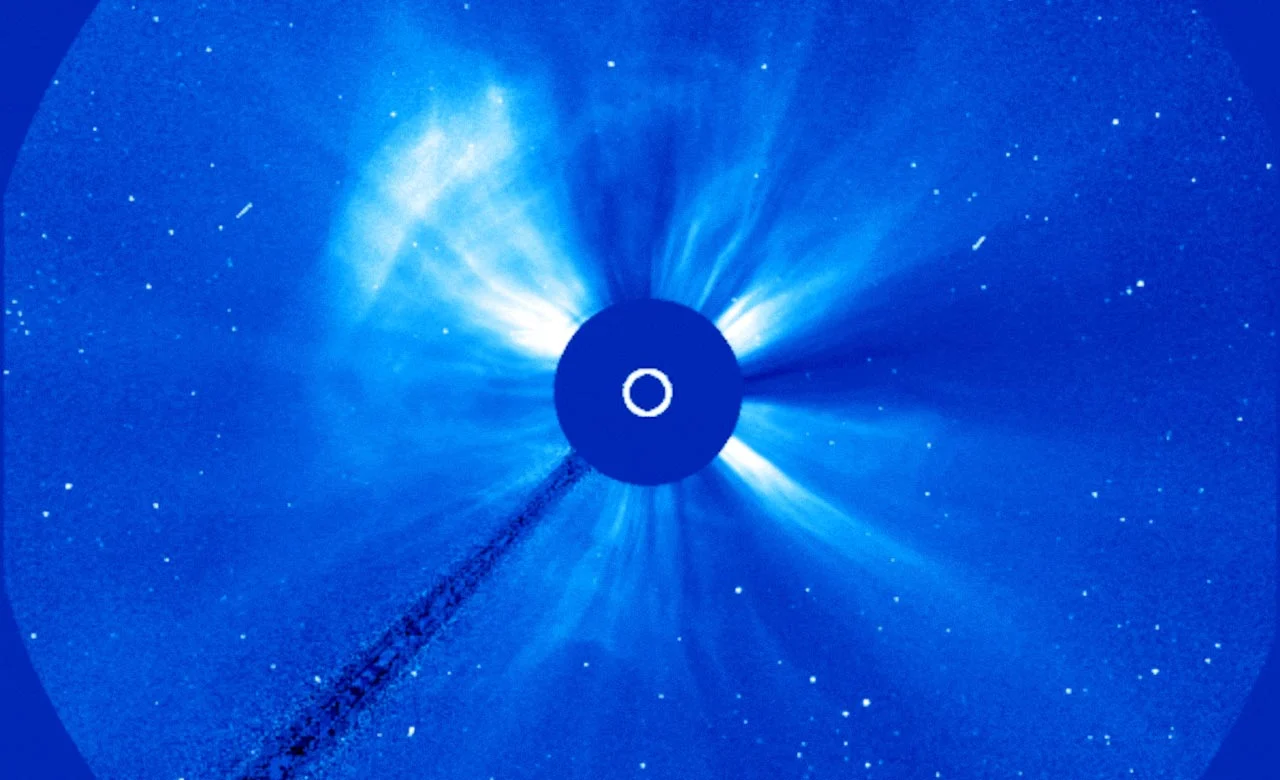
On May 31, a powerful solar outburst triggered a rare severe geomagnetic storm warning. Scientists are using real-time space tools to track coronal mass ejections, highlighting the risks it poses to satellites and communications systems. Image source: U.S. Naval Research Laboratory
As auroras unexpectedly appear in the far south, scientists highlight the critical role of real-time data in defending infrastructure and military readiness. Decades of space weather research at the Naval Research Laboratory, including the use of instruments such as LASCO and CCOR-1, have proven to play a vital role in predicting and mitigating space weather hazards.
We are all used to localized weather warnings, but warnings with global coverage are not available every day. On May 31, scientists detected a strong explosion from the sun, triggering a rare "strong geomagnetic storm" warning on Earth.
The U.S. Naval Research Laboratory (NRL) used advanced space instruments to capture the dramatic event in real time. What they were witnessing was a powerful coronal mass ejection (CME), a massive burst of solar plasma and magnetic energy, heading straight for us.
"Our observations indicate that this eruption was a so-called 'halo coronal mass ejection,' meaning it was emanated from Earth," said Dr. Carl Battams, a computational scientist in the Heliospheric Science Division at the U.S. Naval Research Laboratory. "Our preliminary analysis of the data shows that the eruption had an apparent velocity of more than 1,700 kilometers per second."
Image taken by the National Oceanic and Atmospheric Administration's (NOAA) CCOR-1 coronagraph showing a "halo" coronal mass ejection on May 31, 2025. Launched last year, the CCOR-1 coronagraph was designed and built by the Naval Research Laboratory (NRL). It is the first operational coronagraph to provide critical real-time observational data to NOAA for issuing space weather forecasts and storm warnings. Image Credit: NOAA CCOR-1 Understanding geomagnetic storms and their triggers
Such solar storms will transport the huge energy of the solar wind into space around the Earth and disrupt the Earth's magnetic field. When the sun's magnetic field points south, it strips away the Earth's protective magnetosphere, causing an influx of charged particles and triggering intense geomagnetic activity.
The U.S. National Oceanic and Atmospheric Administration (NOAA) rated the solar storm a G4 on a scale of five, putting it in the "severe" category.
A coronal mass ejection like this could cause massive disruption to technology. They can temporarily destroy satellites, disrupt GPS signals, and interfere with radio communications. In extreme cases, they can even damage spacecraft, increase the satellite's atmospheric drag, and cause it to deviate from its orbit.
"Such interference could impair situational awareness, impede command and control, affect precision guidance systems, and even affect power grids, directly impacting military readiness and operational effectiveness," Battams said.

Image from the U.S. Naval Research Laboratory (NRL) LASCO C3 coronagraph showing the "halo" coronal mass ejection that caused the G4 geomagnetic storm on May 31, 2025. NRL's LASCO instrument has been operating in space since 1996 and has advanced the field of space weather. Image source: NRL
Coronal mass ejections are giant eruptions of plasma and magnetic fields in the sun's corona, often carrying billions of tons of material. Coronal mass ejections usually take several days to reach Earth, but the most powerful events have been observed to reach Earth in as little as 18 hours.
"Coronal mass ejections, explosive releases of the Sun's lower corona, are a major driver of space weather and play a central role in understanding the conditions of Earth's magnetosphere, ionosphere and thermosphere," explained Dr. Arnaud Thernisien, a research physicist in the Advanced Sensor Technology Division of the Naval Research Laboratory's Space Science Division.
During the May 30 event, a relatively slow but powerful flare erupted from the Earth-facing side of the Sun. The energy released blasted the coronal mass ejection directly toward Earth, triggering a geomagnetic storm and producing auroras as far away as southern New Mexico.
NRL's space-based instruments (operating on NASA and NOAA spacecraft) provided critical real-time observations of the event. It is worth mentioning that the acclaimed Large-Angle Spectroscopic Coronagraph (LASCO), which NRL has been operating since 1996, and the Compact Coronagraph 1 (CCOR-1), which will be launched in 2024, have delivered critical data.
Such observations are critical for practical space weather monitoring, allowing forecasters to predict when an event will reach Earth and the geomagnetic storms it may trigger. While it remains challenging to accurately predict the severity, exact timing or duration of geomagnetic storms, these early warnings are critical for the Department of Defense (DoD) and other agencies to prepare.
Severe geomagnetic storms can have significant and far-reaching impacts on Department of Defense and Department of the Navy missions. These events could disrupt or degrade critical systems and capabilities, including satellite communications, Global Positioning System (GPS) navigation and timing, and various remote sensing systems.
"NRL has been a pioneer in heliophysics and space weather research since the field's inception, dating back to 1971 when NRL first discovered a coronal mass ejection through space observations," Battams said. "Since then, NRL has remained at the forefront of coronal imaging with a series of groundbreaking instruments, advancing the study of the heliosphere and space weather."
These include:
The LASCO coronagraph has been operating since 1996 on the joint ESA-NASA Solar and Heliospheric Explorer (SOHO) mission
The Sun-Earth Connected Coronal and Heliosphere Survey (SECCHI) instrument suite installed on NASA's Solar-Terrestrial Relations Observatory (STEREO) twin spacecraft since 2006
Since 2018, the Parker Solar Probe Widefield Imager (WISPR) on NASA's Parker Solar Probe (PSP)
The Solar Orbiter Heliospheric Imager (SoloHI) has been operating on ESA's Solar Orbiter mission since 2019
NOAA's CCOR-1 is designed and built by NRL and will operate on NOAA's GOES-19 starting in 2024
These assets, especially instruments like LASCO and CCOR-1, are essential in providing the critical real-time images that forecasters need to analyze and assess coronal mass ejections, determine the likelihood of an Earth impact, and issue timely warnings.
"They form the backbone of our ability to predict and mitigate the effects of space weather. As the G4 Severe Geomagnetic Storm Warning continues, we encourage the public and critical infrastructure operators to visit the National Oceanic and Atmospheric Administration (NOAA) Space Weather Prediction Center for the latest information and updates," said Senison.
The course of a coronal mass ejection from its violent outburst on the Sun to its arrival at Earth, approximately 93 million miles away, highlights the dynamic nature of the solar system and the Naval Research Laboratory's continued important contribution to heliophysics research and space weather preparedness. Data collected from such events will aid future research, further enhance our understanding and predictive capabilities, and ultimately enhance the resilience of national security and critical infrastructure.
Compiled from /ScitechDaily