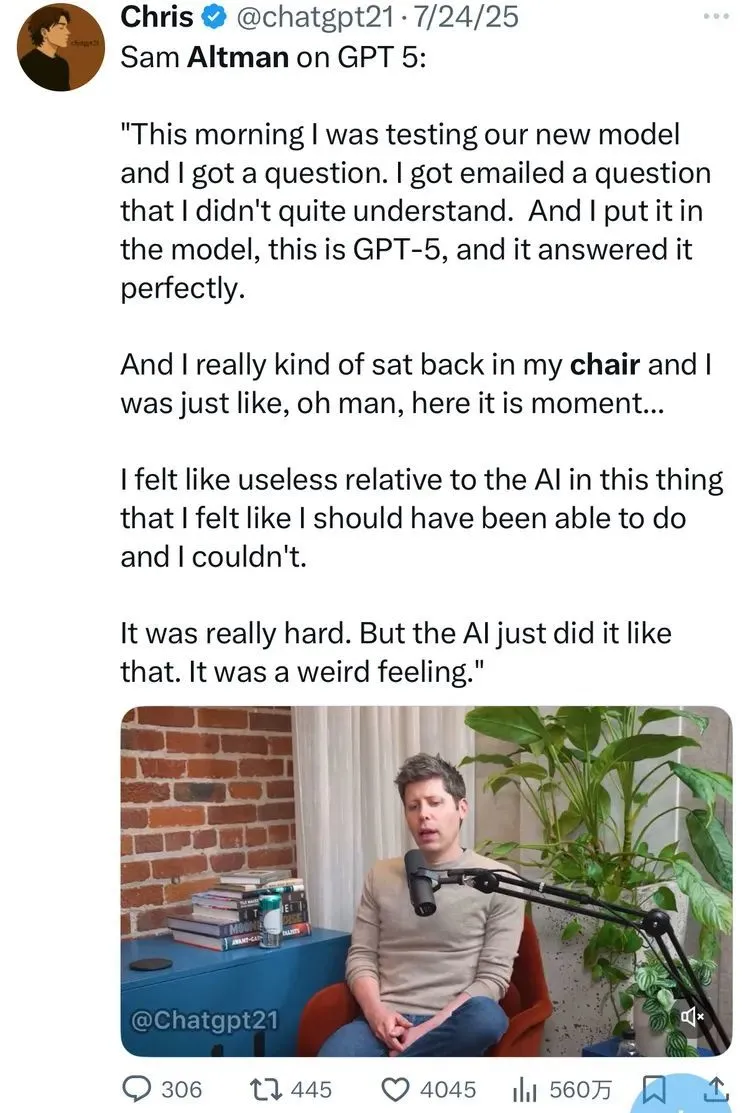
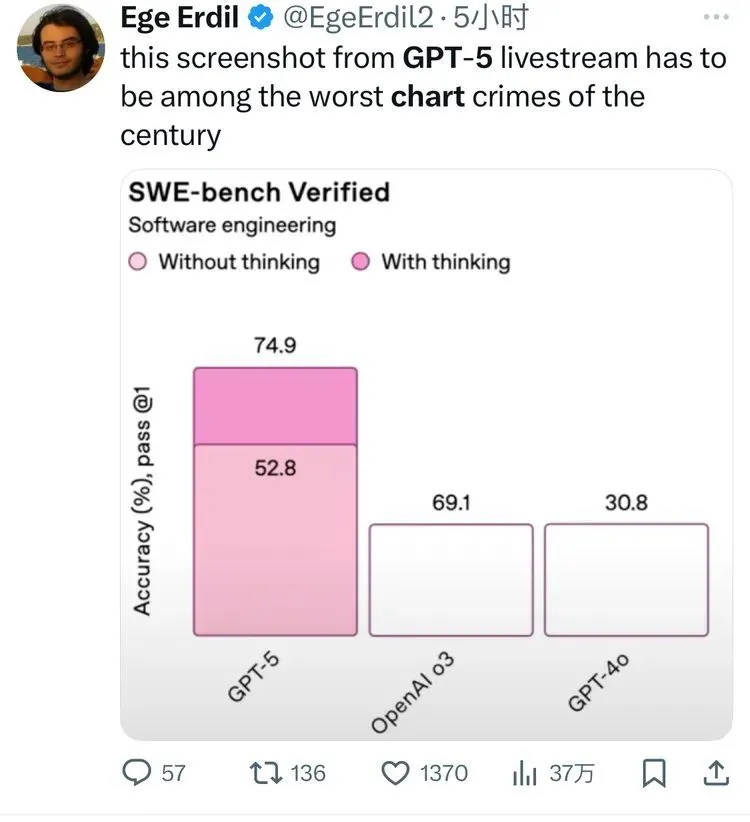
We still don't know what force caused Ultraman to "collapse in his chair". Because people have been waiting for the long-awaited release of GPT-5. At least judging from everyone's first impressions of the press conference, it turned out to be a drawback, and there were even more jokes than highlights... A few months ago, or even before the release, no one would have thought that such a much-anticipated model release would be widely circulated with many incorrect charts that make people laugh and cry:
And this is almost a microcosm of how the conference gave people the feeling.
A lot of work has been done to compete for users' attention, and there are many good details improved, but there are no big surprises, and it was even a little funny at one time. It is still early for "AGI", and the era of hand-to-hand combat has begun.
GPT5 is here, but the model has not reached the AGI moment, not even the "aha moment".
As revealed before release, GPT-5 adopts an "All in one" strategy, integrating reasoning, coding, speech, research and other capabilities into a single model, and automatically calling up corresponding capabilities based on user needs. In various vertical fields, GPT-5 has refreshed benchmark test results, among which the evolution of programming capabilities is the most significant. Whether you are a professional developer or a novice trying vibe coding, it has optimized model capabilities.
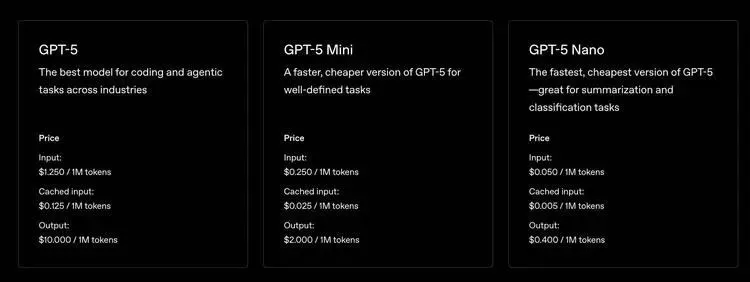
In terms of API, he took into account the wallets of users for the first time and launched a round of major price cuts.Enterprise users can use their own budget to adjust the mid-to-high-end versions, which are GPT-5 standard version, GPT-5-mini version, and GPT-5-nano version. Among them, the price of GPT-5-mini is lower than Google's Gemini 2.5 Flash, while the price of GPT-5 Standard is only one-twelfth of Claude 4 Opus.
The case demonstration of the new model, the benchmark that was refreshed again, and the API price that was lowered almost constituted the entire conference. But the difference is that in the last third, OpenAI added some not-so-cool enterprise case sharing, showing how they help enterprises build their own applications through models, and also added a model specifically for enterprises, GPT-5-chat: for customer service scenarios, latency <200 ms.
And these are the real intentions of GPT-5 release:What they want is no longer the applause of technology demos, but real money from corporate customers. GPT-5 is not an explosive model for generational leaps, but a trump card that OpenAI is preparing to engage in commercial combat.
Combined with Sam Altman's previous prediction on SaaS on X, once enterprises can build their own applications based on GPT-5, the traditional SaaS model will indeed face impact.

But this also proves a deeper reality: the entire AI industry has shifted from technological brilliance to a critical stage of commercial implementation, and even OpenAI is no exception.
One model, multiple intelligences
At the beginning of the release, Sam Altman represented OpenAI and believed that this was not a simple upgrade, but an intelligent "dimensional jump."
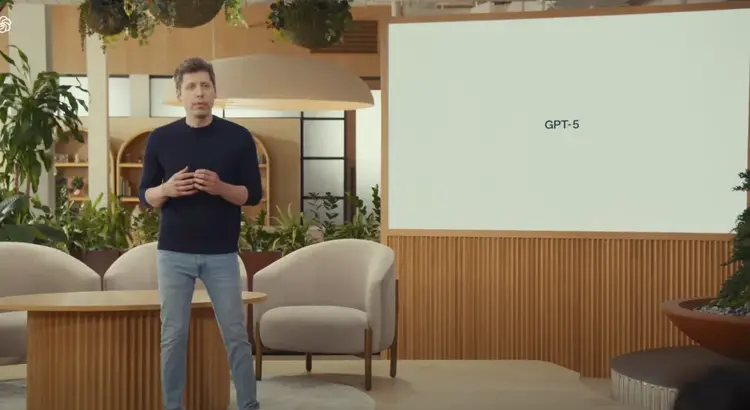
Officials claim that it has introduced a new "intelligent routing" system that can judge the difficulty of your question in seconds and automatically call on the appropriate "brain" to answer it. Use the "high-efficiency brain" to respond quickly to ordinary questions, and automatically switch to the "deep-thinking brain" to complex questions. This combination of fast thinking and slow thinking was already realized in some model products through Autothink earlier this year.
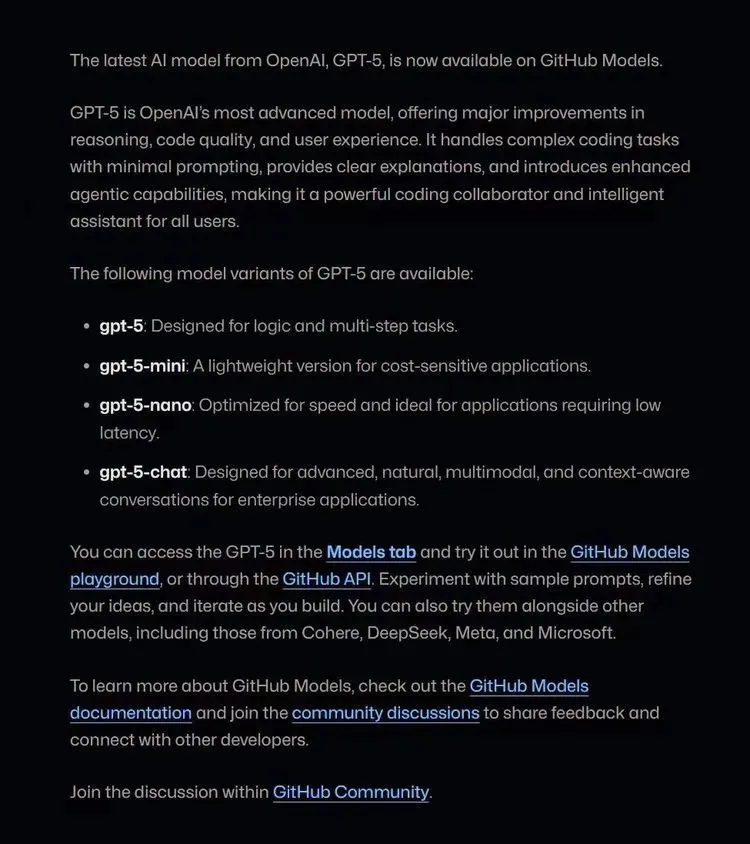
GPT-5 integrates the GPT series and o-series inference models for the first time to form a single multi-modal architecture. The context window is expanded to 1 M tokens, the output can reach 100,000 tokens, and MCP (Model Context Protocol) and parallel tool invocation are supported. All four variants are optimized for code scenarios:
• gpt-5: flagship, long chain reasoning + full mode;
• gpt-5-mini: cost ↓60%, retain 90% programming performance;
• gpt-5-nano: 32 K end-side offline, latency <40 ms;
• gpt-5-chat: Enterprise-level chat, CI/CD integration plug-in.
For different scenarios, GPT-5 has made individual optimizations, such as language sense optimization in writing and flexible multi-language switching capabilities for voice dialogue functions. GPT-5 has also been tested on the new ARC-AGI-2. It outperformed all major models except Grok 4 (Think).
But the most remarkable thing is that the overall coding ability has once again improved to a new level. The coding ability covers two scenarios, one is a non-professional user scenario with low prompt words,
At the press conference, Yann Dubois, head of post-training at OpenAI, used GPT-5 for a live demonstration, asking it to generate a website for learning French with an interactive game.In just a few seconds, GPT-5 writes hundreds of lines of code and directly displays the website's front-end interface.He shared his screen on Zoom and with a few simple clicks, a cool looking website was created.
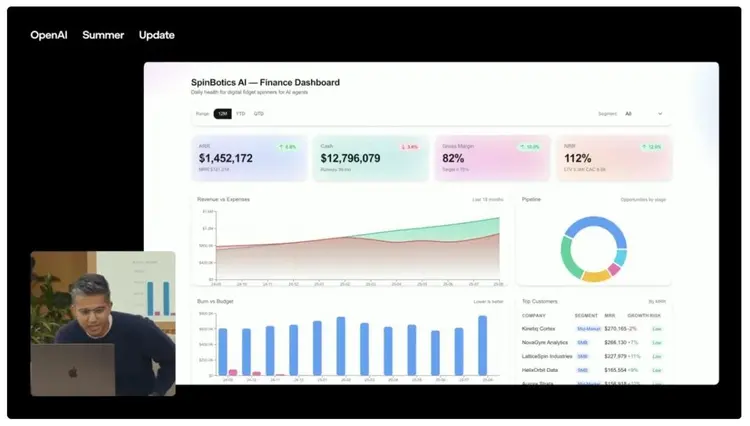
In Canvas, GPT-5 can quickly complete front-end applications in one go, ensuring that users who do not have free and easy-to-use coding models can achieve true Vibe Coding.
In professional programming scenarios, GPT-5 supports one-click upload of the entire front-end and back-end warehouse, generates a visual "code map" in seconds, displays module dependencies, performance bottlenecks and security vulnerabilities in layers, and gives a priority list; for legacy code, it can automatically eliminate useless dependencies, unify naming styles, complete type annotations, and generate Git rollback scripts to ensure zero risk in reconstruction.
At the same time, the model natively supports more than 20 language mixed projects such as Python, TypeScript, Rust, Go, and Solidity. It can intelligently identify cross-language call chains, automatically generate FFI binding, serialization code, and corresponding Docker multi-stage build files, and can open up the entire development and deployment link without manual intervention.
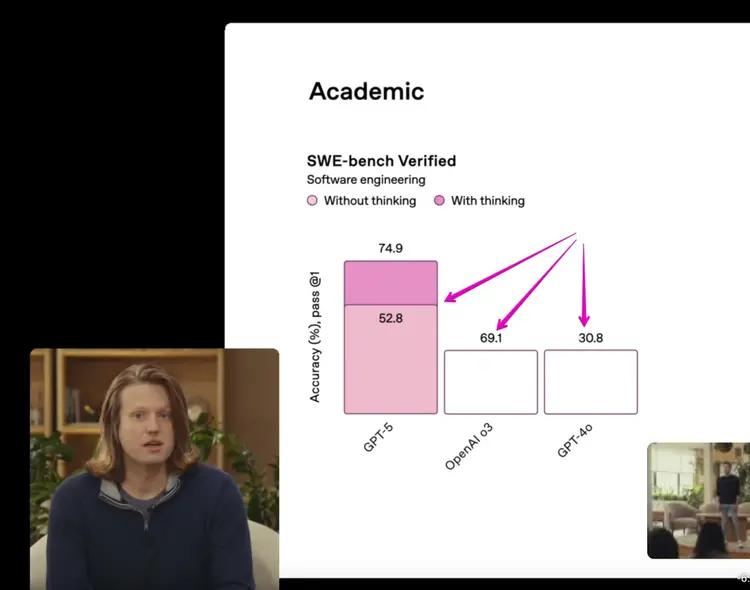
Of course, although OpenAI has been emphasizing that "GPT-5 is the best programming model in the world," in OpenAI's display, there was a behavior of "cheating" on the coordinate axis of the Benchmark chart. Not only was there a mentally retarded error such as 52.8 > 69.1, but it also actually exaggerated the ability improvement of GPT-5.
Putting aside some "incidents", GPT-5 has indeed upgraded "writing code" to "delivering software", from single file completion to cross-language, cross-framework, and end-to-end engineering agents. What developers get is not only faster automatic completion, but also an engineering team that can be deployed, tested, and maintained with one click.
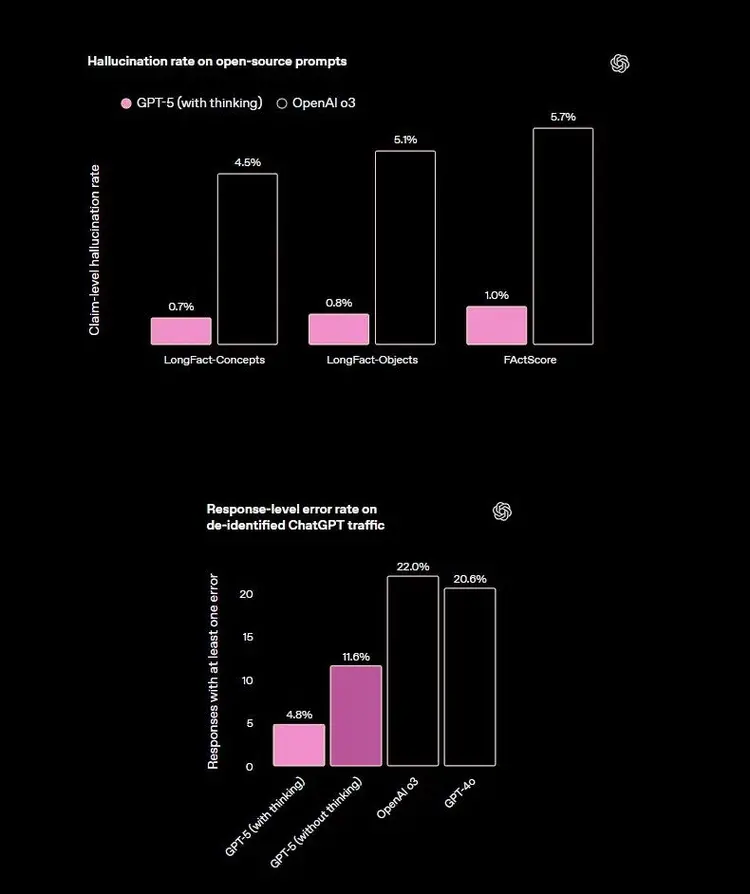
In order to ensure the usability of the model as much as possible, OpenAI spends a lot of time reducing model illusions. Alex Beutel, head of model security research, revealed that OpenAI has invested more than 5,000 hours in in-depth testing to assess the potential risks of GPT-5. One of its core goals is to prevent the model from "lying" to users.
Although the illusion of GPT-5 has been reduced compared to the o3 inference model, "conclusive lies" are still a stubborn problem that is difficult to eradicate in large language models; especially when the model acts as an agent and performs multi-step tasks, this hidden danger will be further amplified. However, OpenAI emphasizes that GPT-5 is more trustworthy in completing complex processes coherently. Beutel noted that there have been cases in the past where models claimed to have achieved their goals but failed to do so, and now the team is working to close such loopholes.
Overall, GPT-5 has undergone comprehensive optimization and improvement in models, products, and scenarios. It may not be the absolute top student in a certain field, but it is an all-around ACE.
Break through commercialization with low prices
"Rolling the price" is often described as the practice of China's large model manufacturers, but this time OpenAI tells everyone that you are wrong, and I will roll it up even harder.
For individual users, OpenAI adopts a free-first-use and hierarchical rate-limiting strategy. Starting today, all ChatGPT accounts can experience GPT-5 directly without queuing. The free tier has a certain quota every day. When it is used up, it will automatically be downgraded to GPT-5-mini to continue the conversation. Plus members’ quota is doubled, while Pro members can use the high-inference level “GPT-5 Pro”. In other words, OpenAI regards 700 million C-end users as the "default entrance", but the real abacus is not here.
For corporate customers, there is an obvious low price to seize the market. According to the official website, the standard version of GPT-5: inputs $1.25/million tokens and outputs $10/million tokens, which is generally 30–50% lower than the GPT-4 era. Mini and nano are even cheaper, with prices as low as $0.3 and $0.05 per million tokens respectively, almost approaching the cost of self-hosting.
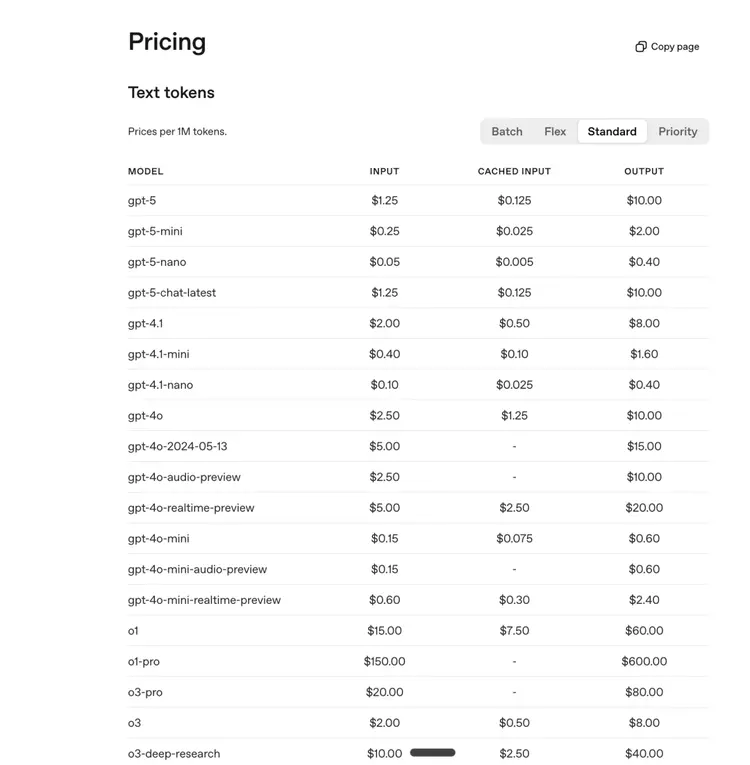
The enterprise package also comes with zero retention, private endpoints, and doubled concurrency. Overall, the same computing power expenditure can save more than 40%.
Obviously, OpenAI is targeting the B-side this time: using ultra-low API prices to directly "poach" companies from self-research or competitors, while the free C-side is just a traffic entrance and word-of-mouth amplifier.
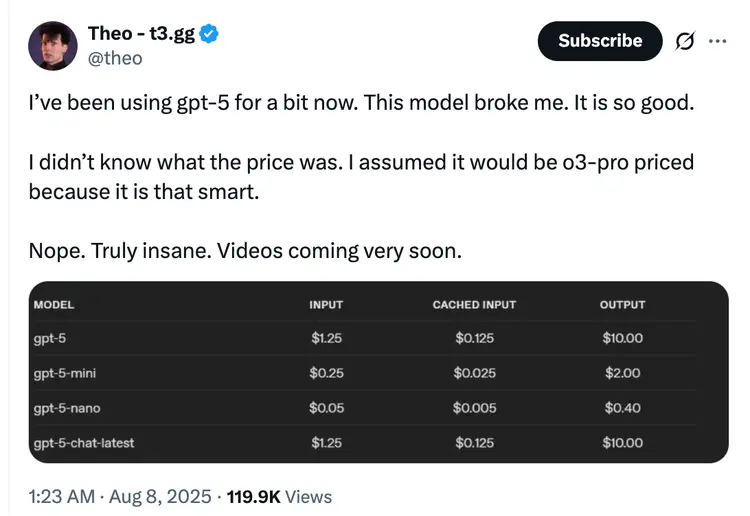
Obviously, the new price makes these developers who have been suffering for a long time very satisfied. When the GPT-5 standard version is only one-twelfth of the price of Claude 4 Opus, those replacement manufacturers that rely on "cost-effectiveness" will face a crisis of survival.
Referring to the last round of model "price war" in China, the basic model market will usher in a cruel survival of the fittest. Small and medium-sized model manufacturers must either find differentiated positioning in vertical fields or be forced to withdraw from the competition.
Of course, the significant drop in reasoning costs has directly lowered the entry threshold for AI applications.When call costs are no longer a constraint, more companies and developers will try to integrate AI capabilities into products. The continued reduction of the marginal cost of software will lead to a new wave of application innovation, which will benefit everyone from tool applications to consumer products.
From technological breakthroughs to price butchers, from ability dazzling to scene implementation, the core logic of OpenAI's release is extremely clear: use cost advantages and product integration to reshape the game rules of the entire AI ecosystem.
When GPT-5 provides capabilities close to the level of human experts at a bargain price, it is actually declaring war on the entire industry - not only to seize market share from competitors, but also to make traditional software service providers feel the pressure of dimensionality reduction. This strategic change marks the official entry of the AI industry from "technology-driven" to "business-driven" stage.
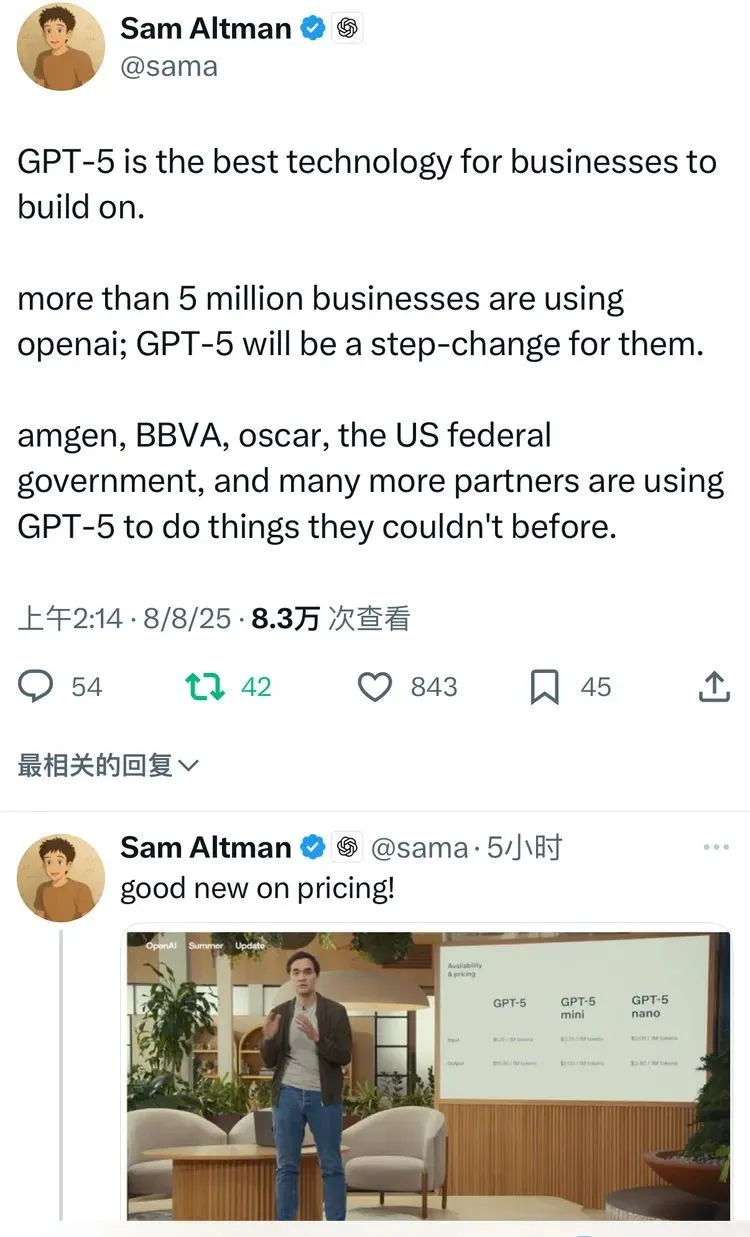
GPT-5 is not the end of technology, but a signal of further advancement in commercial hand-to-hand combat. Next, things like Meta’s ridiculously high price to snatch talents, the “chart error” at the OpenAI press conference, Anthropic’s supply cutoff and the choice between alternatives will appear in front of you more than the amazing model leaps and various “Aha moments”.