By studying leopard spots on rocks on Earth and Mars, scientists will be ready to analyze returned space samples. In 2024, NASA's "Perseverance" Mars rover brought back an unusual rock sample from Mars. The specimen, named "Sapphire Canyon," stands out for its striking pattern: light, leopard-like spots, outlined darkly against red mudstone. Scientists believe it could provide valuable clues in the search for potential sources of organic molecules on Mars.

In 2024, NASA's "Perseverance" Mars rover collected the eye-catching "Sapphire Canyon" rock on Mars. This rock may contain clues to the organic chemistry of Mars. This image depicts NASA's Mars 2020 rover studying rocks with a robotic arm. Image credit: NASA/Caltech Jet Propulsion Laboratory
On Earth, researchers from NASA's Jet Propulsion Laboratory and the California Institute of Technology reported in Scientific Instruments Reviews that they analyzed a similar-looking rock. Their goal was to explore whether a technique called optical photothermal infrared spectroscopy (O-PTIR) could study the Sapphire Canyon samples once they eventually return to Earth.
O-PTIR works by shining two laser beams onto the material. The first laser beam gently heats the surface of the material, producing subtle thermal vibrations that vary with the wavelength of the light. A second laser beam then measures these changes. Taken together, these measurements reveal the material’s unique chemical fingerprint.
The researchers tested O-PTIR on a piece of basalt that contained dark inclusions similar in size to the Sapphire Canyon sample, which author Nicholas Heinz discovered purely by accident, unlike Perseverance's complex sample selection process.
“I was hiking in Sedona, Arizona, and I found a rock that looked like it didn’t belong here, so I put it in my backpack and took it back to look at it.”
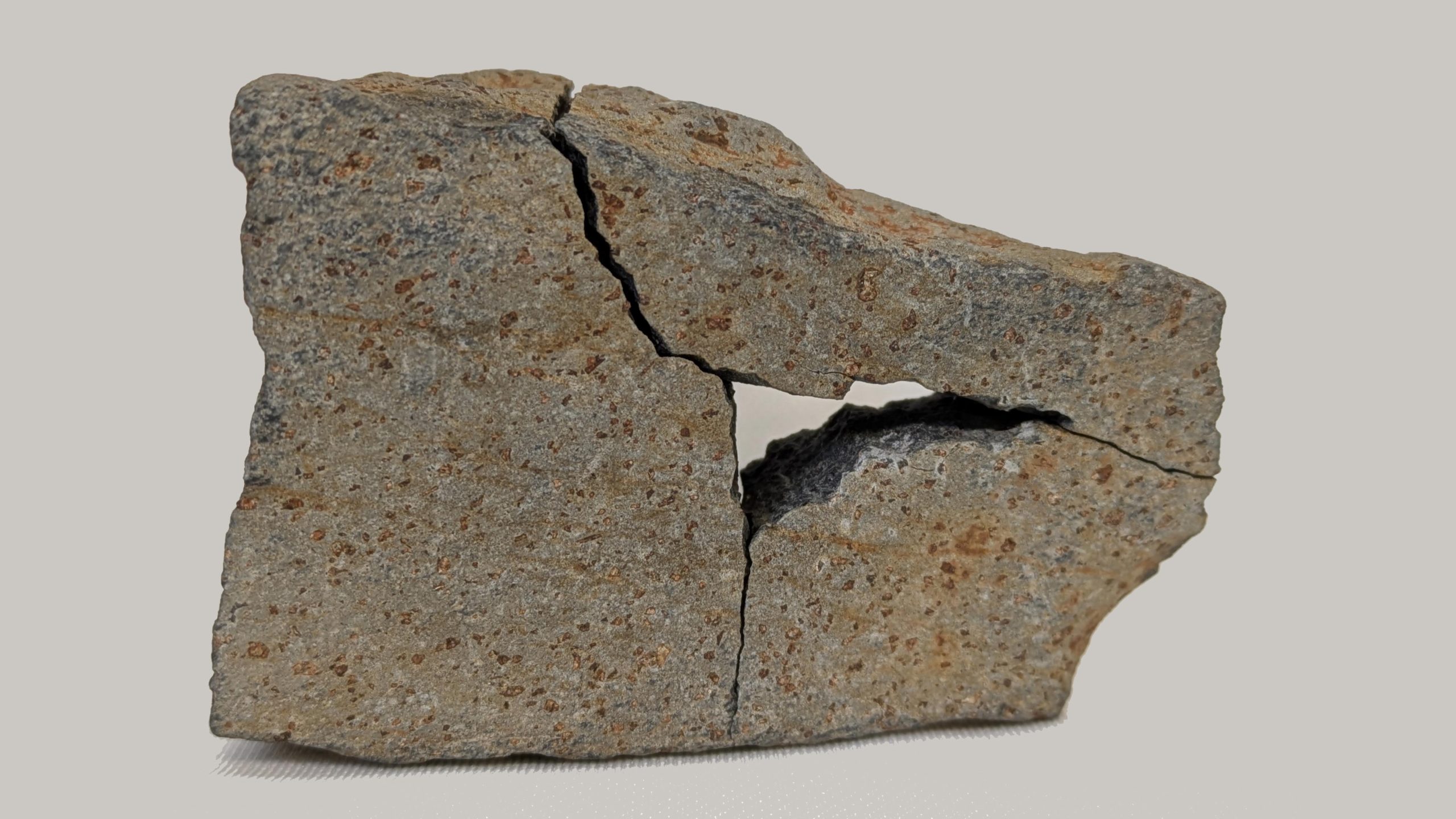
The original, unprocessed sample, which Heinz collected while hiking in Sedona, had spots similar to those on the rocks in Sapphire Canyon on Mars. Photo credit: Nicholas Heinz
They are exploring whether O-PTIR can distinguish the original material of rocks and their dark inclusions, and found that the effect is remarkable due to the enhanced spatial resolution of O-PTIR. In addition, O-PTIR is a fast technique, with each spectrum collected in minutes, allowing scientists to use more sensitive techniques to study identified potential study areas, such as those containing organic matter, in greater detail.
"I would hope that any future return of material from Mars, an asteroid, or any other planetary surface would consider this capability," Heinz said.
The team's O-PTIR technology is the only one of its kind currently available at NASA's Jet Propulsion Laboratory (JPL), and has been used by other NASA missions - in 2024, they helped confirm the cleanliness before the launch of Europa Clipper, a mission designed to study one of Jupiter's moons. Now that they have demonstrated the additional benefits of O-PTIR on Martian samples and for broader geological applications, Heinz says they are working with NASA's Mars Science team to test algal microfossils commonly used as analogues for Mars rovers.
Compiled from /scitechdaily