According to Bloomberg, Goldman Sachs said that hedge funds have turned bearish on Xiaomi stock and may maintain short positions into the earnings season. The report said selling from pension funds and hedge funds has intensified over the past two weeks, with feedback suggesting Xiaomi is "consensus short/sell, at least in the short term, due to a lack of catalysts."
After hitting a record high in June this year, Xiaomi's stock price began to decline. So far, the stock has fallen nearly 30%. However, the latest research report from CITIC Securities believes that Xiaomi will achieve overall revenue of 113.2 billion yuan in the third quarter of 2025, a year-on-year increase of 22.3%; Non-IFRS net profit is 10.2 billion yuan, a year-on-year increase of 63%, and a net profit margin of 9%. CITIC is optimistic that Xiaomi will continue to become the best hard-core technology ecosystem company in China and even the world.
Short positions surged 53%
Xiaomi will announce its quarterly financial results on November 18. Over the past few months, Xiaomi's stock price has continued to be under pressure. As of now, it has retreated nearly 30% from its highest level.
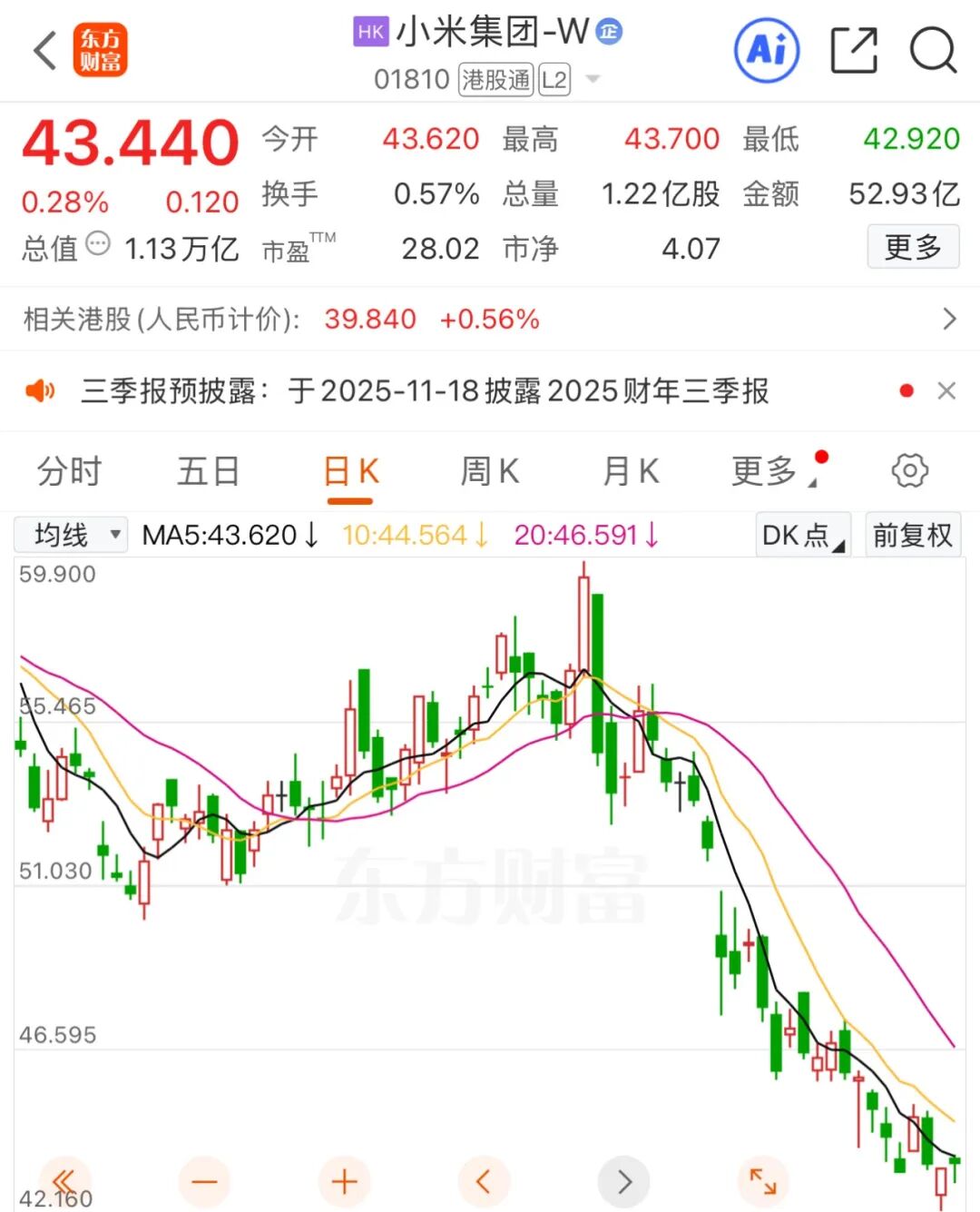
Goldman Sachs reported that short positions on Xiaomi stock among its major institutional brokerage clients rose 53% in the past week. In the past two weeks, institutional trading has been clearly biased towards pure selling, with the main selling pressure coming from pension funds and hedge funds.
Goldman Sachs said that judging from feedback from hedge funds, Xiaomi has become a common short/sell target at least in the short term, due to the lack of catalysts, safety concerns, factory construction delays, and the difficulty of boosting sales in the electric vehicle business despite recent promotion. Goldman Sachs analysts also cut their target prices by more than 10%, citing profit margin pressure from rising memory chip costs.
However, CITIC Securities believes that as the company's car delivery volume increases and ASP rises, innovative business segments such as Xiaomi Auto and AI will turn losses into profits in the third quarter of 2025. In the medium to long term, we are optimistic that Xiaomi will continue to become the best hard-core technology ecosystem company in China and even the world, and continue to enhance the value of the smart hardware ecosystem with its AI capabilities. It will continue to flourish in wider fields such as AI mobile phones, smart cars, smart homes, AI glasses, and embodied intelligence. We maintain a "buy" rating for the company.
SPDB International also reiterated its “buy” rating on Xiaomi. Although Xiaomi's IoT segment growth is facing pressure in the third quarter, it is expected that Xiaomi's automotive business may achieve a single-quarter profit for the first time. In the long run, Xiaomi insists on investing in underlying technologies, including chips, systems, etc., which builds competitive barriers for the company and lays the foundation for long-term growth. As one of the top picks in the industry, Xiaomi's current price-to-earnings ratio is about 23 times, and its valuation has room for growth.
Is it still competitive?
Due to public opinion, investors' votes on Xiaomi's stock price have obviously been affected. So, is Xiaomi still competitive? This may still have to be determined by the data.
Canalys releases global mobile phone sales data for the third quarter of 2025. According to Canalys data, global smartphone market shipments reached 320 million units in the third quarter of 2025, a year-on-year increase of 3%. Among them, Xiaomi mobile phone shipments were 43.4 million units, a year-on-year increase of 1%, and its market share reached 14%, ranking among the top three in the world. In the Chinese smartphone market, Xiaomi mobile phone shipments were 10 million units, a year-on-year decrease of approximately 2%, with a market share of 15%, ranking fourth in China.
Guosheng Securities believes that although shipments in the Chinese market declined after the end of the subsidy project, Xiaomi's growth in the Asia-Pacific and other regions offset this negative impact. Moreover, Xiaomi’s achievement of a high-end mobile phone market share may help offset storage cost pressures. At the end of September 2025, Xiaomi officially released the Xiaomi Mi 17 series of mobile phones. Within 5 minutes of going on sale, it broke the all-day sales and sales record for domestic new phones in 2025. Five days after it went on sale, the sales of the 17 series exceeded 1 million units, with Xiaomi Mi 17 ProMax accounting for the highest sales volume, successfully entering the high-end model market of over 6K units. The continued optimization of Xiaomi's mobile phone product structure may bring positive contributions to mobile phone gross profit margins. However, considering that the global memory chip market is facing a price increase and the cost pressure is increasing, the company's mobile phone gross profit margin is expected to remain around 11% in the third and fourth quarters.
Guosheng Securities also believes that Xiaomi's vehicle delivery volume continues to increase and is expected to achieve breakeven in a single quarter. At the 2025 World Intelligent Connected Vehicle Conference, Lei Jun announced that Xiaomi Auto products have been delivered for one and a half years and 400,000 units have been delivered. In September and October 2025, the monthly delivery volume will exceed 40,000 units. Xiaomi Motors released the "New Year's Eve Purchase Tax Subsidy Plan" on October 24. Consumers who place orders before the end of November can subsidize the purchase tax difference caused by the delivery cycle through final payment reduction, up to a maximum of 15,000 yuan. The company uses this to provide consumers with better interest protection. As Xiaomi's vehicle delivery volume increases, the company is expected to achieve a single-quarter breakeven in its automotive business.
It is worth noting that Xiaomi’s IoT business competitiveness remains stable despite the slowdown in national subsidies. The third batch of 69 billion yuan of trade-in funds was officially implemented at the end of July, and the intensity of state subsidies for home appliances in many places has been reduced. Although the reduction in state subsidies may have a certain impact on the growth of the home appliance track, Xiaomi's comprehensive competitiveness in the IoT field is expected to remain stable due to its product quality advantages and supply chain management and control capabilities.