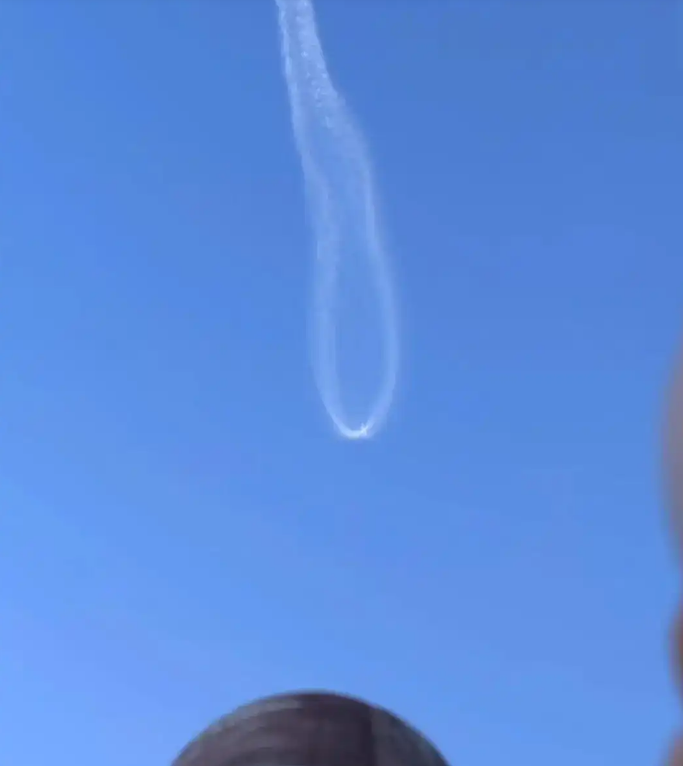
Hangzhou Daily reported that at 6:40 today,Our country used the Long March 7 modified carrier rocket at the Wenchang Space Launch Site to successfully launch the A and B satellites of the Shijian 29 satellite. The satellite successfully entered the scheduled orbit, marking the complete success of the launch mission.After the launch, rocket photographer JAMY_GoNg recorded a shocking scene in Wenchang, Hainan: after the rocket took off, it streaked across the sky, and its wake gradually spread and changed shape, like a glowing "space jellyfish."
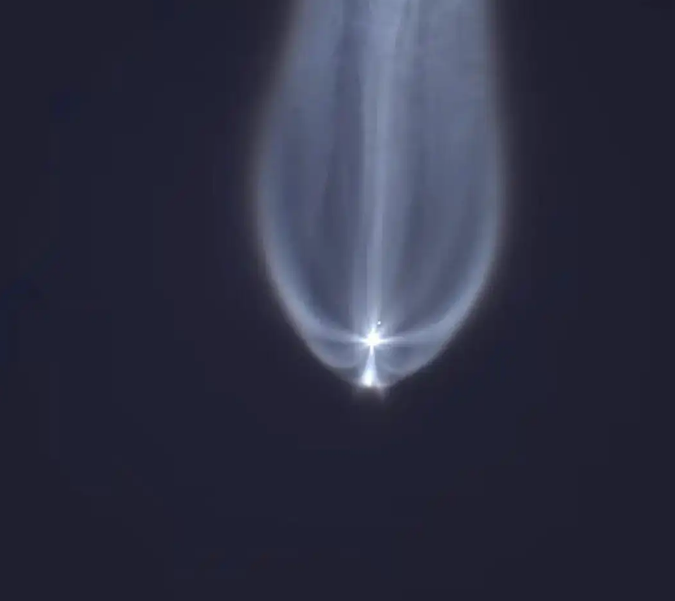
The footage shows that after the rocket's second-stage engine started, the tailing phenomenon became particularly obvious, and then the wake continued to feather and stretch, eventually forming a jellyfish-like light and shadow in the sky.
Professionals explained that when the rocket rises to an altitude of more than 30 kilometers, the high-temperature gas ejected by the engine will expand rapidly. Taking the liquid oxygen kerosene engine used by the Long March 7 as an example, a large amount of water vapor generated by combustion instantly condenses into tiny ice crystals in a low-temperature, low-pressure high-altitude environment.
This process is similar to the condensation of exhaled breath into fog in winter, but because it occurs at high altitudes close to a vacuum, its diffusion range can reach hundreds of kilometers. Ice crystals and carbon particles in the exhaust together act as condensation nuclei, further promoting the growth and formation of clouds.
The Space Center of the Chinese Academy of Sciences has passed spectral analysis,The density of the upper atmosphere and the electron concentration of the ionosphere are retrieved from the halo of the "space jellyfish". These data are of great significance for space weather forecast and satellite orbit correction.