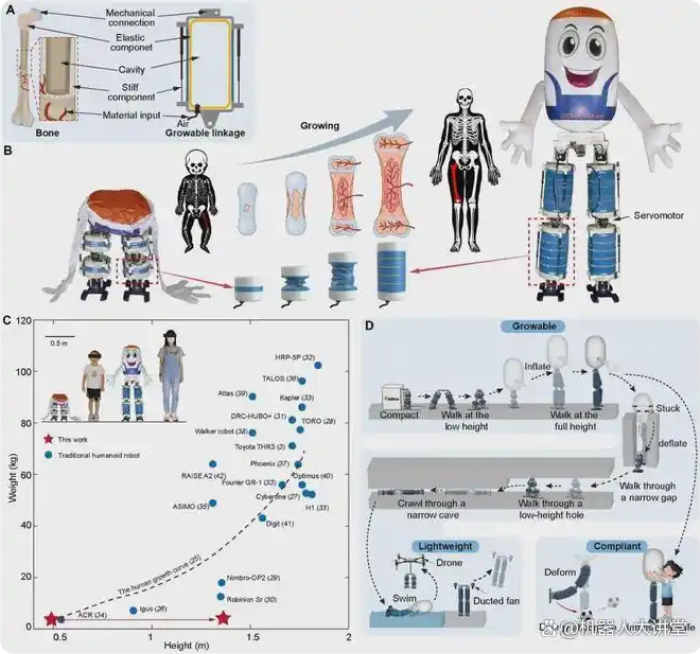
Inspired by the human skeleton, Professor Wang Hongqiang's team at Southern University of Science and Technology recently developed a soft humanoid robot that can grow, deform, and move flexibly - GrowHR, which provides a new flexible idea for the development of humanoid robots.Different from traditional rigid robots, the core design of GrowHR is derived from the bionics of human bones. The characteristics of bone such as growth, light weight, high strength and impact absorption inspired the team to develop a new flexible mechanism based on a pneumatic expansion structure and multi-dimensional stabilization mechanism.
The mechanism uses a soft PVC air chamber to achieve deformation, is wrapped with a non-stretchable fabric layer to improve axial stiffness, and is equipped with rigid connectors at both ends. It weighs only 350 grams but can achieve a stretch rate of up to 315%.
Based on this innovative structure, GrowHR shows extraordinary morphological adaptability. Its height can vary freely between 0.49 meters and 1.36 meters, and it can even "grow" independently from a narrow packaging box to its full height. In order to ensure stable expansion and contraction, the team created a unique synchronized cable restraint mechanism and linear guide rods to maintain balance when changing forms.
In order to ensure stability during the inflation and deflation process, the researchers also creatively designed a synchronization cable restraint mechanism - four equal-length cables are used to ensure that both ends are always parallel.The addition of linear guide rods further enhances the bending resistance, allowing the robot to safely change height while standing.
Based on the above design, GrowHR demonstrates multi-modal movement capabilities that traditional humanoid robots do not have, opening up the imagination of more application scenarios.
The first is the extremely strong morphological adaptability. It can deform through short holes that are only 36% of its original height, and squeeze through slits that are only 61% of its original width by shrinking its belly, significantly improving its accessibility in complex terrain.
This shape-shifting ability also unlocks a unique crawling mode. Through the cooperative work of the growable connection structure and the servo motor, GrowHR can wriggle like an earthworm, and the crawling speed is 1122 times higher than when using only a motor or a soft actuator, so that it can enter extremely small caves.
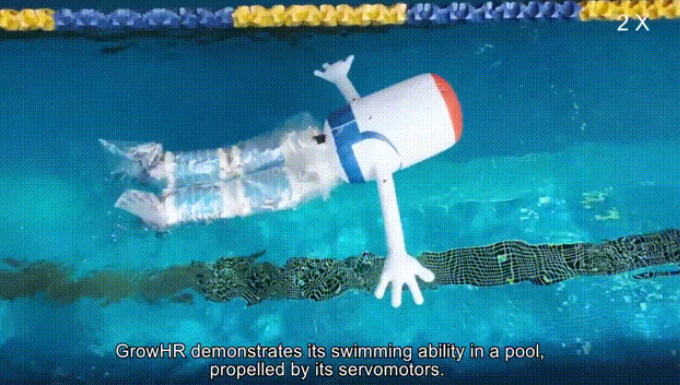
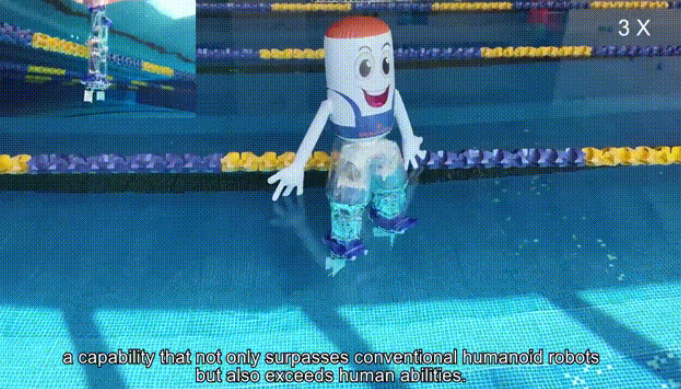
Not limited to land, its capabilities also extend to water.Since the density is only 5.8% of water, it can not only float and swim in the water, but also bear 16 times its own weight. With the help of flippers and mass blocks, it can even achieve light work of "floating on the water" and can be used for water rescue, water surface cleaning and other tasks.
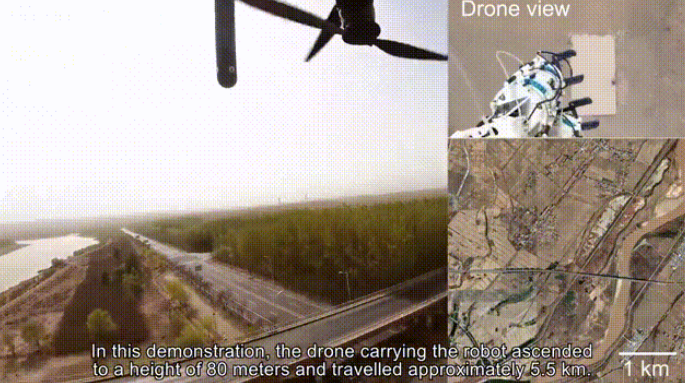
Since it only weighs 4.5 kilograms, GrowHR can be transported by air with the help of ducted fans or drones. The longest flight distance in the experiment reached 5.5 kilometers, demonstrating its great potential for performing search and rescue missions in remote areas.
For a robot that may enter a home and get along with people day and night, safety is always the first priority. GrowHR's design has "intrinsic safety" engraved in its DNA from the beginning.
Although it is 1.36 meters tall, GrowHR weighs only 4.5 kilograms, less than 20% of the weight of traditional rigid robots of the same size. This ultra-light design means that even if a collision occurs, the impact force is much smaller than that of a traditional robot.
Experimental data shows that the impact force of GrowHR when it falls to the ground is only 1/1.7 of that of a rigid robot of the same weight.
GrowHR is designed with security at its core. Its ultra-light weight (less than 20% of a rigid robot of the same size) means that even in the event of a collision, the impact force is far less than that of traditional robots.Tests show that its impact force when falling to the ground is only 1/1.7 of a rigid robot of the same weight. It can safely hug children, even if it accidentally falls, with extremely low risk to both humans and machines, and its weight even allows children to easily move it, which provides a key safety foundation for future home service robots.
In addition, its flexible structure also brings unique dynamic performance. For example, the legs can store and release elastic energy when stressed, completing sensitive actions such as kicking a ball that are difficult to achieve with rigid robots.
The research team said that in the future, by increasing the degree of freedom, using more powerful actuators and combining advanced control algorithms, the autonomy and dynamic performance of such robots are expected to be further improved.
From autonomous deformation, multi-environment adaptation to intrinsic safety, GrowHR seems to bring the health assistant "Baymax" in the movie "Big Buck" into reality, and even goes further - it not only knows how to hug safely, but also masters various skills such as flying, swimming, water drifting and "shrinking bones" to wear seams. A future of robots that is more flexible, safer, and can be deeply integrated with the human environment is gradually becoming clear from such exploration.