SpaceX and Tesla jointly launched the Terafab project at 8pm ET on Saturday night and broadcast it live on the X platform. The goal of the Terafab project is to manufacture 100 billion to 200 billion advanced 2-nanometer chips per year. SpaceX founder and Tesla CEO Musk retweeted the live broadcast and said that Terafab’s target annual production capacity is to produce 1 terawatt (terawatt) of computing power. Since the United States’ annual power generation is only 0.5 terawatt, most of the future computing power must be transferred to space.
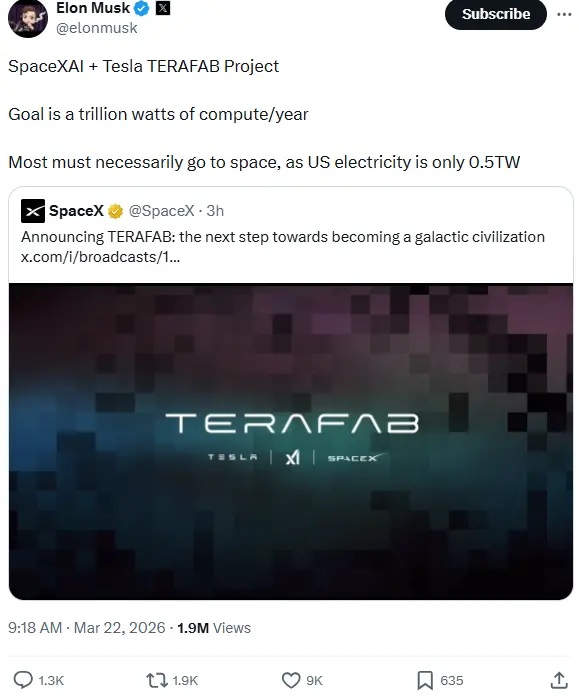
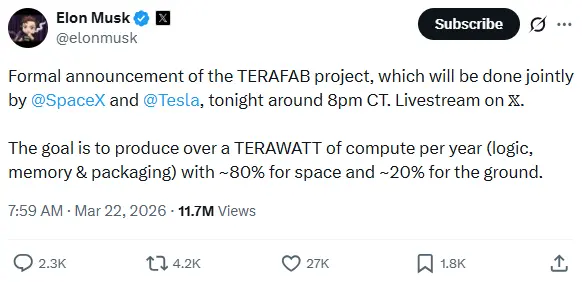
He also pointed out in an earlier tweet that Terafab's artificial intelligence chip manufacturing will cover the fields of logic, memory and packaging. 80% of the chips produced will be used in space, and the remaining 20% will be used on the ground.
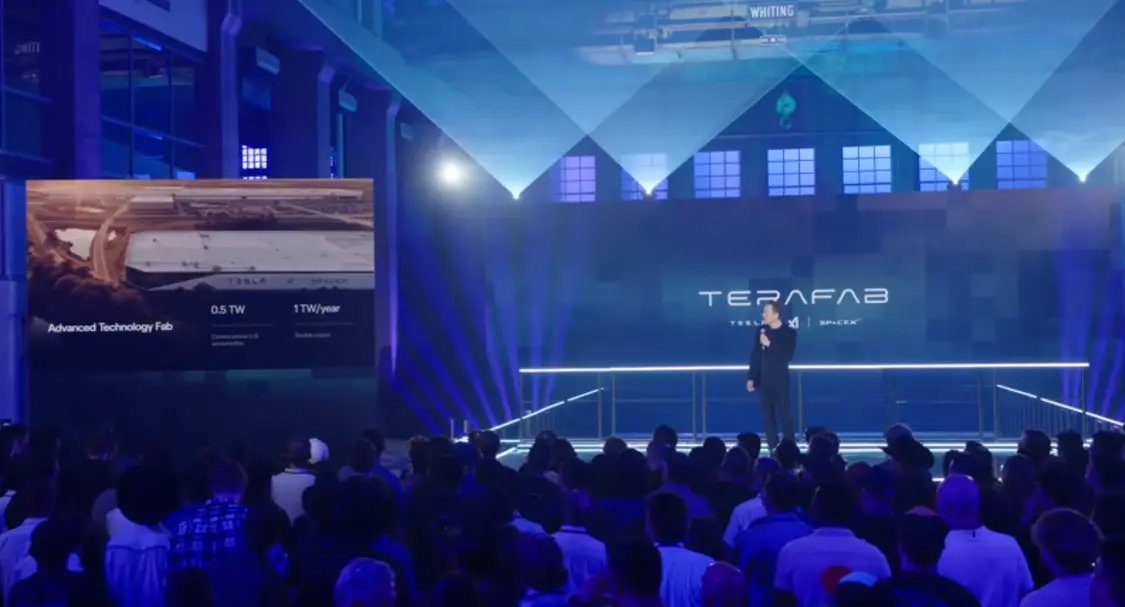
Terafab will be located in Austin, Texas, USA, and will be jointly operated by SpaceX and Tesla.
grand plan
Musk has said that while the semiconductor industry is increasing production, it is still moving too slowly to meet the supply of chips he expects it will need. This is one of the key reasons why he promoted Terafab.
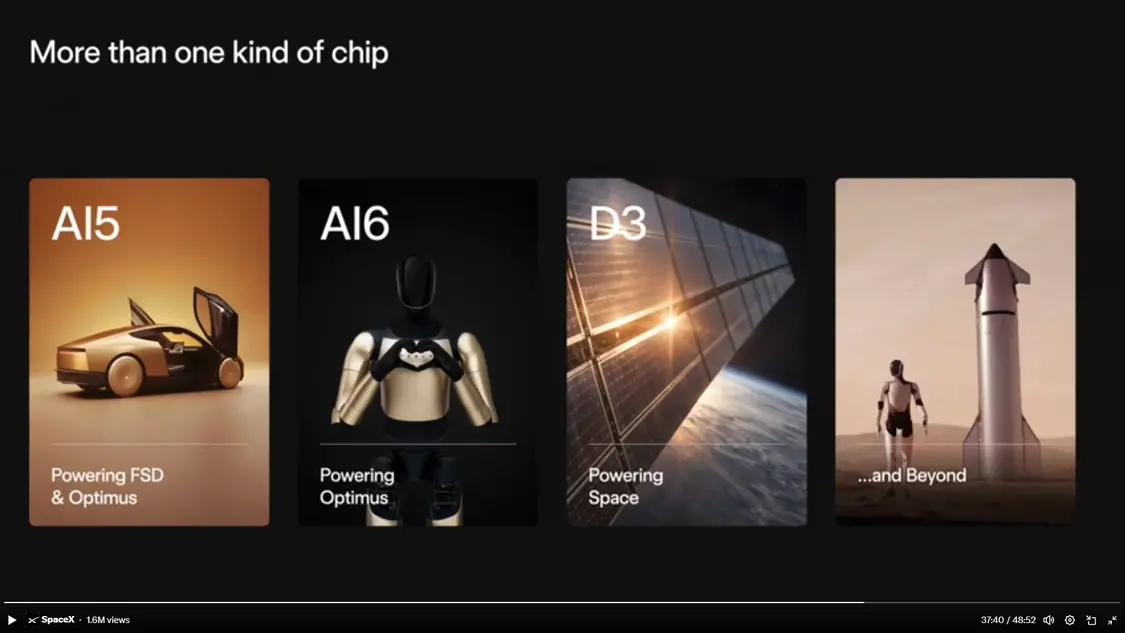
Musk emphasized at the Terafab press conference that the project is expected to produce two major types of chips, one of which will be optimized for edge computing and reasoning and will be mainly used in Tesla electric cars, driverless taxis and Optimus Prime humanoid robots. The other category is high-performance chips designed for space applications and available for use by SpaceX and xAI.
Among them, AI5 is designed as a dedicated chip for Tesla's fully autonomous driving system and Optimus Prime robot. Its performance and computing power are 40 to 50 times higher than that of the existing AI4. The next generation AI6 is expected to be designed by the end of this year and will be mainly used in the second-generation Optimus Prime robot and large-scale inference clusters. The D3 chip is designed around the space environment and will provide computing power for projects such as Starlink and Starship.
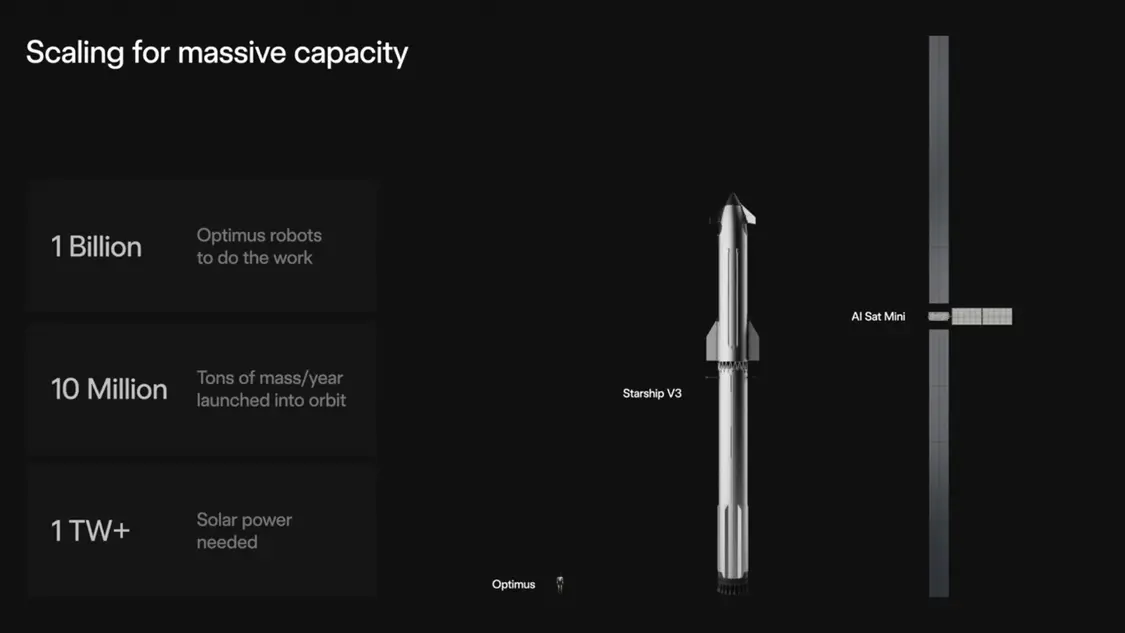
At the press conference, Musk also showed the design drawing of the future mini artificial intelligence data center satellite, which is part of the SpaceX large satellite system and is designed to perform complex space computing. In January this year, SpaceX applied to the Federal Communications Commission to launch 1 million data center satellites.
However, Musk himself does not have any experience in semiconductor production. Given that the scale of investment in this industry has always been huge and the production equipment is complex and sophisticated, Terafab is likely to be unable to achieve mass production in the short term. In the live broadcast conference, Musk did not give a specific timetable for the construction or mass production of the Terafab project.
Raising funds to build and launch artificial intelligence data centers in space is one of the main drivers behind SpaceX's planned IPO later this year. According to comprehensive reports, SpaceX is expected to conduct an IPO this summer, and its valuation may exceed US$1.75 trillion.