ByteDance launched a new generation of multi-modal video generation model Dreamina Seedance 2.0 and announced that the model has been officially integrated into its video editing application CapCut. OpenAI has just announced the closure of the Sora application, which is seen as temporarily "shrinking firepower" from the consumer video generation track. ByteDance has chosen to increase its presence in the same field, with the intention of further improving its competitiveness in the global creator tools market.

ByteDance stated in the announcement that Dreamina Seedance 2.0 can help creators complete the drafting, editing and synchronization of video and audio content through text prompts, images or reference videos, and can quickly generate films without complicated operations. This model can generate videos without reference images. As long as the creator describes the scene in his mind in a few words, the system can automatically generate the corresponding picture. Officials also emphasized that with the new model, CapCut can render more realistic materials, motion and light and shadow effects under multiple viewing angles and lens languages, and can be used to edit, enhance or correct user-owned materials.
In terms of application scenarios, Dreamina Seedance 2.0 is positioned as a general-purpose video generation and creation auxiliary tool, suitable for food tutorials, fitness teachings, business or product introductions, and content containing a large number of sports or action elements - these were once the "difficulties" of early AI video models. This model is also regarded as a preliminary creative verification tool. Creators can quickly generate samples based on sketches or conceptual ideas to test styles and storyboards before deciding whether to commit to actual shooting. Currently, the first version of the model in CapCut supports video generation of up to 15 seconds, and provides six aspect ratios for users to choose from.
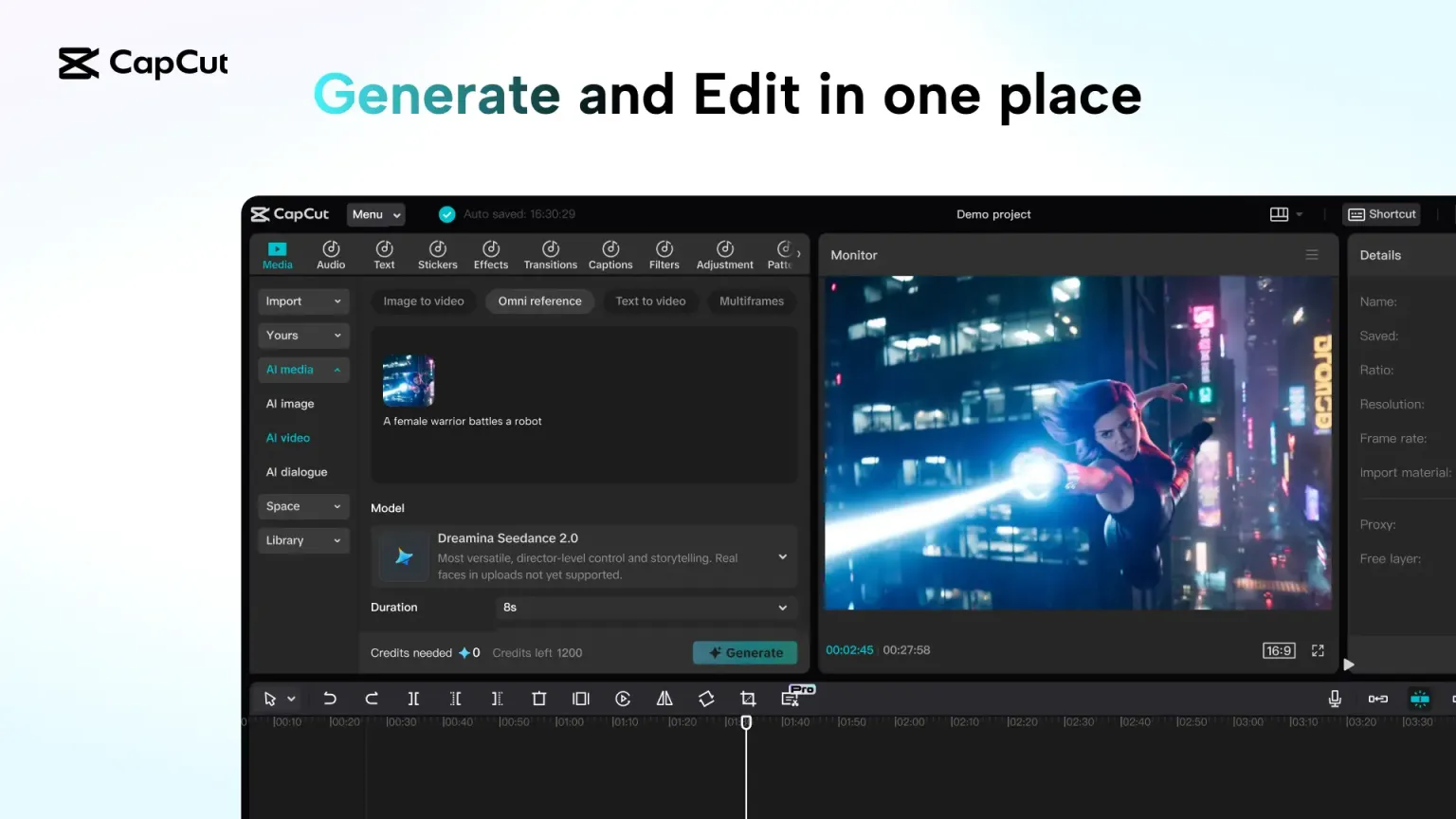
This access to CapCut adopts a phased launch strategy. It will first be opened to users in Brazil, Indonesia, Malaysia, Mexico, the Philippines, Thailand and Vietnam, and will be gradually expanded to more markets later. In the Chinese market, Dreamina Seedance 2.0 has been integrated into Bytedance’s editing application “Jianying”. Previous reports pointed out that ByteDance had been criticized by Hollywood and related organizations due to copyright disputes, and had once "shelved" the global release of the model. The current limited launch market is regarded as a cautious test of compliance and risk control.
With the expansion of access scope, Dreamina Seedance 2.0 will be implemented in multiple modules within CapCut, including editing functions such as "AI Video" and generation tools such as "Video Studio". It will also be launched on ByteDance's AI generation platform Dreamina and marketing platform Pippit to connect creation and commercialization scenarios. ByteDance stated that it will cooperate with experts in relevant fields and the creator community to continue to iterate model capabilities in actual use.

In terms of content security and compliance, ByteDance has set multiple restrictions for the model: First, the model will prohibit the generation of new videos based on pictures or videos containing real faces, intended to reduce the risk of deep forgery; second, CapCut will block attempts to generate unauthorized intellectual property images or materials. The company also pointed out that if these restriction mechanisms had been fully mature, the model would have been opened in the US market, which also confirms that the current rules are still being adjusted and improved.
To facilitate external identification, content generated by Dreamina Seedance 2.0 will be embedded with invisible watermarks by default for marking and tracking when disseminated outside the platform. This mechanism is expected to play a role in future copyright dispute scenarios. For example, when a rights holder initiates a takedown request or alleges infringement of generated content, watermarks can be used to assist in confirming whether the work was generated by this model.