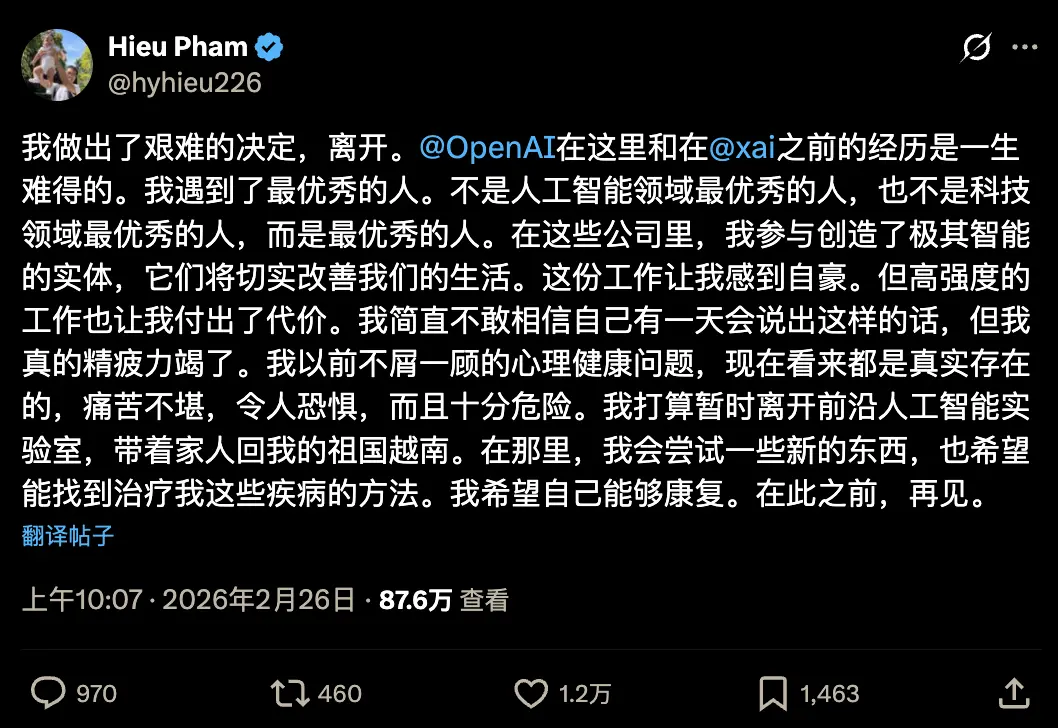
An OpenAI engineer resigned and returned to China due to severe mental exhaustion, revealing the cruel involution of the Silicon Valley AI circle. Under the double torture of "0-0-2" extreme oppression and moral anxiety, the core R&D backbones of giants such as xAI and OpenAI are embarking on an unprecedented collective escape.OpenAI engineer Hieu Pham finally had to decide to stop working completely and leave Silicon Valley.
https://x.com/hyhieu226/status/2026841633342501150
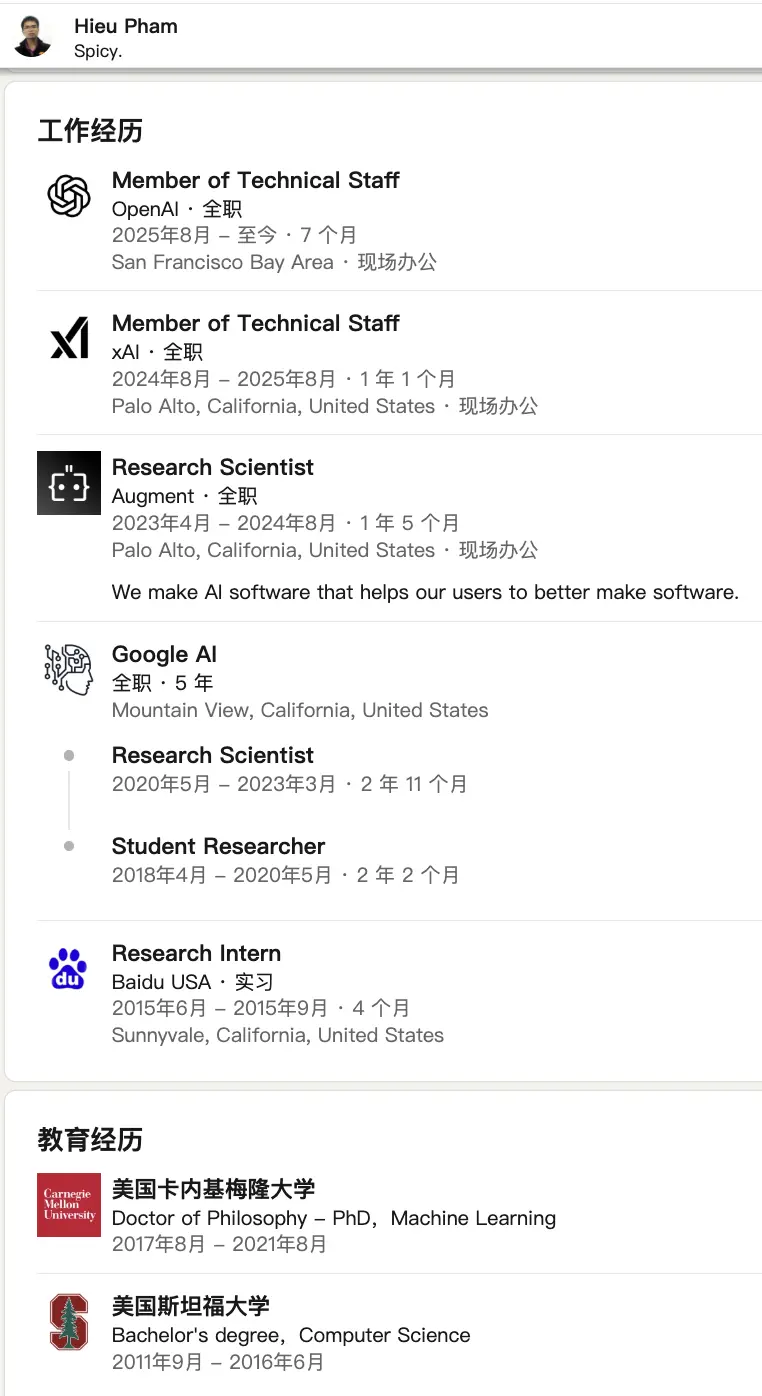
If you look at his resume alone, he is at the center of the most enviable career coordinate system of this era.
He won an IMO silver medal in high school;
Entered Stanford University to study computer science as an undergraduate, and represented Stanford in the global ICPC finals;
Subsequently entered CMU to studymachine learningPhD.
He worked at Baidu Silicon Valley Lab when Andrew Ng was in charge, and worked with AnthropicCEODario Amodei worked as a colleague, and later moved from Google to xAI, and then to OpenAI, which he has just left.
https://www.linkedin.com/in/hyhieu/
In these cutting-edge laboratories where the world's smartest brains gather, he works side by side with top engineers, coding code and debugging models day and night.
His job is to create intelligent entities that are extremely intelligent and promise to fundamentally improve human life.
This sense of accomplishment of participating in making history once made him feel extremely proud.
To this day, this engineer, who is regarded as an industry elite, left a shocking farewell message on X.
He announced that he was resigning from his position at OpenAI and was preparing to return to his hometown of Vietnam with his family.
He did not announce his next entrepreneurial plan, nor did he reveal any intention to change jobs. His appeal was just to "find a way to cure his disease."
Huge mental overdraft overwhelmed him.
In the public text, Hieu Pham confessed that he was completely burned out.
The deteriorating mental health issues he once dismissed as something only a coward would complain about now haunt him like a nightmare.
He described his current mental state as "painful, terrifying, and extremely dangerous."
Some people in the comment area even stigmatized foreign employees holding H-1B as "commercial spies."

Before that, he had left a monologue full of existential angst online.
He looked at the model he had trained with his own hands and felt an unprecedented existential threat.
When artificial intelligence becomes too perfect and subverts everything, what will be left of humanity?
He concluded at the time that it was only a matter of time.
Hieu Pham's departure is like a boulder dropped on the still lake of Silicon Valley.
What this boulder aroused was not gossip about personnel changes in a certain company, but a collective reflection in the entire industry on a spreading, almost cruel work model.
Raj Dabre, a senior research scientist at Google, quickly came out in support of his former competitor.
Raj Dabre, who is also at the heart of this technological frenzy, bluntly points out that being at the forefront of technology is no child's play.

https://x.com/prajdabre/status/2026860586546692313
Behind the high salary and dazzling halo are breathless high pressures and unimaginable psychological costs.
During countless late nights when chased by a dead end, even the most tenacious practitioners will fall into self-doubt, questioning whether all the sacrifices are really worth it.
In Silicon Valley, a land that once boasted freedom, flexibility and work-life balance, a silent alienation of labor models is closing the loop.
The grand narrative of chasing AGI is cleverly packaged as a holy war to save or change the destiny of mankind.
In this narrative system, any desire for rest is seen as a betrayal of the mission.
Major AI startups and technology giants have all fallen into an extreme frenzy.
There were once "hardcore" rumors circulating in the industry about the eighty-hour work week, but now this intensity is even regarded as mild.
The working pattern of top researchers is evolving into an extreme state known as "0-0-2", that is, working from midnight to midnight, leaving only two hours of breathing time throughout the weekend.
At some star startups, team members have moved entirely into cramped two-bedroom apartments.
The living room is a conference room, the bedroom is a computer room, and the dining table is piled with cool takeout boxes.
The operating rules here are absolute concentration for up to sixteen hours a day. There are no weekends or holidays. There are only constantly beating model parameters and never-ending training clusters.
Company executives even blatantly declared in the recruitment notice that as long as everyone focuses on the same ambitious goal, the chance of success will increase exponentially, and employees do not need to worry about housing, meals or even the so-called social life.
Many people naively believe that as long as they sprint for a few months and cross the AGI singularity first, they can usher in eternal wealth, freedom and technological utopia.
The reality is just the opposite.
The iteration of large models is like a bottomless black hole. There are always new parameters that need to be fine-tuned, and there are always larger computing power clusters that need to be scheduled.
The so-called "sprint" was extended indefinitely and turned into a long marathon that overdrafted our vitality.
As this high-pressure environment becomes normalized, a secret and huge wave of resignations is taking place.
The core of this exodus is no longer the elimination of marginal employees, but the top researchers, founders and core technical backbones who have built the modern AI building with their own hands.
Among them, the Chinese AI forces that once served as the mainstay of major star teams are experiencing the most severe losses and shocks.
Just in mid-February this year, xAI, owned by Musk, faced a severe personnel earthquake.
Within just twenty-four hours, two core Chinese co-founders, Tony Wu and Jimmy Ba, announced their resignations.

https://x.com/Yuhu_ai_/status/2021113745024614671

https://x.com/jimmybajimmyba/status/2021374875793801447
Wu Yuhuai was once the core face at the xAI press conference, often sitting next to Musk and occupying the absolute C position.
In his farewell letter, he fondly recalled the years in the trenches and countless sleepless nights spent with the team, but his fatigue with the way the huge machine operated was also implicitly revealed between the lines.
He lamented that in an era full of possibilities, a small team equipped with AI can also move mountains and seas, which seems to imply that he is somewhat tired of the big factory corps combat, crazy stacking of resources and manpower mode.
Jimmy Ba then handed in his resignation.
There are rumors that this is due to the huge internal R&D pressure to close the gap with OpenAI in a short period of time.
Extending the timeline slightly, six of the original twelve co-founders of xAI have now sadly left the company, with the attrition rate as high as an astonishing 50%.
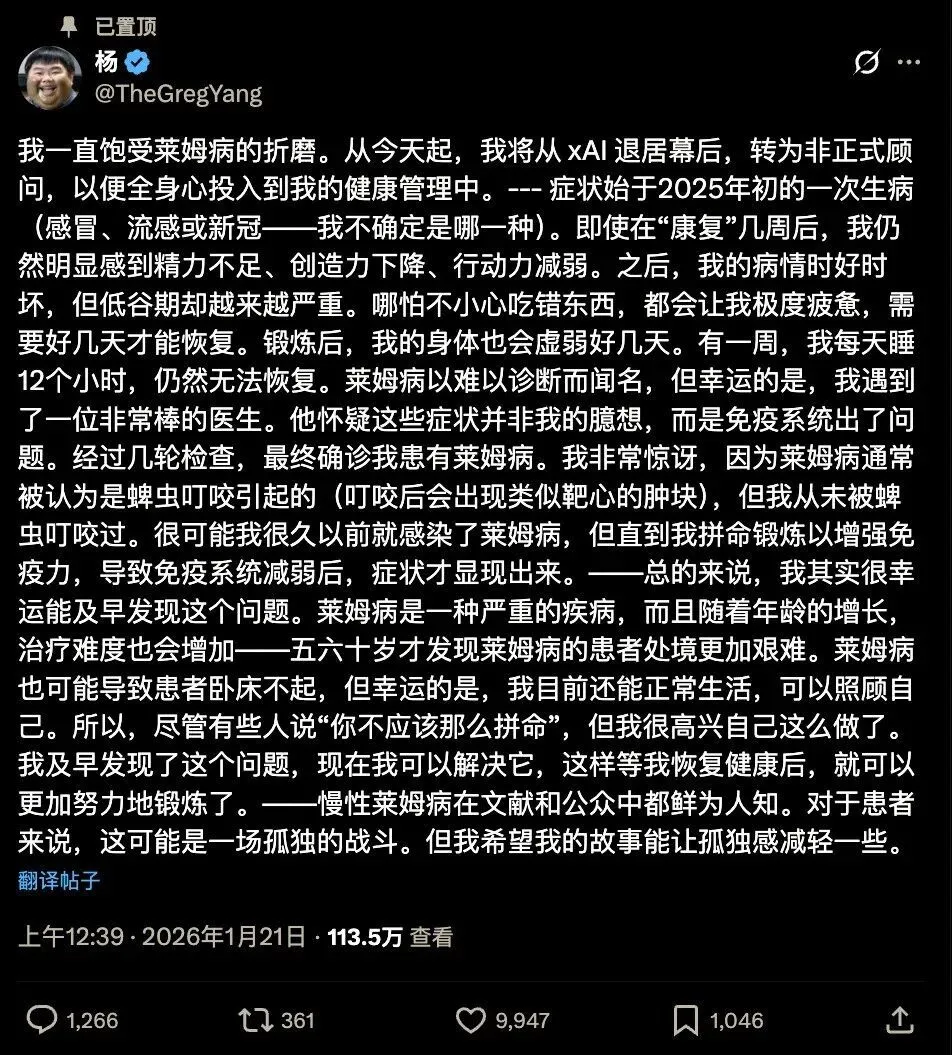
Before Wu Yuhuai and Jimmy Ba, another high-profile Chinese technology expert, Yang Ge, who is also the co-founder of xAI, also chose to withdraw early.
https://x.com/TheGregYang/status/2013652609455006006
Greg Yang was diagnosed with Lyme disease after his body lit up with red lights due to chronic overload.
When he left, he had to admit that in the process of building this company from scratch to one, he had seriously overdrawn his own health bottom line.
In addition to xAI, this storm has also swept through other leading companies.
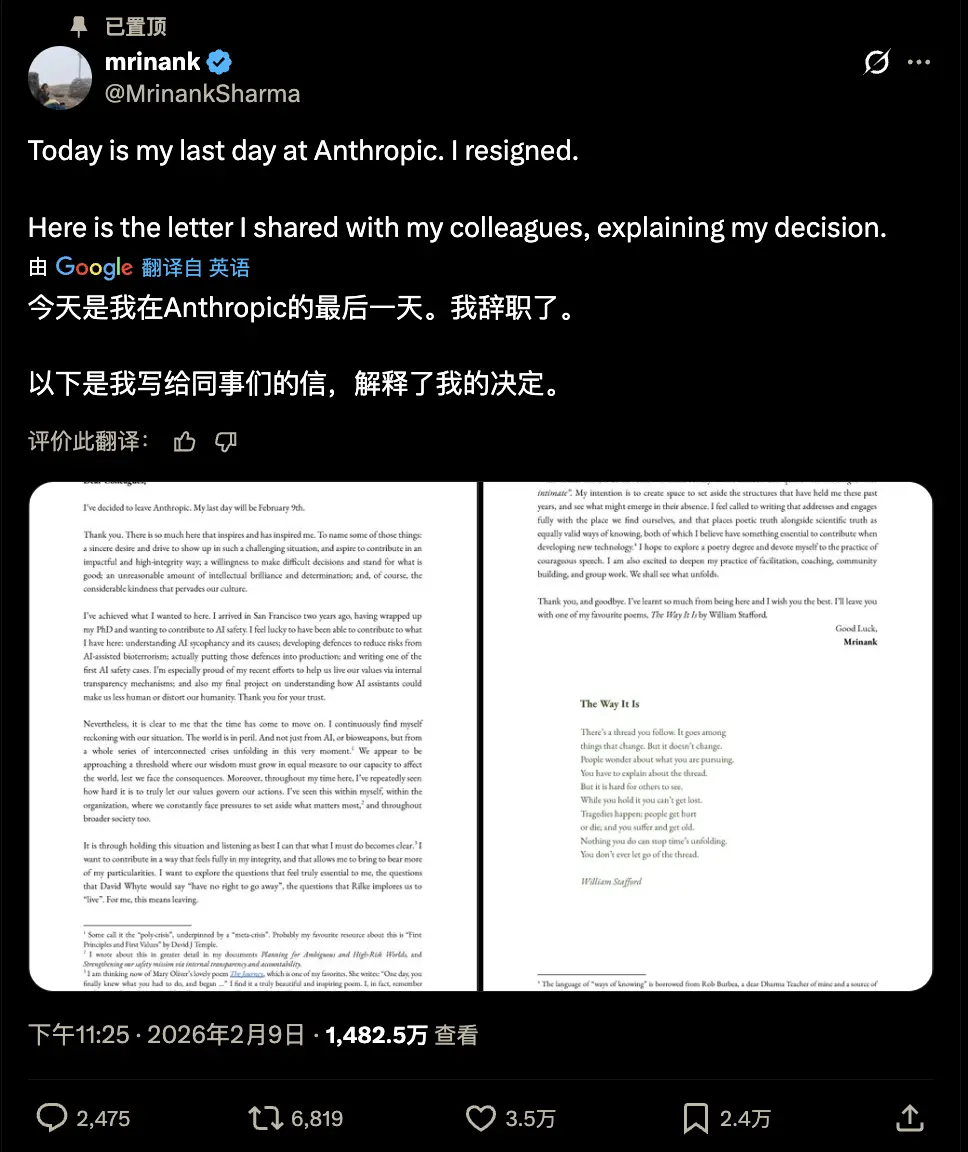
At Anthropic, Mrinank Sharma, who used to lead the security team, gave up a promising future on the golden track.
https://x.com/MrinankSharma/status/2020881722003583421
The legacy he left to the industry is full of absurd poetry. He warned the world that "the world is in danger" and then turned around to pursue a quiet life of writing poetry.
At OpenAI, key figures such as Jerry Tworek, who led the development of core inference models, and Zoe Hitzig, who left due to dissatisfaction with commercialization compromises, form part of the long list of departures.
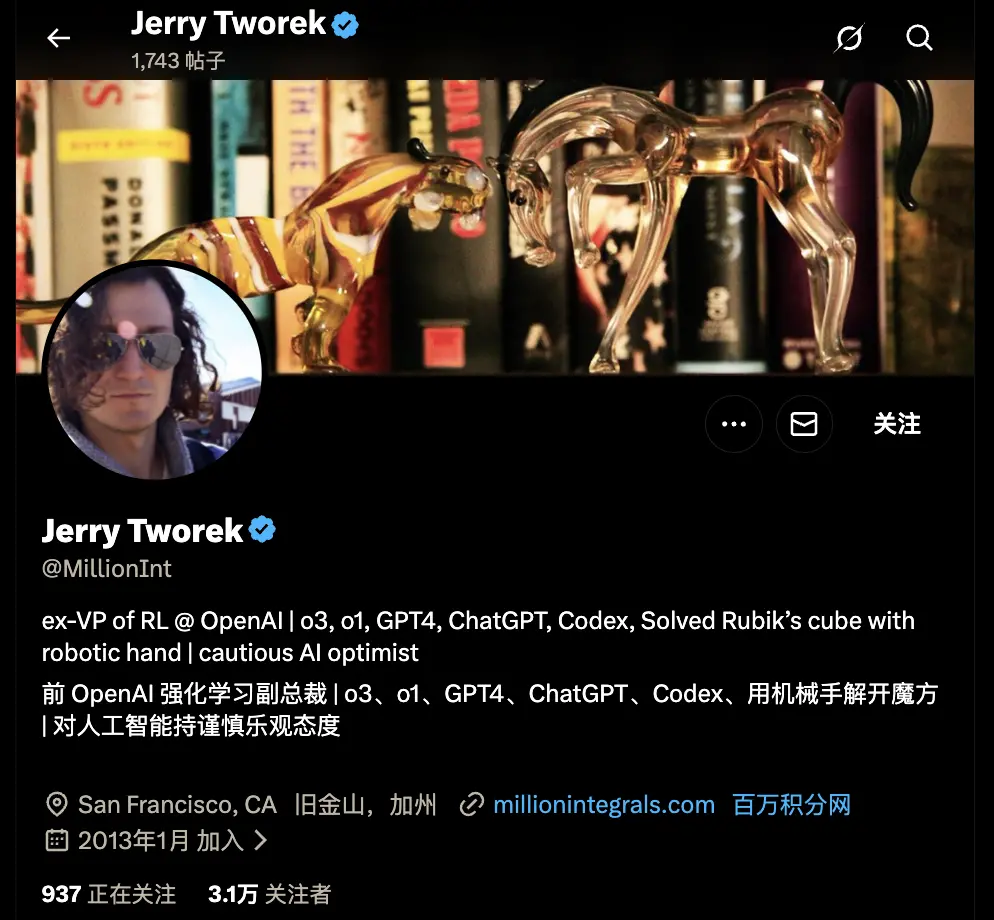
https://x.com/MillionInt
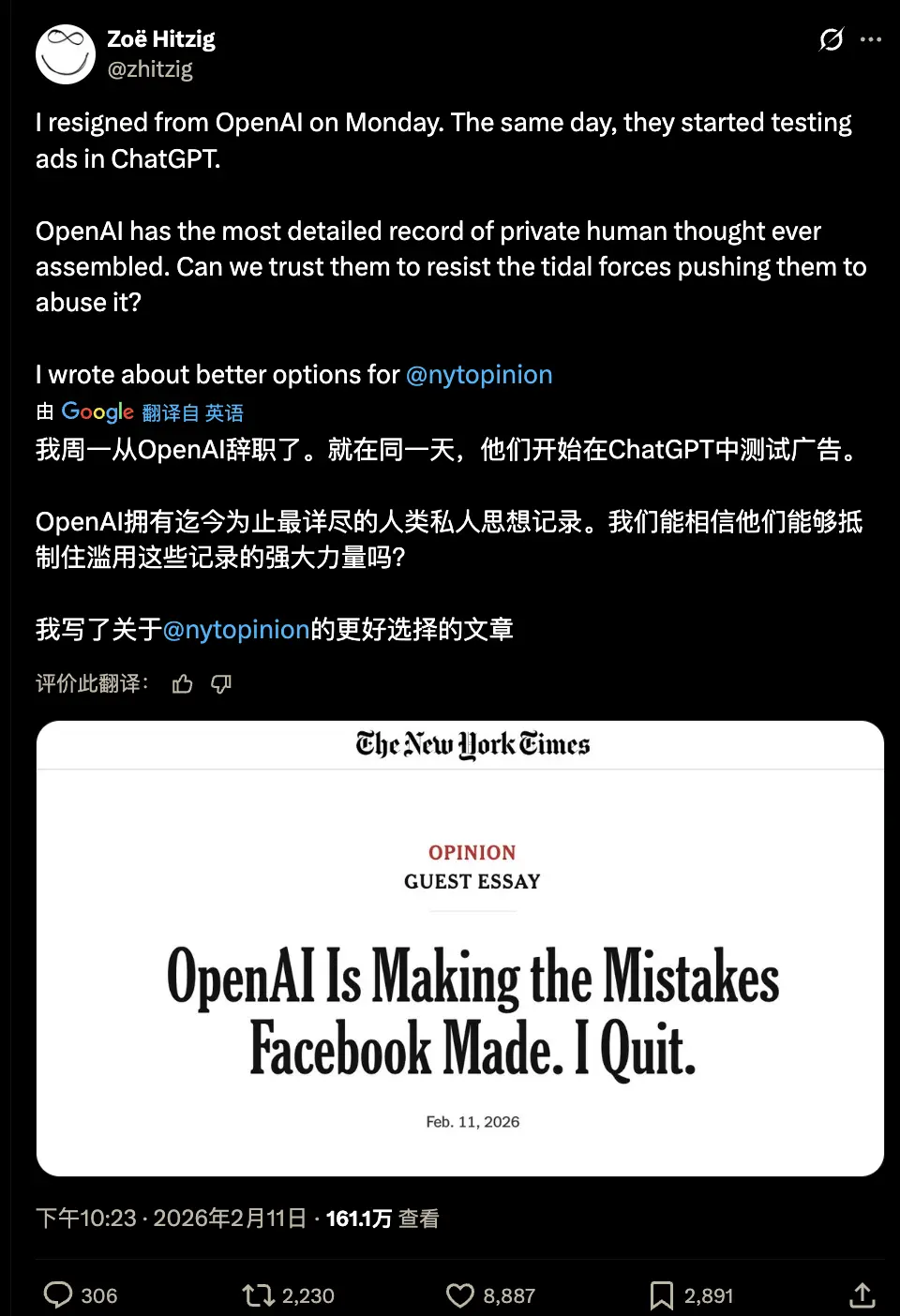
https://x.com/zhitzig/status/2021590831979778051
These top smart brains invariably choose to escape, not just because of physical fatigue.
Code can be outsourced and computing power can be rented, but the wear and tear of the human mind is irreversible.
AI researchers are experiencing an unprecedented level of professional psychological trauma.
A phenomenon known as "cognitive overload" is spreading among this group.
The rate of evolution of cutting-edge technology has far exceeded the limits of the natural adaptation of the human brain.
Every morning when you wake up, hundreds of new papers will appear on arXiv, and competitors may have released a model last night that is enough to subvert the existing paradigm of the industry.
This kind of technical anxiety day after day keeps practitioners in a state of stress that is on the verge of being eliminated.
They dare not take a break or cut off the connection with the Slack (American Feishu) work group, for fear of missing any subtle technical turning point.
The deeper torture comes from moral anxiety and existential crisis.
For researchers working on AI safety and alignment, they spend their days calculating the odds that artificial intelligence will ultimately lead to the destruction of humanity.
This kind of calculation is by no means a mathematical game on paper, but is based on their deep insight into the underlying logic of the model.
They know better than anyone the power brewing in those glowing server cabinets.
The cognitive dissonance of asking a person to spend day after day building a technology that he personally believes has a high probability of catastrophic consequences is enough to destroy any solid psychological defenses.
They are forced to act as the "moral police" of Silicon Valley, shouting at the boardroom to slow down capital requirements, but are often drowned in the roar of greed for business profits.
The logic of capital is always cold.
Investors are waving checks worth tens of billions of dollars, demanding that companies deliver new features next month that will make Wall Street buzz.
In order to maintain the valuation myth, companies can only channel pressure layer by layer to each specific engineer.
Under this logic, human beings are no longer the subjects of history creation, but have degenerated into the fuel that keeps this huge machine running.
When the flash of genius is alienated into endless mechanical labor, when the pure enthusiasm for exploring the unknown is drowned in the cruel arms race for computing power and parameters, running away becomes the last dignity of human beings.
The entire industry seems to be stuck in a frenzied inertia that cannot put on the brakes.
The company's large models are increasingly able to understand complex human emotions, and can even write delicate and moving poems and provide empathetic psychological counseling.
The engineers who developed these models have exhausted their emotions and empathy in the real world, and even a safe dinner has become a luxury.
The flywheel of technology is crushing the biological clock of human beings, rushing towards the illusory "singularity".
Hieu Pham may be able to find a brief moment of peace at home in Vietnam.
Those Chinese geniuses who have left the laboratory may also be able to find the fun of coding in small-scale exploration.
The Silicon Valley machine won't stop humming just because they're gone.
There will always be fresh blood that is younger, more ambitious, and more eager to prove themselves to fill those vacant positions and continue to invest in this unprecedented computing power melting pot.