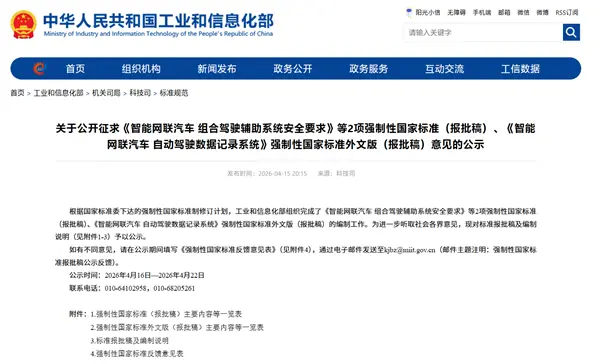
The Ministry of Industry and Information Technology has recently released the mandatory national standard "Safety Requirements for Intelligent Connected Vehicle Combination Driving Assistance Systems" (draft for approval), which was publicly solicited for opinions from April 16 to 22, and is recommended to be officially implemented on January 1, 2027.This standard is China’s first mandatory national standard for L2-level assisted driving. It was jointly drafted by Huawei, Xiaomi, BYD, Tesla, etc. to fill the gap in the industry’s safety baseline.
The standard divides L2 combined driving assistance systems into three categories: basic single-lane, basic multi-lane, and pilot combined driving assistance systems, clarifying functional boundaries, capability thresholds, and safety requirements.
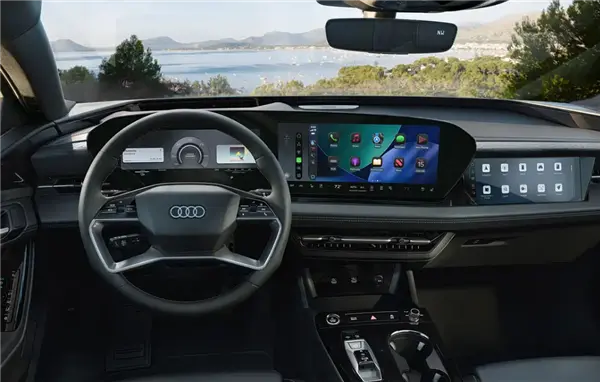
The core focus is on the driver's responsibility, requiring vehicles to be equipped with a driver status monitoring system to detect hands and line of sight in real time.
The key rules are clear: taking your hands off the steering wheel for 5 seconds will trigger a prompt, and failing to correct the situation for 10 seconds will escalate the warning; taking your eyes off the road for 5 seconds will trigger a return prompt, and if you do not return to normal, the system will gradually degrade.
If risk mitigation is triggered due to driver disengagement, or multiple violations, the system will disable the auxiliary function for a certain period of time (at least 30 minutes).
The standards also require car companies to provide clear instructions for use and driver training, and to avoid exaggerated publicity;At the same time, a multi-level test system for site, road, and document inspection is constructed. At 80km/h, stationary obstacles need to be identified and slowed down 120 meters away.
This standard applies to M-class passenger vehicles and N-class cargo vehicles. After implementation, models that do not meet the standards will be banned from being put on the market.
This move will standardize the L2 market, strengthen human-machine co-driving, reduce the risk of misuse, and promote the safe development of intelligent driving.