People often think of "putting lightning in a bottle" as a fantasy metaphor, but rarely imagine what else can be done next if it is really done. Now, researchers at Northwestern University have not only "trapped lightning" in the lab, but are using it to create a cleaner fuel, methanol. They use plasma contained in glass tubes to directly convert methane into methanol, significantly reducing the reliance of traditional processes on energy and extreme working conditions.
Methanol is a basic chemical with a wide range of uses. It is an important raw material for some plastics and acids, and can be used as a clean fuel for automobiles, ships and cooking stoves. It is also widely used in industrial solvents and sewage treatment. However, the current mainstream route for methanol production in the industry is extremely energy-consuming and complex, and the starting point is also methane gas. In the traditional process, methane is first cracked into carbon dioxide and hydrogen in high-temperature water vapor at about 800 degrees Celsius, and then recombined through a catalytic reaction to generate methanol molecules in another device at a high pressure of about 200 to 300 atmospheres. Although the technology of this route is mature, maintaining such high temperature and pressure consumes a lot of energy and emits a large amount of carbon dioxide, which runs counter to the increasingly stringent demands for emission reduction.
The scientific community has been looking for a simpler, less energy-intensive alternative, but methanol production itself presents another layer of difficulty. It is certainly not easy to decompose methane under harsh conditions. Even if methanol is successfully produced, the methanol molecules themselves are extremely reactive and can easily continue to react and be further oxidized into carbon dioxide. This means that the process must not only "break up" methane, but also "press the brakes" at the right time to terminate the reaction process in time, which is not easy to achieve in engineering.
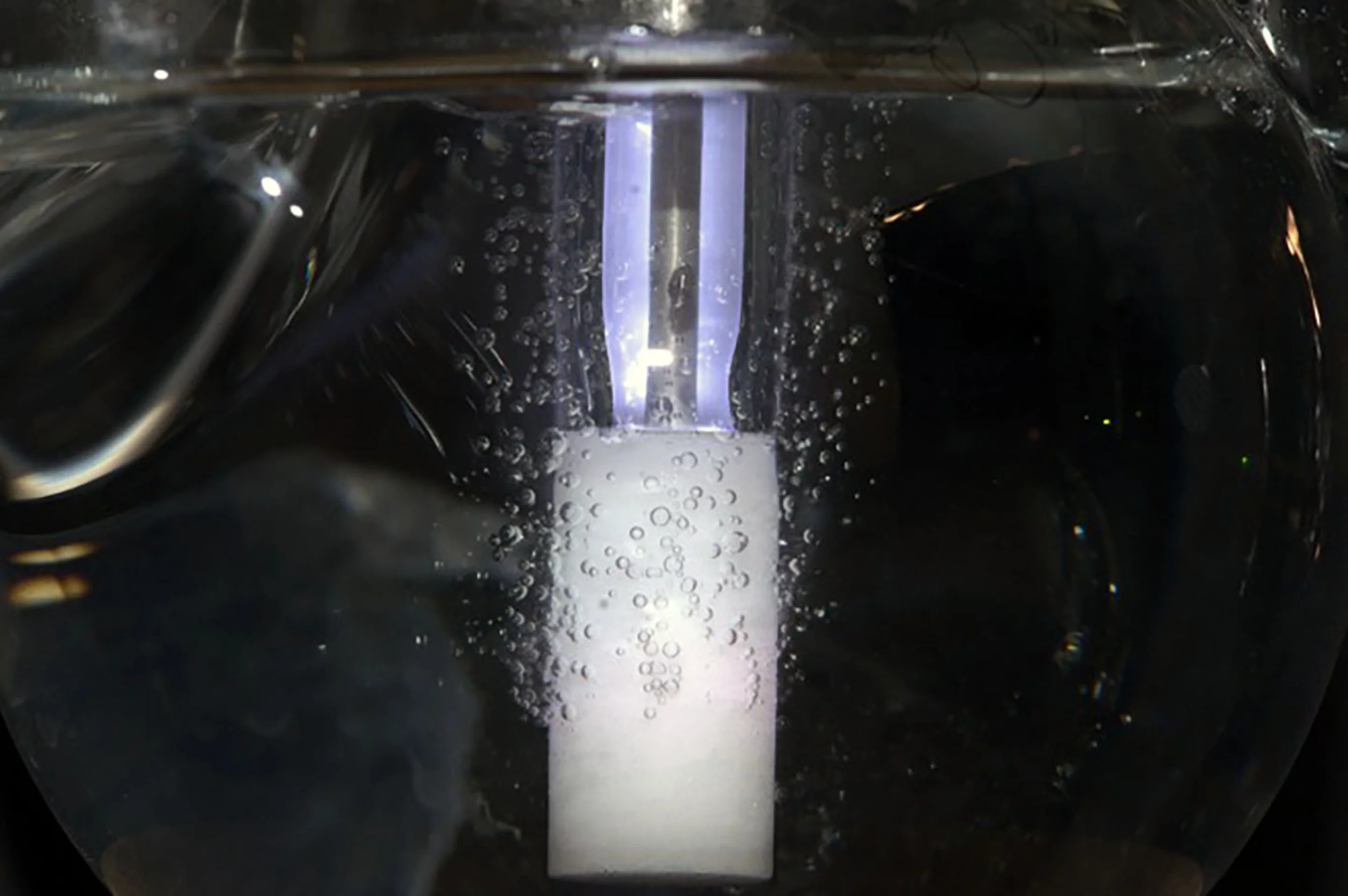
In response to these two key challenges, the Northwestern University team proposed a new system that can be called "lightning in a bottle." Instead of relying on extreme temperatures and pressures, researchers use short, high-energy electrical pulses in a reactor filled with water to create plasma - a high-energy state of matter similar to lightning - in a glass tube. Inside the reactor, methane gas is passed into a porous glass tube, and the surface of the tube wall is loaded with a copper oxide catalyst; when a high-voltage electric pulse is applied, the gas in the tube is instantly converted into plasma, causing methane and water molecules to be broken up at the same time to form highly reactive fragments.
These fragments will recombine in a very short time to form methanol, and the water in the reactor will immediately "dissolve" the generated methanol. The research team pointed out that this rapid absorption is crucial, which is equivalent to "freezing" the reaction at an ideal node to prevent methanol from continuing to be oxidized into carbon dioxide, fundamentally bypassing the over-reaction problem that is unavoidable in traditional processes.
To further improve efficiency, the team also introduced argon gas into the system. Argon is chemically extremely inert under normal conditions, but in a plasma environment it participates in reactions that help stabilize the discharge process and suppress unwanted side reactions. Under this operating condition, the selectivity of the system to methanol is significantly improved, while also producing a small amount of valuable by-products, such as hydrogen and ethylene.
Dayne Swearer, co-author of the paper, said that in addition to methanol, the system also produced ethylene and hydrogen, as well as a small amount of propane, which are themselves higher value chemicals or fuels. Ethylene is an important precursor monomer for the production of plastics, and hydrogen is a key bulk base chemical and a zero-carbon fuel. He emphasized: “We used very abundant methane gas in exchange for methanol, ethylene, hydrogen and a small amount of propane. These products themselves are more economically valuable.”
Overall, this technology is seen as an important step forward in the field of methanol production. First, it fundamentally eliminates the need for extreme temperatures and pressures, significantly reducing production costs, energy consumption and environmental footprint. Secondly, the new process compresses the original multi-stage and complicated process into an approximate one-step reaction: methane is directly converted into methanol in the same system, while minimizing useless or harmful by-products.
At present, this "lightning in a bottle" device is still at laboratory scale, but if it can be successfully scaled up in the future, it is expected to realize a distributed system for on-site conversion of methane. The researchers envision that such devices could be deployed in remote locations or locations with methane leaks to convert this abundant but highly efficient greenhouse gas directly into valuable industrial chemicals. Sweller pointed out that the current conventional method for dealing with leaked methane is to ignite it on the spot and convert the methane into carbon dioxide. Although the greenhouse effect is slightly lower than that of methane, it will still aggravate climate warming. And if the small reactor is sent directly to the source of the leak, the methane that would have been directly burned can be turned into transportable liquid fuel.
Next, the team will continue to optimize system performance and explore how to efficiently recover and separate high-purity methanol products. Relevant research results have been published in the Journal of the American Chemical Society.