Mount Etna in Sicily, Italy, is the most active volcano in Europe, but the scientific community has been difficult to explain how it was formed because traditional geological models cannot be fully applied to this volcano. The latest research from the University of Lausanne proposes a new hypothesis, arguing that Etna may not belong to the familiar plate boundary volcanoes, subduction zone volcanoes or hot spot volcanoes, but is similar to a special type of rare "petit-spot" volcano.
Mount Etna is located on the east coast of Sicily. It has a history of activity for more than 500,000 years. It has an altitude of more than 3,000 meters and erupts multiple times every year. It is one of the most intensively observed volcanoes in the world. Despite this, its origins are still only partially understood: none of the three main ignition mechanisms, namely plate splitting, subduction, and intraplate hotspots, can fully explain its magma source and chemical characteristics.
A research team from the University of Lausanne, in cooperation with Anna Rosa Corsaro of the Catania branch of the Italian National Institute of Geophysics and Volcanology (INGV), published a paper in the Journal of Geophysical Research: Solid Earth, proposing that the magma of Mount Etna was not generated by large-scale melting in the mantle before the eruption, but was continuously replenished by a small pre-existing magma "inventory" in the upper mantle over a long period of time. This magma accumulates at the top of the upper mantle about 80 kilometers from the surface, and then intermittently rises up driven by tectonic stress.
Generally speaking, the formation of volcanoes can be roughly classified into three categories: First, at plate rupture boundaries such as mid-ocean ridges, the plate separation allows the rising mantle to decompress and melt, forming new oceanic crust; second, at subduction zones, the downwardly subducting oceanic crust plates carry The water in the belt lowers the melting point of the overlying mantle, triggering melting and creating explosive volcanoes like Mount Fuji in Japan; third, within the plate, abnormally hot mantle plumes form hot spots, constructing volcanic island chains such as Hawaii and Reunion.
However, Etna "does not look like any standard answer." Although it is close to the subduction zone, its rock chemical composition is closer to hot spot volcanoes; but below it, there is no clear evidence of mantle hot spots like Hawaii. The new study points out that what's unusual about Etna is that the magma it consumes is not "smelted fresh" for each eruption, but is extruded from an existing small-volume melt pocket in the upper mantle.
The research team believes that the unusual tectonic background is one of the key factors: the African plate and the Eurasian plate continue to collide in this area, causing the plate near the subduction zone to bend, forming a series of cracks and weak zones on the plate. As the plate slowly bends, these cracks are like channels created when a compressed sponge is squeezed, allowing magma in the upper mantle to rise in batches along the cracks and build large layered volcanoes on the surface.
Based on this idea, the researchers proposed that Etna may belong to a type of "fourth volcano" that has only been recognized since 2006 - an onshore, enlarged version of the micropoint volcano. The so-called micropoint volcanoes are a type of small submarine volcano discovered by Japanese scientists in the bend zone of the deep-sea plate. Their existence shows that there are indeed scattered magma pockets at the top of the upper mantle, which can be "decompressed" into volcanoes under appropriate tectonic conditions.
Sebastien Pilet, the first author of the paper and a professor at the School of Earth Sciences and Environment at the University of Lausanne, pointed out that the formation mechanism of Etna is strikingly similar to that of these tiny submarine volcanoes, but the scale is magnified to a completely different level. In the past, micro-point volcanoes observed on the seafloor were only a few hundred meters high, but Etna is a typical large-scale stratovolcano. It began to be active about 500,000 years ago and is now more than 3,000 meters above sea level. It is a giant.
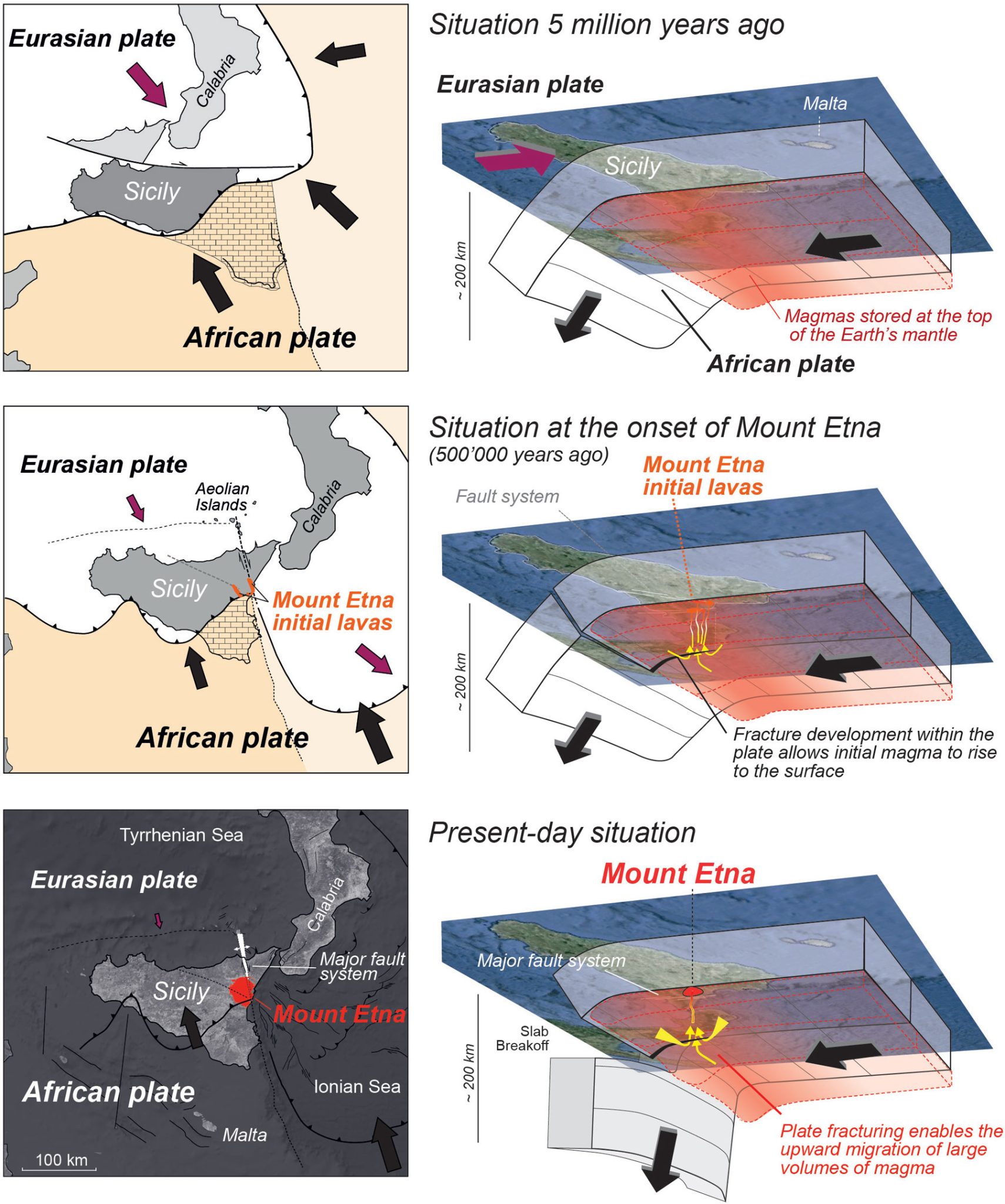
To test this new hypothesis, the research team conducted a systematic analysis of rock samples from Mount Etna during its approximately 500,000-year evolution, tracking long-term changes in the chemical composition of its lava. The results show that the chemical fingerprint of Etna magma is relatively stable, even as the surrounding tectonic environment has evolved over the long geological history. This shows that the source area that supplies magma has existed in the upper mantle for a long time, and changes in eruption intensity and volume are mainly related to plate movement and changes in fracture channels caused by it, rather than drastic changes in the deep magma source itself.
Based on this, the researchers proposed that Etna is more like a long-term "leaking" pipe, which continuously leads the magma in the low-velocity layer of the upper mantle to the surface, thereby maintaining its abnormally frequent eruptive activities. This "leaking pipeline" model mutually confirms the view of the upper mantle magma sacs reflected by micro-point volcanoes, providing a new theoretical framework for understanding the origin of volcanoes in different tectonic environments around the world.
This research not only helps to redefine Etna's position in the volcano classification map, but also provides new ideas for assessing the risks of its future activity. By more accurately characterizing the depth, scale and replenishment methods of magma reservoirs, INGV researchers in Catania are expected to introduce more realistic parameters into volcano monitoring and disaster assessment, thereby improving early warning capabilities for this super "normally open" volcano.