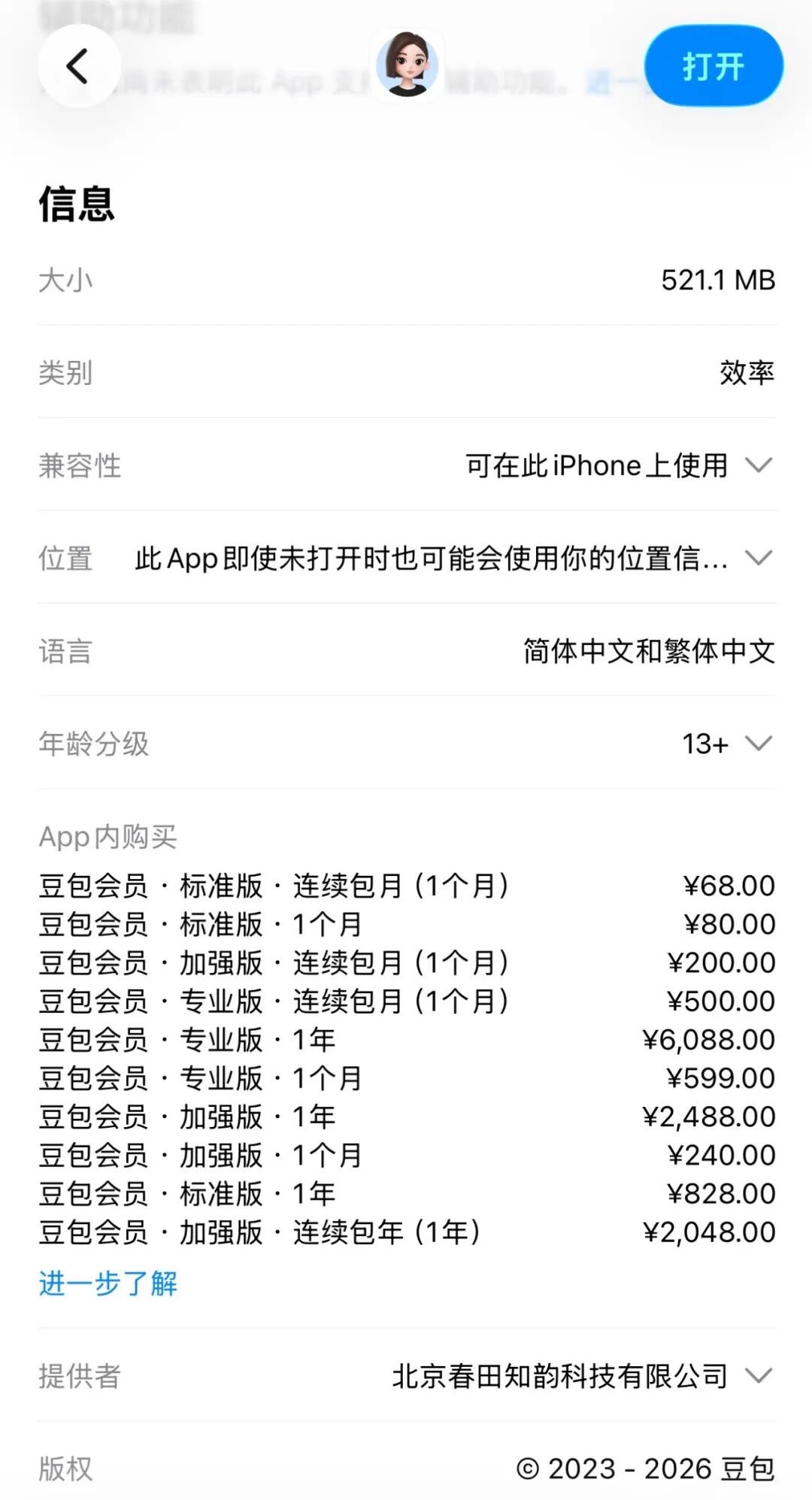
During the May Day holiday that just passed, some users discovered that Doubao has added three new paid membership subscription options on the App Store application homepage: the standard version is 80 yuan per month, the enhanced version is 200 yuan per month for continuous monthly subscription, and the professional version is 599 yuan per month, with an annual fee of 6,088 yuan. For comparison, the annual cost of ChatGPT Pro, which is also in the professional camp, is about US$2,400 (approximately RMB 16,366).

Doubao later responded that the free service will continue to be provided, and the paid version is mainly for complex tasks and productivity scenarios, and the solution is still in the testing phase. As of press time, it is not known when the paid entrance will be officially launched.

The industry’s response to this move is not uniform, but all parties have noticed a basic fact: This is the highest-priced attempt to date among domestic C-end universal AI assistant products.

The cost of computing power is the most intuitive incentive. According to data previously released by Volcano Engine, as of March 2026, the average daily Token calls of the Doubao model have exceeded 120 trillion, nearly double that of three months ago, and more than 1,000 times that of May 2024 when it was released. According to third-party reports, ByteDance’s capital expenditure in 2025 will be approximately 160 billion yuan, a large proportion of which will go to the procurement of AI computing power and infrastructure construction. This figure has been cross-verified in reports from multiple brokerages.

In a cost estimate circulated in the technology community, the hardware depreciation of a single inference accounts for about 58%, and the electricity cost is about 29%. 120 trillion daily tokens means huge hardware clusters and rising electricity bills. This cost structure makes large-scale free services unsustainable, and it is almost only a matter of time.

Doubao is not the first player to make adjustments. In February 2026, Zhipu raised the price of its GLM Coding Plan by more than 30%; in March, the price of GLM-5-Turbo API increased again by 20%; in April, GLM-5.1 continued to increase the price by 10%. Cloud vendors are also canceling discounts one after another. Tencent Cloud announced that starting from May 9, 2026, the prices of AI computing power-related products and services will increase by 5%.

DeepSeek layered the application page for the first time before the V4 model was officially launched, turning on the fast mode and expert mode. At that time, some industry insiders believed that this move was DeepSeek preparing for adjustments to the subsequent paid subscription system. However, after V4 was officially launched, it started large-scale discounts, implemented limited-time discounts on APIs, and adjusted the billing rules for cache hits.

When the largest free user pool begins to set a payment threshold, it is no longer a financial consideration of a certain company, but a collective shift in the delivery model.

Paid model, meant for productivity?

The three-level payment system launched by Doubao this time does not start with the conversation itself.

According to product page information and people close to the business, payment capabilities are concentrated in high computing consumption scenarios such as PPT generation, in-depth data analysis, and film and television production. Functions such as basic dialogue and text polishing remain free.

The logic of this design lies in user stratification. QuestMobile data shows that Doubao’s monthly active users in the first quarter of 2026 will be approximately 345 million. Among such a huge user scale, only a small part of the deep users consume a lot of computing resources, but their Token consumption is much higher than the average level. The three levels of pricing screen out these users and create a corresponding relationship between high consumption and payment.

At the same time, the free basic functions are retained, so that the vast majority of light users are not affected. This maintains Doubao’s scale and basic base as a national-level application.

From the perspective of product competition, this adjustment has another intention. For a long time, the free version to control costs has made many compromises in model version, context length and inference depth, leading to some market feedback that the upper limit of Doubao's capabilities is limited.

Previously, an AI-related practitioner from a major manufacturer told Phoenix.com that Doubao had many concerns when testing professional models. “The most intuitive difficulty is large-scale users. It is very difficult to achieve the ultimate performance and take care of a huge user base.”

But in fact, the performance of the Seed 2.0 Pro model released by ByteDance in February this year has entered the first echelon in multiple benchmark tests; the video generation model Seedance 2.0 also directly benchmarked OpenAI's Sora. One of the purposes of the paid version is to provide a delivery outlet for these technical capabilities that is not constrained by cost.

Another industry insider said to Phoenix Technology, “The current priority of computing power within Byte is on Seedance, and most innovative research must give way to Seedance.”

On the application side, the phased mission of Doubao App has been achieved. Since the AI ​​application war during the Spring Festival this year, the DAU of Doubao’s strongest competitors has dropped significantly. However, Doubao’s rise continues unabated. QuestMobile’s latest “2025 AI Application Layer Development Core Report” shows that as of December 2025, the scale of domestic AI native App monthly active users (MAU) has shown an obvious stepwise differentiation. Among them, Doubao and DeepSeek ranked first and second with monthly active scale of 226 million and 135 million respectively, forming a "duopoly" pattern and leading the entire industry in a discontinuous manner.

After March, Doubao’s DAU advantage further widened, forming a gap lead. Another industry insider stated that data from third-party platforms show that the peak DAU of Doubao has been around 150 million.

But at the same time, the QuestMobile report pointed out that the number of new users of AI applications in the first quarter showed a two-way extension trend of "sinking + silver hair". The average monthly usage of Doubao is 54.8 times, and the user activity rate is 33.5%. Both indicators are significantly higher than Qianwen and DeepSeek.

The above-mentioned industry insiders said that Doubao App basically has a lot of silver-haired and young people in the market. This is far from the current productivity scene that Doubao wants to rob. The payment model is intended to help it rob the productivity crowd.

The computing power explodes first?

To a certain extent, Doubao’s trial of payment means that the largest free player in the Chinese market has taken the initiative to calculate the cost of Token. The background will return to the consideration of Token economics.

To use a popular metaphor, the free model of AI applications in the past two years is equivalent to a water plant. Not only does it not charge water fees, but it also promises unlimited water supply, and the cost is borne entirely by the company itself. The more tokens are consumed, the faster the company's cash is burned.

But the essence of “Token economics” is the AI ​​industry’s repricing of the above-mentioned unsustainable “free water supply” model.

At this year’s GTC conference, Huang Renxun explained Token economics: Token is a new commodity. If they can obtain more capacity, they can generate more Tokens and their income will increase.

Volcan Engine President Tan Dai also made a similar statement. The price difference of Token essentially reflects the difference in capabilities. The next generation model has stronger capabilities and the cost of a single Token may rise, but the marginal economic value created will also be higher.

It can be said that Doubao’s charging attempt is a verification of this “Token economics” in the largest user pool in China.

The capital market has responded enthusiastically. On May 6, the first trading day after the holiday, the computing chip sector collectively strengthened. Haiguang Information (688041) surged in volume after the opening and hit the daily limit, with its total market value once exceeding 820 billion yuan. Cambrian (688256) rose more than 9%. In the direction of memory chips, many stocks such as Netac Technology, Longsys, Montage Technology, and Demingli have reached their daily limit or increased by more than 10%. The Science and Technology Innovation 50 Index rose sharply that day.

In this round of growth, a logic that has been mentioned repeatedly is: when the most important free players in the industry begin to establish paywalls, it means that the scarcity of AI computing is being confirmed by the price mechanism. After that, the business return expectations of hardware, cloud services, and model layers will all be repriced accordingly.

AMD CEO Su Zifeng also intuitively stated in the latest financial report conference call that the data center CPU market will expand at an annual growth rate of more than 35%, and the scale will exceed 120 billion US dollars by 2030, and there may be "extremely serious capacity shortages" in the future. AMD's stock price rose more than 16% in after-hours trading after the release of its earnings report.

Doubao is no longer an exception. The entire AI track is entering the stage of re-pricing.

The superposition of the above events in time forms a price transmission chain from the software end to the hardware end. Kaiyuan Securities stated in a research report that the number of domestic Token calls continues to break new highs, indicating that the industrial implementation of domestic AI large models is in a comprehensive advancement stage. Soochow Securities further pointed out that in the first quarter of 2026, the computing power leasing industry has seen "quantitative changes" in increasing orders and price increases, as well as "qualitative changes" in upgrading the Token-sharing business model, and thus concluded that "2026 is the first year for domestic AI computing power to be fully realized."

Volcano Engine data also shows that the number of corporate customers with cumulative Token usage exceeding one trillion has increased from about 100 at the end of 2025 to 140.

From the pricing adjustment of a national-level application to the collective rise of the chip sector, these events occurred independently, but formed a complete narrative within the same window. The free era of the AI ​​industry is undergoing a systematic contraction. Under the water, the relationship between supply and demand of computing power is undergoing fundamental changes.