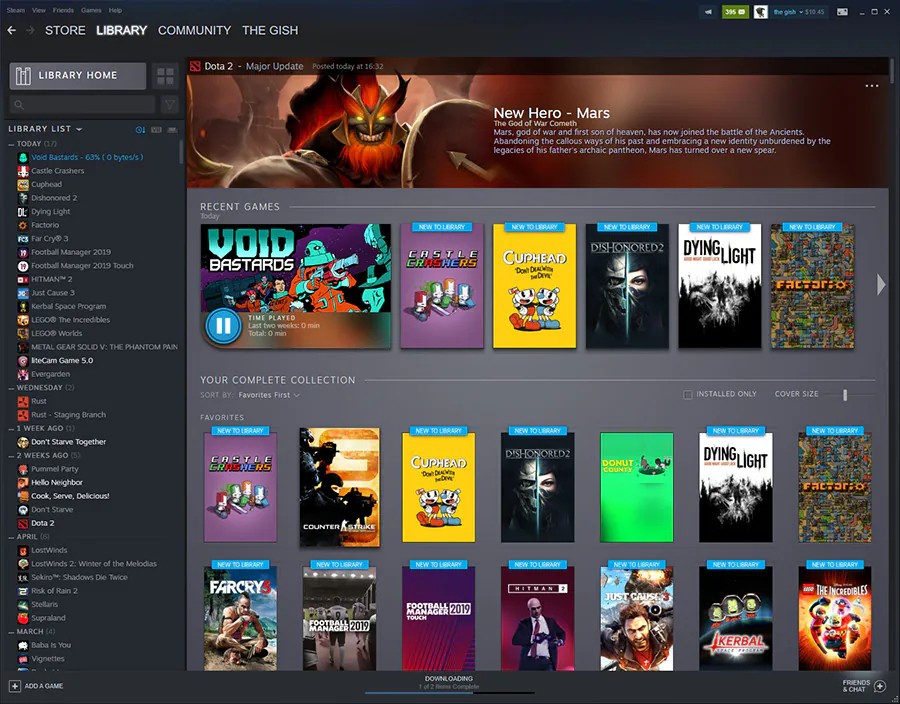
Recently, foreign media Tech4gamers published an article studying the phenomenon of "players buy more games than they play." The outlet claims that modern gamers are buying far more games than they can actually complete, and strangely this phenomenon is only growing. Large digital game libraries seem to be a badge of honor, with many gamers owning hundreds of games, most of which they almost never launch. There is much more behind this behavior than just impulsive consumption.

First of all, "game inventory backlog" has become a part of the gaming field. For today's players, the process of purchasing games has become extremely convenient, and various discounts are endless, so players can easily buy many games. In addition, game releases are also frequent, which ultimately encourages players to hoard.
Second, while buying a game provides an almost effortless and immediate hit of dopamine, starting a new game requires an investment of attention, emotion, and time. As people get older and have busy jobs, these become increasingly difficult to do. Moreover, the anticipation of a game is often more exciting than the actual experience. Players like to imagine what it would be like to play a 100-hour AAA masterpiece... Purchasing a game represents a possibility and symbolizes the future fun, relaxation, excitement and sense of accomplishment in a hobby that the player truly loves.
In addition, actually playing these games means facing various possibilities, such as the game not opening, not playing, not fun enough, too difficult, or simply not having time to complete the level, etc. So gamers choose not to face these possibilities, instead hoarding more and more games, enjoying the joy of buying them and looking forward to playing them—games they may never actually play.
There is also the membership subscription system that has completely changed players’ concept of ownership. Services like Microsoft Game Pass and Sony PlayStation Plus turn games into an endless buffet. Players no longer carefully select a game, but browse a vast game library, always feeling that there are better games waiting for them. Modern gaming culture also encourages this behavior, as digital stores are primarily designed to maximize consumption. Paradoxically, however, more choices lead to less play time.
Because when players are faced with too many choices, decision fatigue begins to set in. Rather than focusing on a single gaming experience, they tend to wander through different games and eventually give up entirely. If one part of a game bores them, modern gamers will immediately move on to another game to get that dopamine hit.
Tech4gamers said: "Ultimately, buying more games than you can play is not a bad thing. For many people, collecting games has become a hobby. Buying games can be relaxing, like visiting a bookstore or organizing a playlist. Not every game needs to prove its value by its completion in your game library. Sometimes, the satisfaction of owning an item far outweighs the joy of using it. "