Cloudflare, a network service provider, has been paying attention to the proportion of global Internet robot traffic (number of HTTP requests) to real human traffic since 2025. Originally, the company expected that the traffic generated by robots will eventually surpass humans around 2027, and then robot traffic will maintain rapid growth and leave real human traffic behind. Now the rapid adoption of AI agents is accelerating this process.
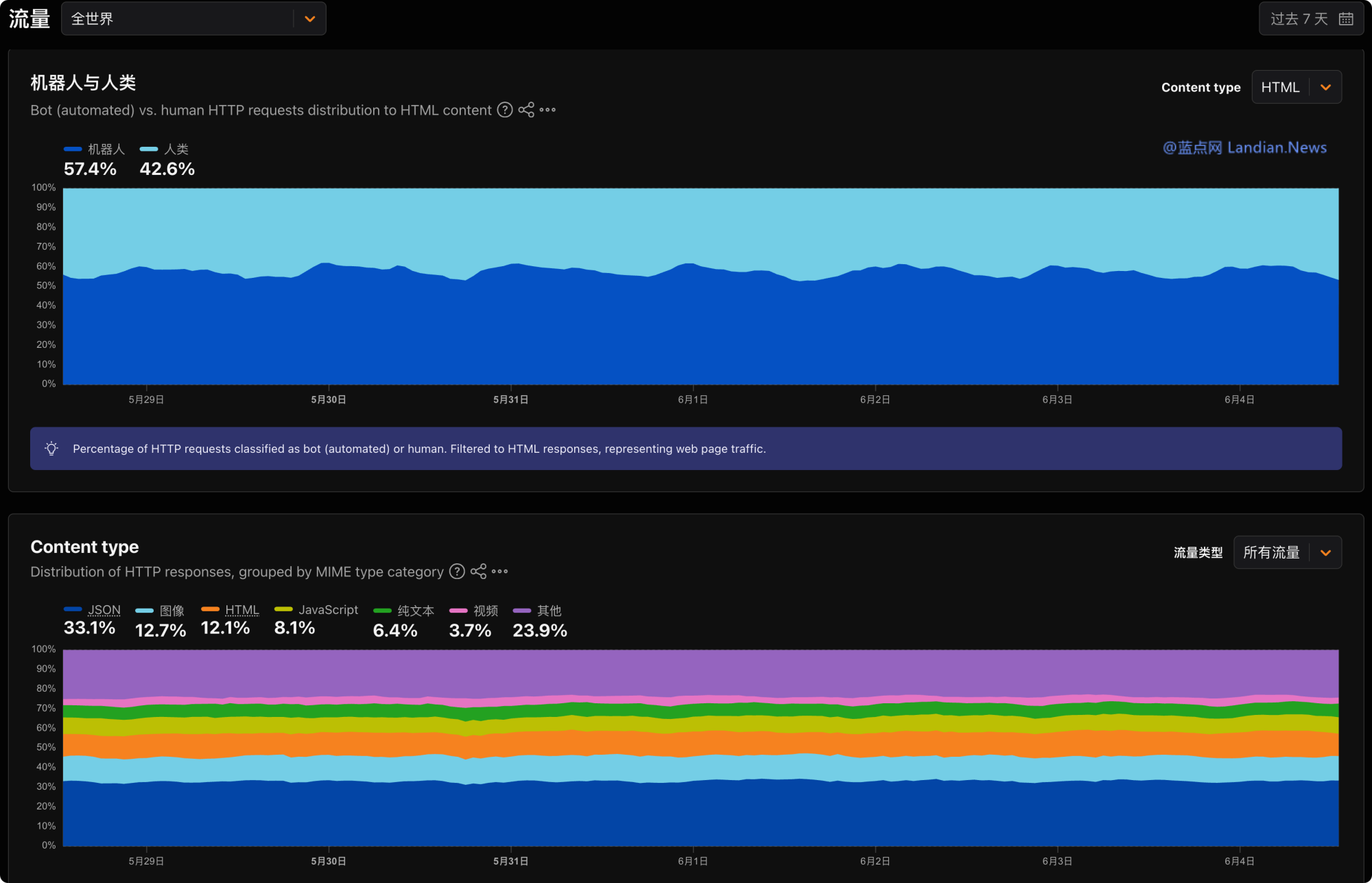
Cloudflare CEO Matthew Prince tweeted on June 4, 2026 that the traffic generated by robots has exceeded that of humans. Previously, Matthew Prince estimated that the surpassing time would be the end of 2027, and then revised the forecast to early 2027 based on data. The current data shows that in mid-2026, robot traffic has reached the historic goal of surpassing real human access traffic.
What does robot traffic include:
Robots here refer to programs run through automated scripts or codes, such as spiders used by search engines to crawl Internet content, automated programs used by security companies to scan and observe the Internet, agents based on artificial intelligence technology, etc. As long as Internet traffic is generated but not real humans performing access operations, it will be counted as a robot. Therefore, when you use AI agents to query product prices, obtain the latest information, and perform multi-step tasks, you are also generating massive amounts of robot traffic.
Cloudflare observes Internet traffic in two ways: access logs generated by websites hosted by Cloudflare, and resolution requests generated by 1.1.1.1 public DNS. Starting in 2025, Cloudflare began to classify traffic based on visitor attributes (robots or humans), but due to the lack of previous data, it is impossible to go back too far to compare data.
Cloudflare Radar radar observation data shows that the proportion of traffic (number of HTTP requests) generated by robots reaches 57.5%, while the proportion of traffic generated by real humans is 42.5%. It is unclear when robot traffic and human traffic will reach the balance point of 50%, because Cloudflare's data is a bit confusing and the specific time cannot be determined yet.
But the real traffic consumed is humans:
The traffic mentioned above refers to the number of HTTP requests, not the conventional traffic such as GB. Calculated according to conventional traffic, the traffic generated by real humans is much higher than that of robots. The reason is that Internet videos consume a lot of traffic when watching videos, and robots are more inclined to crawl text and structured content. The traffic generated by this part of content is relatively not very high, so in the short term, if calculated according to conventional traffic, robot traffic should not exceed that of real humans.
Interestingly, according to statistics obtained by Cloudflare Radar, the area with the most robot traffic is the island of Gibraltar, followed by Singapore. These areas have a large number of data centers and hosting infrastructure, so both the number of robot HTTP requests issued and the received HTTP requests generated by robots from local or other regions are very high.