The Space Exploration Technology Company (SpaceX) owned by the world's richest man, Elon Musk, launched an IPO promotion to investors. On June 4, local time, SpaceX officially released a 17-minute roadshow video. SpaceX Chief Financial Officer Brad Johnson reviewed the company's rocket, satellite and artificial intelligence businesses in the video, and reiterated that SpaceX's original intention was to "reform human development and promote human beings to become a multi-planetary species."

"We are essentially an infrastructure builder. We are the only company in the world that is building an integrated infrastructure of software and hardware to provide power support for multiple businesses." Johnson mentioned.


On June 3, SpaceX announced the price of its initial public offering at US$135 per share, with approximately 556 million new shares issued, raising a total of approximately US$75 billion. The company is valued at approximately US$1.77 trillion, making it the largest IPO in history.

Starship’s cost advantage is “unparalleled”

According to the video, SpaceX started in 2002, and its foundation is the aerospace business. It has "achieved what others thought was impossible and turned the impossible into reality." In 2008, SpaceX became the first private company to develop and launch a liquid-fuel rocket into orbit, with the product Falcon 1; in 2012, it became the first private company to successfully dock a spacecraft with the International Space Station; in 2015, For the first time in the world, the rocket body was recovered and landed from space power; in 2017, it was the first to reuse an orbital-stage rocket booster for another launch; in 2020, SpaceX became the first private company to send astronauts into orbit and fly to the International Space Station.

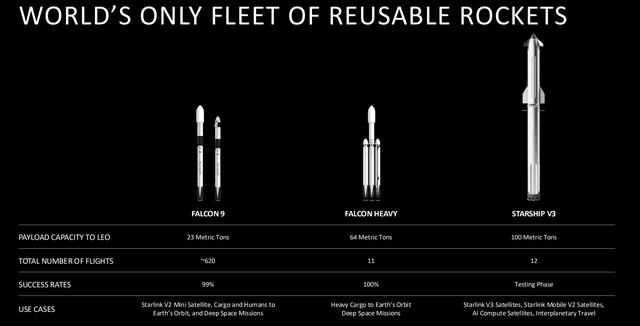
Today, SpaceX's reuse technology has developed from the recovery of one sub-stage of the Falcon rocket to the reuse of the entire rocket of the starship; the Falcon 9 has a transport capacity of 23 tons, the Falcon Heavy has a transport capacity of 64 tons, and the third-generation starship transport capacity will soon reach 100 tons.


"From the perspective of rocket reuse, recycling technology is the key to breaking the situation, significantly reducing launch costs and increasing the total number of launches. We have a large number of rockets for launch customers to choose from. Last year alone, Falcon 9 completed 165 launches. Now starships are moving towards full reuse. From a cost perspective, starships have unparalleled advantages." Johnson said.

In addition to the cost advantage, the starship transportation capacity has also been greatly improved: Falcon 9 and Falcon Heavy are respectively 23 tons and 64 tons. The third-generation starship is about to exceed 100 tons. The fourth-generation starship is in the design stage, and the planned transportation capacity has doubled again to 200 tons of orbital transportation capacity.


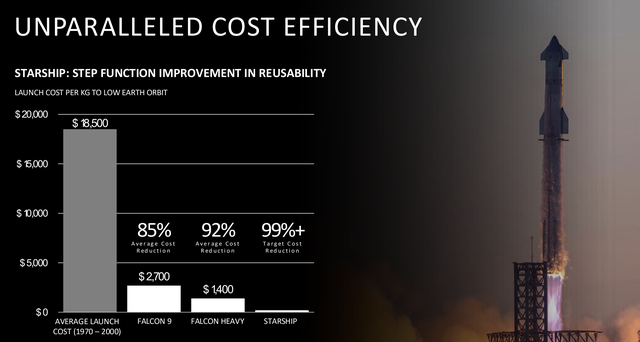
The cost calculation chart released by SpaceX shows that in terms of unit payload launch costs in low-Earth orbit, the average cost of the global aerospace industry from 1970 to 2000 was US$18,500 per kilogram; relying on one-stage recovery and reuse technology, Hunter The Eagle 9 can reduce the cost to US$2,700/kg, an 85% reduction from the historical average. The Falcon Heavy has further dropped to US$1,400/kg, a 92% reduction. As for the starship with a full rocket reusability, its target cost reduction is over 99%.

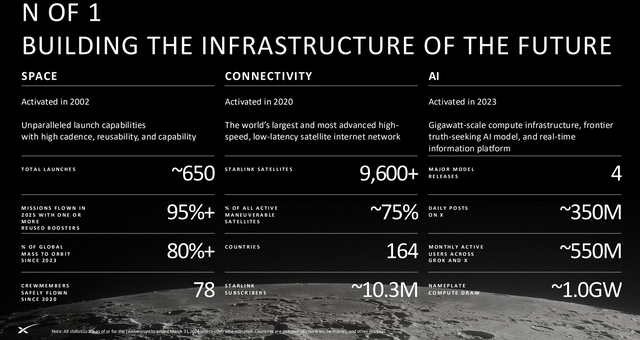
In terms of satellites, the video introduces that Starlink has the world's largest satellite Internet cluster, and the number of controllable maneuverable satellites in orbit accounts for 75% of the world's total number of similar satellites. The number of users has grown rapidly, reaching 4.4 million at the end of 2024, rising to 8.9 million last year, and exceeding 10.3 million in the first quarter of this year. Its business has been launched in 164 countries and regions, covering a population of more than 3 billion.

Calling the artificial intelligence business “a clear closed loop of commercialization”

In terms of artificial intelligence business, Johnson said that this business follows the mature business model of aerospace and Starlink, relying on top launch capabilities to open up the entire industry chain, and self-developed large models to retain full-link revenue.

SpaceX has built the Colossus supercomputing data center, equipped with NVIDIA GB200 and GB300 high-end AI chips in batches, and launched the world's first gigawatt-level AI training cluster. It is also equipped with a gigawatt-level Megapack energy storage power station. Large-scale hardware deployment has formed the core barrier of the company's computing power.

The company plans to launch an on-orbit space AI computing power project in the next few years: relying on satellite solar power generation and natural space radiation heat dissipation, on-orbit computing power can significantly reduce daily operation and maintenance costs and solve the pain points of limited power supply and cooling resources in ground data centers.

With mature aerospace technology reserves such as self-developed ion propulsion systems, inter-satellite laser interconnection links, spaceborne computers, and reaction flywheels, SpaceX has become the only company in the industry that has the conditions to implement distributed computing power in space in the short term.

Johnson emphasized that the company's AI commercialization closed loop is clear: relying on its own aerospace infrastructure to build a computing power base, continuously iteratively optimizing large models, compressing unit computing power costs, realizing revenue through external leasing of computing power, and operating income to feed back the investment in computing power and self-developed model research and development. At present, there has been substantial progress in commercialization: it has signed a contract with Anthropic to open supercomputing resources to host the other party's large models; it has also cooperated with Cursor to optimize large self-developed code models with its own computing power. While leasing computing power to external parties, the company continues to increase its own research and development of general-purpose large models.

The potential market space for enterprise AI business exceeds US$20 trillion

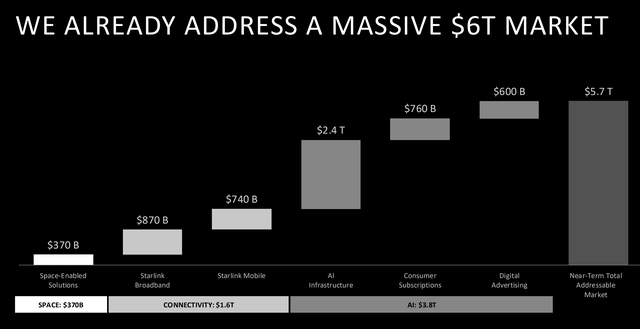
Looking forward to the prospects, Johnson said that the company has targeted the three major tracks of space, computing power, and AI, with a total reachable market size of approximately US$6 trillion; in the long run, the potential market space for enterprise AI business exceeds US$20 trillion. In addition to its current main business, the company's mid- and long-term plans cover cross-regional space point-to-point transportation, space intelligent manufacturing, asteroid resource mining, and lunar industrial development. According to the project rhythm, it plans to achieve manned moon landings in the next few years and build a supporting system for long-term sustainable operation of the moon.

Previously, SpaceX estimated in its prospectus that its potential market size is as high as US$28.5 trillion. It is expected that more than 90% of the market will come from the AI ​​field, and the vast majority of it may come from enterprise AI (Enterprise AI).


He mentioned that the group’s total capital expenditure in the past two years was US$21 billion, with most of the funds invested in AI business. He emphasized that relying on the computing power hosting cooperation with Anthropic, the AI ​​sector has already generated revenue.

The prospectus shows that from 2023 to 2025, SpaceX achieved revenue of US$10.387 billion, US$14.015 billion, and US$18.674 billion respectively. Operating profits during the same period were -US$3.505 billion, US$466 million, and -US$2.589 billion, respectively, and net profits were -US$4.628 billion, US$791 million, and -US$4.937 billion respectively. In the first three months of 2026, the company achieved revenue of US$4.694 billion, a year-on-year increase of 15.4%; during the same period, it had an operating loss of US$1.943 billion and a net loss of US$4.276 billion, which was almost equal to the level of last year.

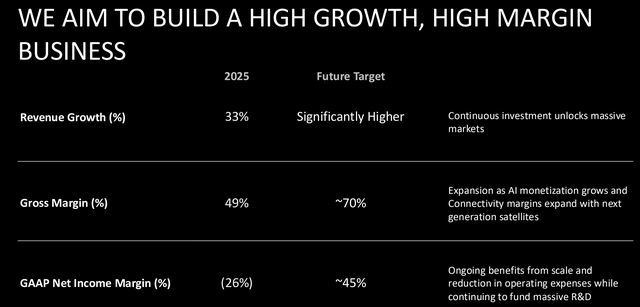
Johnson said that from a long-term perspective, the company's subsequent revenue growth is expected to further increase. The forward gross profit margin is expected to reach 70% (last year was 49%), and the GAAP net profit margin is about 45%. However, he did not give a detailed timeframe for this goal.