The HDMI Forum recently officially released the new generation HDMI 2.2 interface standard, bringing up to 96 Gbps bandwidth, but the first batch of devices that fully support this standard are not expected to be officially launched until 2027.
The HDMI 2.2 interface was first announced at CES in 2026. Compared with HDMI 2.1, the maximum bandwidth doubles from 48 Gbps to 96 Gbps, even exceeding the current DP 2.1 specification. The new standard provides higher throughput through an upgraded fixed-rate link (FRL) transmission mode, leaving sufficient redundancy for future ultra-high-resolution, high-refresh-rate display devices and, ideally, reducing reliance on display stream compression (DSC).
According to reports, new products that can truly unleash the 96 Gbps bandwidth, including the highly anticipated next-generation RDNA 5 GPU that is expected to support HDMI 2.2, will not be launched until 2027. Rob Tobias, CEO and president of the HDMI Authorization Authority, said in an interview with ARMdevices that chip manufacturers are expected to start production and provide FRL2-related silicon samples this year, and it will not be until next year that terminal products labeled HDMI 2.2 will appear on the market.
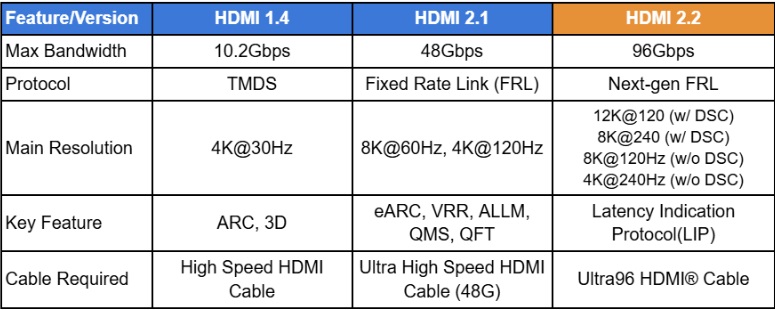
In terms of specific specifications, HDMI 2.2 is designed to support high-end display configurations such as 4K 240Hz and 8K 60Hz full-color sampling, and is mainly targeted at enthusiast-level gaming monitors, professional video production equipment, and immersive VR applications. At the same time, the HDMI Forum also launched a new cable certification program "Ultra96". In order to unlock the full 96 Gbps bandwidth of HDMI 2.2 in the future, users need to use Ultra96 certified cables with compatible devices.
From the perspective of development pace, the implementation pace of HDMI 2.2 continues the "slow-heat" path of the previous generation standard. Although HDMI 2.1 was released as early as 2017, it will be a few years before it is widely used in mainstream consumer monitors and TVs. Now, the HDMI 2.2 standard has been finalized, but the fully supported terminal ecosystem still needs time to follow up, and the market and players will have to wait patiently for a period of time.