Astronomers used the Atacama Large Millimeter/submillimeter Array (ALMA) and the gravitational lensing effect to track the source of a high-energy neutrino event and unexpectedly discovered a distant galaxy with deep dust that had been hidden in the universe for a long time. This galaxy is named JCMT0402−0424 and is about 11 billion light-years away from the Earth. The research team gave it a more vivid nickname-"Shadow Blaster".
Initially, people thought that its energy came from a supermassive black hole, but the latest observations show that what really drives its activity may be extremely violent star formation.
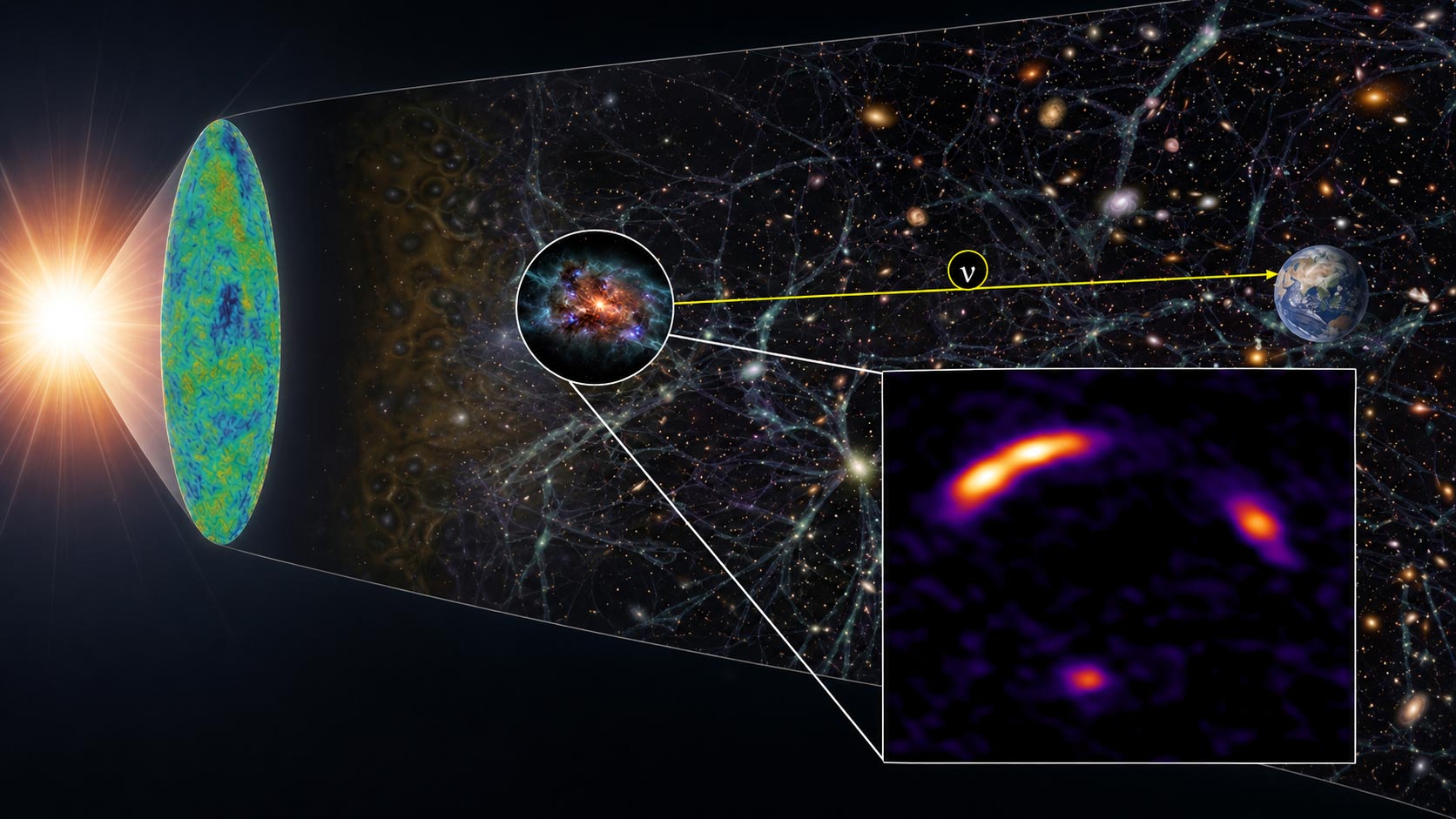
The discovery is directly related to a high-energy neutrino event called IC 210922A. The event was first detected by the IceCube neutrino observatory in Antarctica, and then an international research team from multiple institutions carried out follow-up observations in the hope of finding the celestial source of the neutrinos. Most of the few known sources of neutrinos in the past were related to supermassive black holes, but their numbers were too small to explain the large number of high-energy neutrinos that astronomers have detected in the universe.
To further confirm the source of the signal, researchers used ALMA and other telescopes to observe Shadow Blaster. The galaxy is almost completely obscured by dust in visible light, but is unusually bright at submillimeter wavelengths and has therefore been under-identified. More importantly, there happens to be another galaxy between the Earth and this galaxy. This foreground galaxy acts as a "gravitational lens", bending and amplifying radio waves from the distance, which is equivalent to providing astronomers with a natural telescope.
Using this natural magnification effect, the research team was able to examine the Shadow Blaster's internal structure in greater detail. The results show that there are no signs of high-energy radiation associated with typical supermassive black holes in the interior of the galaxy. Instead, they point to another explanation: the gas and dust here are likely to be heated by unusually strong star formation activities. The researchers further discovered that there is a highly dense "compact core" at the center of the galaxy, with a large amount of gas and dust compressed within an area of about 1,500 light-years. This extremely dense environment is one of the ideal conditions for the production of high-energy neutrinos.
The research team believes that this result provides a new direction for understanding the source of high-energy neutrinos in the universe. In the past, supermassive black holes were generally regarded as the main producers of neutrinos, but the emergence of Shadow Blaster shows that compact galaxies with rich dust and active stellar explosions may also be important sources. Researchers estimate that such galaxies may be able to contribute a significant portion of the high-energy neutrino background in the universe, perhaps up to close to 20%.
This research also provides new clues to the long-standing question of "where do high-energy neutrinos in the universe come from?" If follow-up observations continue to confirm this conclusion, then the astronomical community's understanding of the source of neutrinos will no longer be limited to black hole-dominated models, but will need to incorporate hidden galaxies with violent star formation into the core explanatory framework. This is undoubtedly an important advancement for modern astrophysics, and it also shows that galaxies obscured by dust and difficult to observe directly may hold the key to solving the deep mysteries of the universe.