The U.S. Space Force recently announced that it has officially received a new generation of ground-based anti-satellite weapon system code-named "Meadowlands" and incorporated it into the active equipment sequence. This system uses high-power electromagnetic beams to "blind", "disrupt" and suppress enemy orbital targets, showing that the U.S. Space Force already has battlefield offensive and defensive capabilities similar to other military services.
The U.S. Space Force Combat Force Command completed the operational installation of the "Prairie Zone" Counter Communications System (CCS) on June 8, 2026. The system was developed by L3 Harris Technology Company under the "Combat Mission System Support" framework. The space electromagnetic warfare force "Space Delta 3 (DEL 3)" is responsible for the actual operation. The subsequent procurement and support of the system will be carried out by the "System Detachment 89" (Delta 89) assumes the responsibility, and plans to form a complete scale of about 32 units in the future.
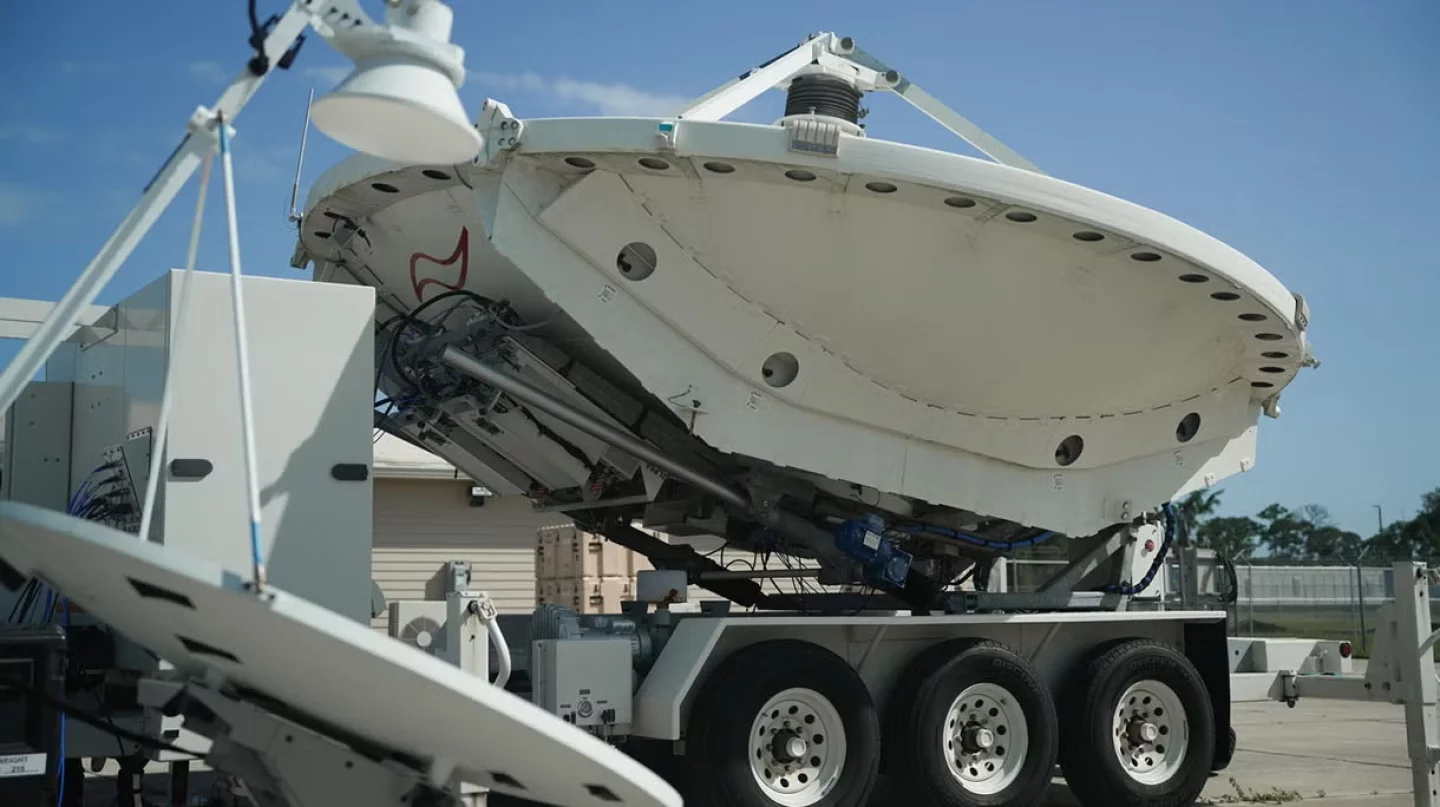
"Prairie Zone" adopts a wheeled trailer platform, and the entire container-type cabin is installed on the trailer. It can be airlifted by a C-130 "Hercules" tactical transport aircraft or larger transport aircraft, and has high mobility deployment capabilities. The core configuration of the system includes a multi-band, dual-polarized satellite communication antenna and supporting low-noise amplifier, power amplifier and antenna photonic unit. The overall volume and weight are significantly reduced. Compared with the CCS Block 10.2 "legacy system" used by the Space Force in 2020, which originally required 23 transport boxes to complete the transition, it has now been reduced to 7 transport boxes to complete the deployment of the entire system.
As a set of anti-satellite systems specifically targeting orbital targets, the main task of "Steppe Zone" is to carry out electromagnetic strikes against enemy satellites and other on-orbit assets, not through kinetic energy destruction, but through the generation of electromagnetic interference with "reversible effects" to weaken or interrupt the functions of target satellites, thereby avoiding the creation of orbital debris. In terms of uplinks, the system transmits high-power directional countermeasures signals to enemy satellite receiving antennas, interfering with the satellite's receiving control instructions from the ground, blocking its acquisition of key telemetry data and various business data flows, and making the satellite "disabled" at the level of command and mission execution.
On the downlink, "Grassland Zone" can also emit interference signals in the direction of ground stations, terminals or mobile users, suppress enemy tactical communication links, data downlink channels, and rely on satellites' real-time picture and intelligence transmission capabilities, thereby implementing electromagnetic "blockade" within the theater. In addition, the system also has the ability to "spoof", which can simulate the complex waveforms of military or commercial satellite networks, send disguised signals to enemy satellites and ground receiving equipment, tamper with or pollute data packets, cause the automatic receiving and processing system to produce an error response, and even trigger a destructive feedback process until the target link completely loses effective communication.
Even more covertly, the "steppe zone" can also establish an electromagnetic "silence zone" over a specific geographical area by continuously suppressing early warning, reconnaissance or tracking satellites, making it difficult for the enemy to obtain radar detection results and satellite early warning information in a timely manner. This capability can create an "electromagnetic stealth corridor" for various friendly platforms to enter a certain airspace or sea area, and perform infiltration or strike missions under the condition that the enemy's surveillance system is almost completely disabled.
Official public information shows that this electromagnetic "quiet zone" capability has been intuitively demonstrated in "Operation Midnight Hammer" on June 22, 2025. In this large-scale joint operation, the U.S. Central Command, in close coordination with the U.S. Strategic Command, the U.S. Space Command, and the Space Force, implemented electromagnetic warfare operations to conduct electronic suppression of a large area over Iran and create a huge "silent zone." Under this cover, seven B-2 "Phantom" stealth bombers departed from Whiteman Air Force Base in Missouri and carried out a 36-hour long-range strike mission. Together with a total of 125 fighter aircraft of various types (including F-22 "Raptor", F-35 "Lightning II", F-15, F-16, etc.) and "Tomahawk" cruise missiles launched by US Navy submarines, they carried out precision strikes on multiple suspected nuclear weapons research and development facilities and caused serious damage.
With the "Prairie Zone" system formally forming operational capabilities, the U.S. Space Force's practical toolbox in the fields of electromagnetic warfare and counter-space operations has been further expanded, extending from traditional satellite communication suppression to refined intervention in enemy space assets and overall shaping of the electromagnetic environment in the theater. Judging from the technical path and application mode of the system, the United States is trying to achieve "soft kill" and "system paralysis" of enemy space systems through reversible electromagnetic effects while avoiding creating space debris and directly destroying satellites. This also indicates that competition on the future space battlefield will focus more on precision electromagnetic countermeasures and networked space combat capabilities.