Astronomers have recently used the ages of more than 155,000 stars in the Milky Way to independently estimate the age of the universe. The results show that the universe is at least about 13.7 billion years old, providing new and strong evidence for the currently widely accepted "standard age of the universe" of about 13.8 billion years. Relevant research was submitted to the preprint platform arXiv on July 1, further pointing to the following: Solving the "Hubble tension" problem that has troubled the cosmological community for many years may require finding the answer in the "late universe" rather than overturning the entire standard cosmological model.
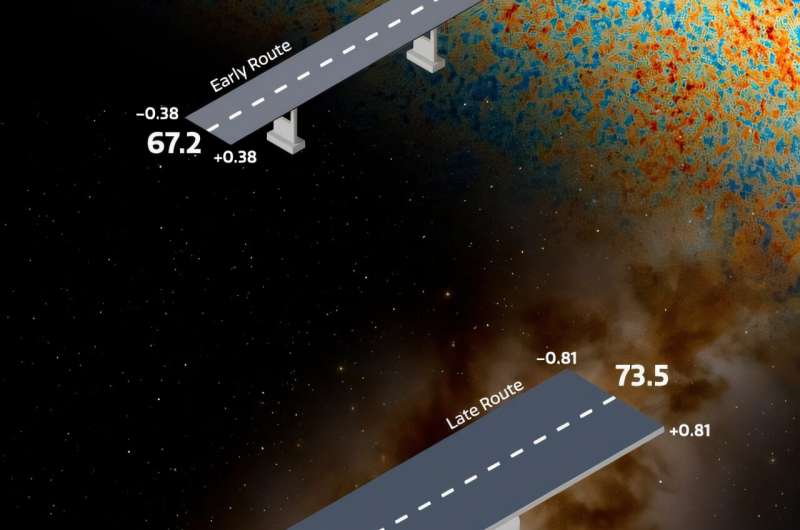
The determination of the age of the universe is closely related to the so-called "Hubble tension". There are currently two main ways to measure the expansion rate of the universe (i.e. Hubble constant): One is to use the "afterglow" of the Big Bang - the cosmic microwave background radiation (CMB) to estimate the expansion history of the universe under the assumption of the Standard Cosmological Model (ΛCDM) , obtaining an approximate age of the universe of 13.8 billion years; the other relies on direct observations of the local universe, including "standard candles" such as Cepheid variables and supernovae, and gives a higher expansion rate, corresponding to a universe age of only about 12.5 billion to 12.9 billion years. The difference in the value of the Hubble constant between the two methods is about 9%. This "mismatch" is called the "Hubble tension".
This new study was led by Indranil Banik of the University of Portsmouth, UK. The team did not start with the overall cosmological model, but turned to the oldest stars in the Milky Way, treating them as "fossils" that record the early history of the universe. The research team pointed out that if a star with a history of about 13 billion years can be found, the actual age of the universe must be larger, because the formation of stars after the Big Bang also takes a certain amount of time.
In specific work, the team first selected 247,103 so-called "subgiants" as samples. This type of star has just left the main sequence star stage, and its internal structure and evolutionary stage make it easier to accurately estimate its age. These stellar data come from China's Guo Shoujing Telescope (LAMOST) and the European Gaia survey project. The researchers screened out objects that did not meet the characteristics of "typical old stars" through chemical composition screening, and combined them with another set of independent methods for cross-checking, and finally obtained a "refined sample" of 155,600 stars.
By analyzing these oldest and extremely long-lived stars in the Milky Way, the research team found that the oldest star among them is about 13.73 billion years old, with a statistical uncertainty of about plus 18 million years and minus 15 million years. If we also consider that the stars themselves took about 200 million years to form after the Big Bang, then this result is highly consistent with the age of the universe of about 13.8 billion years predicted by the standard cosmological model combined with cosmic microwave background observations. This value is also quite consistent with previous results based on other old stars and globular clusters.
It is worth noting that the research team also emphasized that the current results are still limited by uncertainties in many aspects, including the number of samples, quality screening criteria, stellar evolution model assumptions, star formation time scales, and theoretical predictions themselves. Each factor will roughly bring an upper limit of error of about 150 million to 200 million years. Therefore, improving any one link alone will be difficult to make a "leap-forward" improvement in the accuracy of determining the age of the universe in the short term.
Despite these sources of error, the new estimate of the minimum age of the universe is still significantly higher than the 12.5 to 12.9 billion years that would be obtained by simply extrapolating the local expansion rate to nearly the entire history of the universe. This means that if the "Hubble tension" has its roots in new physics, it is more likely that it only took effect at some later time in the history of the universe, rather than dominating the overall evolution of the universe from the beginning.
The research team pointed out that this may imply that the expansion method of the universe has changed in some way over the past billions of years, or that there are special characteristics in the local environment of the universe we live in, such as large-scale holes, causing the locally observed expansion rate to be "artificially elevated." The paper writes that based on the existing evidence, the so-called "late universe scheme" is increasingly becoming one of the strong candidates to explain the Hubble tension; another possibility is that we are in a huge local under-density region (void), causing the locally measured expansion rate to be higher.
This work was submitted to the arXiv preprint platform under the title "Estimating the age of the universe using a large sample of the oldest stars in the Milky Way", adding a vote from the "stellar clock" to the ongoing discussion surrounding the age of the universe and the debate over the Hubble constant. For researchers who aim to defend the standard cosmological model, the new results are undoubtedly a shot in the arm; but to completely resolve the "cosmic problem" of Hubble tension, multiple observations and theoretical work from the early and late universe will still be needed in the future.