At this moment, history was rewritten. On July 23, Beijing time, the Fields Medal, known as the “Nobel Prize in Mathematics,” was announced. Chinese mathematician and University of Chicago professor Deng Yu won the award for his groundbreaking proof of Hilbert's sixth problem. Together with Wang Hong, who is also a 2007 alumnus of the School of Mathematical Sciences of Peking University, he achieved the "zero" breakthrough for Chinese scholars in this award.
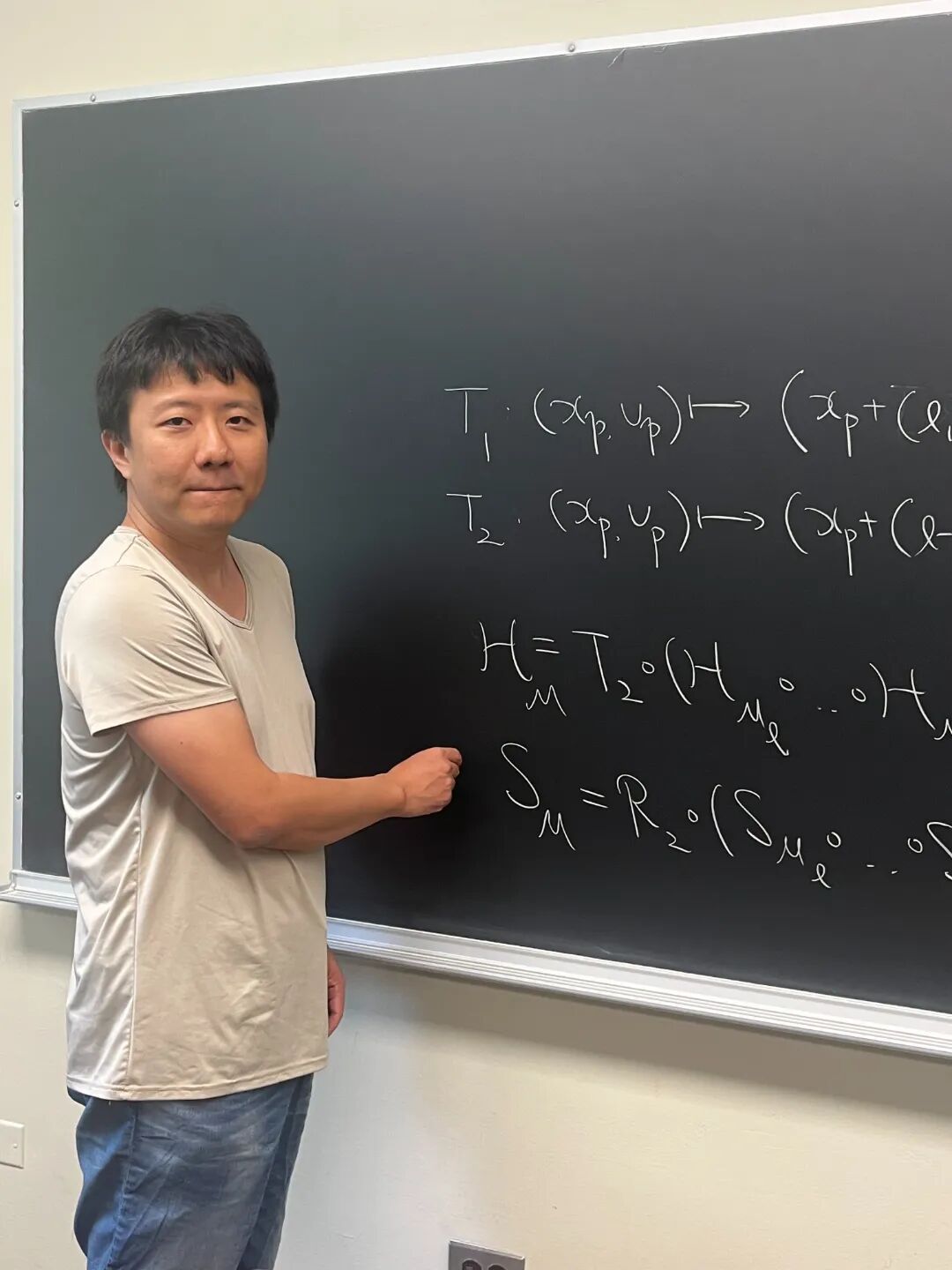
"I am very happy to receive this honor. I am very honored that my name can be listed after many masters whom I have admired for a long time. This is not only a recognition for myself, but also for my work and research field. No matter what happens in the future, I can continue to move forward in the journey of mathematics." Deng Yu said in an exclusive interview with a reporter from Science and Technology Daily.
"It's natural to be happy when your research results are recognized, but you can't do research just to win awards. Some work doesn't win awards, but it may not be unimportant. You still have to focus on the direction you like and challenge big problems." He added.
It was this almost stubborn determination that brought him to the podium of the Fields Medal.
Challenging a Century-old Mathematics Problem
In 1900, the German mathematician David Hilbert proposed 23 of the most important mathematical problems at the International Congress of Mathematicians in Paris. Among them, the sixth
To put it simply, we hope that physics can be like Euclidean geometry, based on a few logical and self-consistent axioms, and all physical laws can be systematically derived through rigorous mathematical reasoning. "Of course, this goal is too ambitious. The specific issue Hilbert was focused on at the time was actually the derivation of macroscopic fluid equations from the motion laws of microscopic particles." Deng Yu explained.
Under certain conditions, this problem can be broken down into two steps: first, starting from the Newtonian dynamic equation that describes the motion of microscopic particles, deriving the Boltzmann equation at the mesoscopic scale; then starting from the Boltzmann equation, deriving the macroscopic fluid dynamics equation. Over the past 100 years, mathematicians have basically clarified the second step, but the first step has always stagnated.
The difficulty is that Newton's laws of motion are reversible, but Boltzmann's equation is irreversible. How to evolve from a time-reversible mechanical mechanical system to a time-irreversible thermodynamic system? This problem has long troubled the mathematical community.
In 1975, American mathematician Oscar Lanford rigorously proved for the first time that the Boltzmann equation could be derived from Newton's dynamic equations in a sufficiently short time scale. In the nearly half a century since then, many important works have appeared on the research on Hilbert's sixth problem, but there has been no substantial progress in the step from short-term generalization to long-term.
"Lanford built the first mathematical bridge from micro to macro, but the 'length' of this bridge is limited," said Deng Yu. "What we did is to extend this bridge to any long time."

How difficult was the research process? Deng Yu thought for a while and said: "The difficulty is not to suddenly come up with a clever trick, but to find the bad items that can be offset while retaining the good items in an extremely complex combination. This kind of deduction often takes dozens of pages, and every step must be accurate."
In the end, Deng Yu, together with his collaborators Zaher Hani, a professor at the University of Michigan, and Ma Xiao, a postdoctoral fellow at the University of Michigan, devised a complex "cutting algorithm" - decomposing a long time into several short time intervals, and then summarizing these intervals to find the key breakthrough.
In August 2024, they rigorously proved the derivation from Newton's dynamic equations to Boltzmann's equation for the first time under long-term conditions, providing a complete framework for Hilbert's sixth problem.
Teamwork is not a one-man show
This groundbreaking work began with a chance encounter.
At the end of 2018, at an academic conference, Deng Yu, who was studying the stochastic initial value theory of the dispersion equation, met Hani. Hani asked him a question about the derivation of wave mechanics equations, which happened to fall at the intersection of probability and partial differential equations. This was exactly the direction that Deng Yu was interested in.
To this end, from 2018 to 2023, they gradually built a complete framework for dealing with the long-term limit of the wave mechanics equation. In December 2022, at a conference in New York, Deng Yu met Ma Xiao, a fellow junior at Princeton University. "After chatting for a while, I found that he has a deep understanding of our work." He immediately invited Ma Xiao to join the team. "Facts have proven that this is an extremely correct decision. Without him joining us, we would have taken many more detours."
The real inspiration comes from a very ordinary lunch. In the fall of 2021, Deng Yu visited Brown University. At that time, he had just completed a short-term result and was thinking about how to generalize it to the long term. While eating fried chicken that day, a thought suddenly flashed through his mind - what would happen if the short time τ was pushed to 2τ? A rough architecture diagram emerges immediately. He used a noon time to form a clear overall idea.
"Of course, it took a long time to conduct subsequent specific verification, but I thought of several key points from the beginning." Deng Yu said.
Nearly three years passed between the fried chicken lunch and the final completion of the thesis. In the spring of 2023, the team migrated the mature framework in the wave mechanics equations to the Boltzmann equation, but the technical details are completely different and a new set of combined estimates needs to be developed from scratch.
"Most of my mathematical research is in collaboration with others." He said that he is not suitable "
There’s “no age limit” for doing math
In July 2026, the World Cup was in full swing, and Deng Yu’s circle of friends kept up with the pace of the event. Two years ago, even in the final sprint of his thesis, he did not miss the European Cup. At that time, he was in seclusion at his home in Shenzhen. He basically didn't go out for several days. He kept several boxes of Red Bull at home. He wrote articles during the day, and when he was tired, he would watch football to relieve his fatigue. “I did forget to eat and sleep in the last few weeks, but the overall state is still relaxed,” he said.

This relaxation stems from one obsession - to do what you truly love. A set of "One Hundred Thousand Whys" opened his door to mathematics when he was in elementary school. He won the gold medal in the International Mathematical Olympiad at the age of 16, and was recommended to the School of Mathematical Sciences of Peking University at the age of 17. Mathematics occupied most of his time, and he enjoyed it. "If there comes a time when I'm sure I can only do mediocre math, I'll leave. But until then, be willing to keep trying."
He admitted that the road to scientific research is not always smooth. Some papers have gone through a review period of four to five years. "It is impossible not to be anxious, but we are confident in our work." What was even more difficult was that from 2017 to 2018, the postdoctoral research was coming to an end. Because the papers he published before were relatively niche, he encountered obstacles in finding a job. "I couldn't get any offers for a long time." For this reason, he even considered switching careers to Wall Street to work in finance. "But because I love mathematics so much, I feel that I haven't despaired of myself yet, so I can try again." In the end, the University of Southern California gave him a chance.
The Fields Medal has an upper age limit of 40 years, and mathematics is often regarded as a "precocious" subject. When asked if he had ever had anxiety due to his age, Deng Yu responded simply: "Never, mathematics is not track and field, and there is no age limit." He mentioned that one of his favorite mathematicians, Sergiu Klainerman, did important work before he was 40 years old, and made equally important results at the age of 60. Now he is still doing research in his 70s.
Deng Yu said that they have only completed a key step in proving Hilbert's sixth problem, and are still far from completely solving this problem. Now, he has set his sights on the fluid limit of high-density gases and unsolved problems in quantum field theory. “We have some new tools and hopefully can solve more things.”
"Thinking and solving problems have been integrated into life, and there is no need to deliberately distinguish between work and leisure." He said. This is probably the most ideal state for a mathematician - patiently dismantling in the "no man's land", remaining determined in the silence, until a certain moment, the bad term