On July 24, 2006, a blockbuster transaction occurred in the chip industry that could go down in history - Advanced Micro Devices (AMD) officially announced the acquisition of graphics card giant ATI Technologies for approximately US$5.4 billion. At the time, the deal was widely viewed by the outside world as a highly risky "giant gamble," putting AMD directly on the opposite side of the two chip giants, Intel and Nvidia. However, twenty years later, it turns out that it was this strategic merger that completely rewritten AMD's development trajectory and established its current dominance in multiple cutting-edge computing fields.
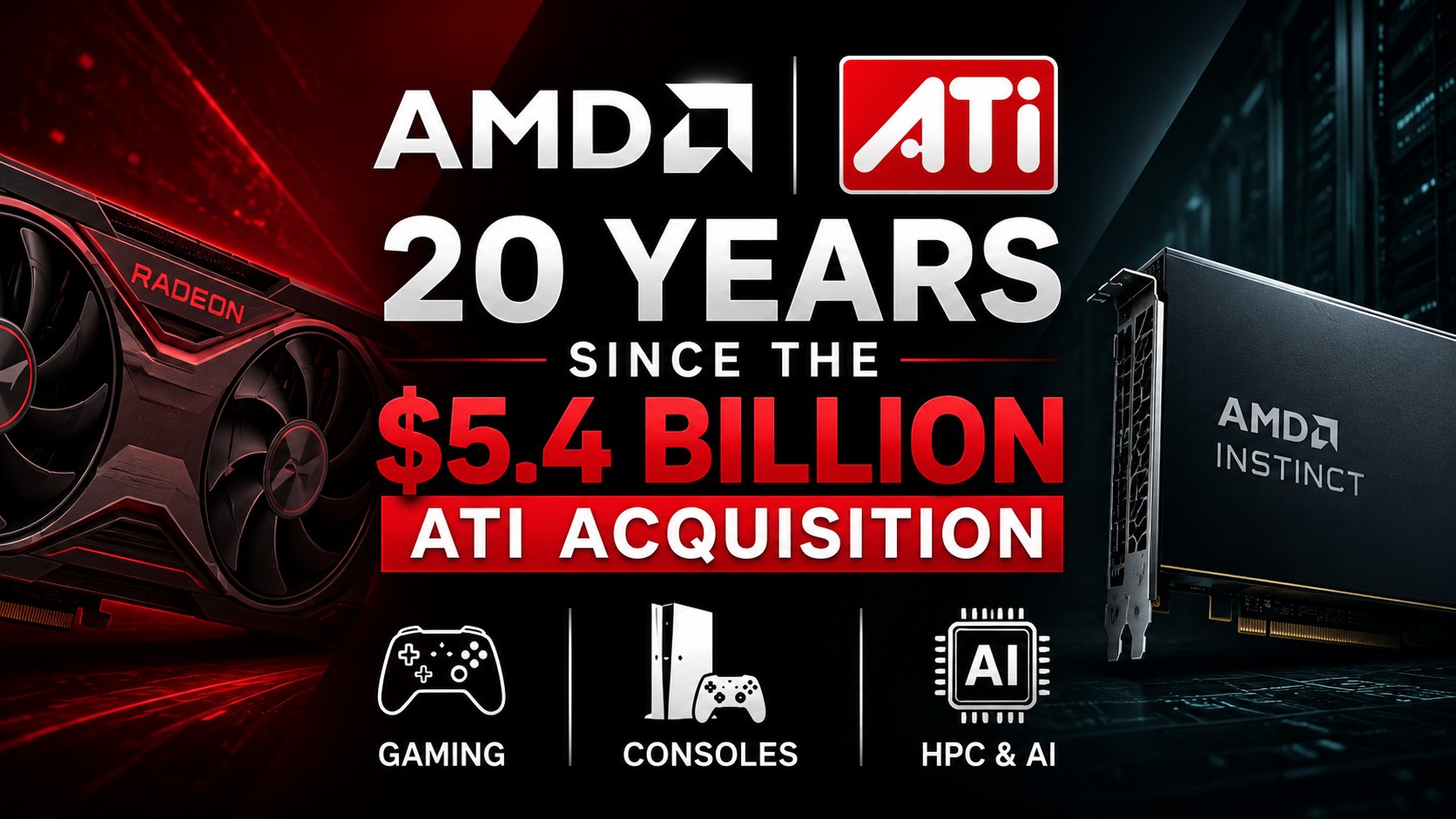
Before the acquisition, AMD's business was mainly focused on central processing units (CPUs), while ATI was the leader in the graphics processing unit (GPU) industry along with Nvidia. Through the annexation of ATI, AMD not only acquired the famous Radeon (Sapphire/Raywind) graphics card brand, but also directly inherited the top graphics technology accumulated by ATI for decades. Although the ATI brand completed its historical mission and retired in 2010, its technical genes have become the core cornerstone of all Radeon graphics products since then.
More profoundly, this merger broke the barriers of traditional chip architecture and opened a new era of deep integration of CPU and GPU. AMD used this to pioneer the fusion processor (APU), which integrated the computing core and graphics core on a single chip, completely changing the internal form of personal computers. Today, AMD still maintains its industry leadership in APU and integrated graphics.
In addition to being Nvidia's strongest competitor in the desktop graphics card market for a long time, ATI's technology accumulation also shines in the game console and hardware ecosystem. From Sony's PlayStation to Microsoft's Xbox to the current hot handheld game consoles, the "heart" of almost most mainstream devices uses AMD's custom chips that integrate Zen architecture and Radeon graphics technology.
Not only that, the acquisition of ATI 20 years ago also paved the way for AMD's explosion in the artificial intelligence wave. Based on ATI's technology accumulation, AMD has successfully created the Instinct series of accelerators designed specifically for high-performance computing and AI workloads, becoming the core force against Nvidia's data center GPUs in the current cloud computing provider and enterprise server markets.
Looking back twenty years later, AMD's acquisition of ATI is not just a simple graphics card business transaction, but a strategic transformation that has profoundly reshaped the semiconductor industry. From Radeon graphics cards to game consoles to today's AI computing accelerators, this $5.4 billion deal finally pushed AMD from a pure CPU manufacturer to a full-stack computing giant.