
Abstract:
Apple recently updated its Mac mini product line and launched a new model equipped with M6 chip. Unlike previous updates, which were usually updated during the autumn Mac release cycle, this time the Mac mini was updated ahead of schedule before the new iPhone launch event, and directly jumped from M4 to M6, rather than the M5 version that the outside world may have expected.
The new M6 Mac mini continues the miniaturized body design launched in the M4 generation, with basically no changes in appearance size, weight and interface layout. Both generations of products use an aluminum metal body that is 5 inches square and 2 inches high, and weighs the same 1.5 pounds. The front panel continues to be equipped with two USB-C interfaces with a maximum speed of 10Gbps and a 3.5mm headphone jack for easy connection of commonly used peripherals; the power button is still located in the bottom corner of the fuselage.
Core upgrades focus on internal hardware. The M4 version of Mac mini uses a 10-core CPU, consisting of 4 performance cores and 6 energy efficiency cores, and is equipped with a 10-core GPU and a 16-core neural network engine. The M6 version has been upgraded to the M6 chip based on the 2-nanometer process, equipped with a 12-core CPU, including 2 super cores, 4 performance cores and 6 energy efficiency cores; the GPU has also been increased to 12 cores.
Apple claims that the M6 chip brings “the world’s fastest single-thread performance.” In terms of graphics and AI computing, each core of the new 12-core GPU incorporates a neural accelerator. This design has previously appeared in the M5 chip and is designed to improve the processing efficiency of tasks such as machine learning and generative AI. According to data released by Apple, the peak AI computing power of the M6 GPU can be up to 4 times that of the M4, and the graphics performance can be increased up to 2 times.
The neural network engine has also become the focus of this update. The M4 uses a 16-core neural network engine, while the M6 uses dual 16-core neural network engines, doubling the number of cores. Apple said that the new architecture can bring about twice the performance of the previous generation of neural network engines; when processing large language model prompt words in LM Studio, combined with the GPU neural accelerator, the speed can be up to 4.8 times that of M4. This means the M6 Mac mini will be better suited for running AI models locally, performing end-side inference, or processing machine learning workloads.
In terms of memory configuration, the M6 Mac mini offers 16GB, 24GB and 32GB unified memory versions. The M4 Mac mini initially offered the same three gears, but Apple scaled back some of its high-end configurations in May this year, and the 32GB option was canceled for a time. Now the 32GB memory specification has returned on the M6 model.
In addition to capacity selection, the unified memory bandwidth has also been increased from 120GB/s of M4 to 170GB/s of M6. For users running large AI models locally, higher bandwidth means more efficient data transfer between CPU, GPU and neural network engine, helping to shorten end-side inference time.
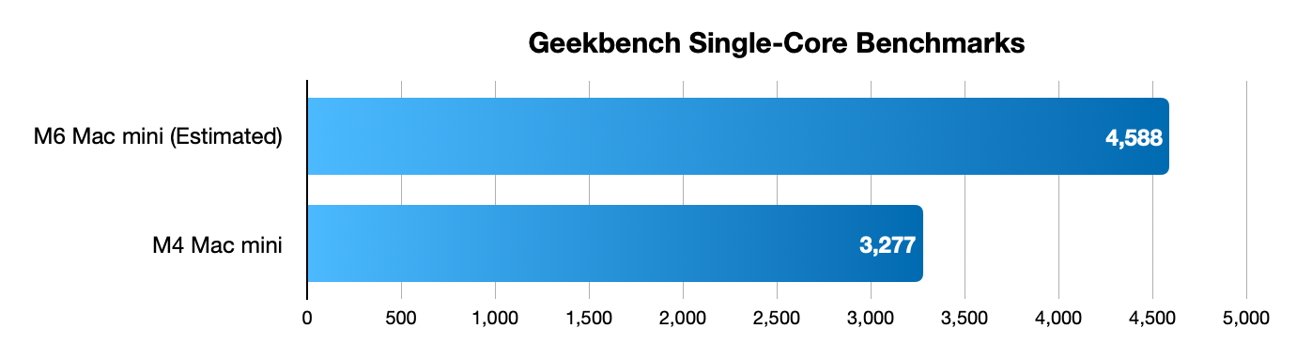
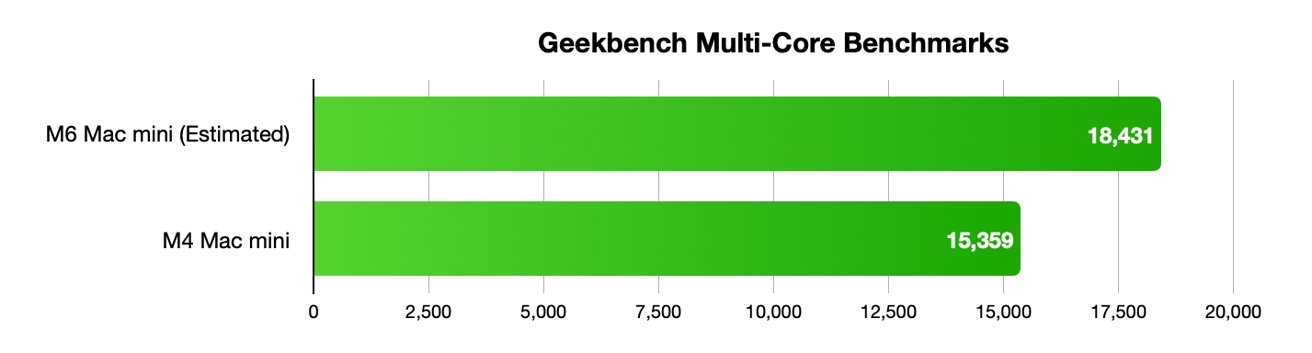
Currently, the third-party running scores of the M6 Mac mini have not been announced, so the actual performance remains to be verified. According to Apple, the CPU performance of the M6 is up to 40% faster than the M4, and multi-threading performance is improved up to 1.2 times. Based on the M4 Mac mini's single-core score of 3,277 points in Geekbench 7, the M6 may theoretically reach about 4,590 points; the multi-core score may increase from about 15,359 points to 18,431 points. It should be pointed out that these values are based on Apple’s claimed improvement ratio estimates and are not publicly available actual measurement results.
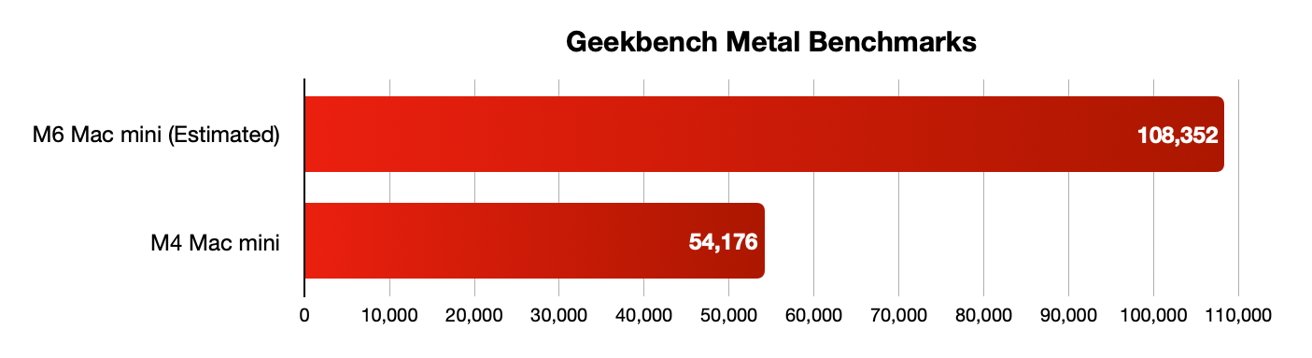
In terms of GPU, the Geekbench Metal score of the M4 Mac mini is about 54176 points. If the M6 does achieve twice the graphics performance, the Metal benchmark score of the new machine can theoretically exceed 100,000 points, which is close to the level of the Mac mini equipped with the M4 Pro chip. The final performance still needs to be confirmed by actual testing after the M6 model is launched.
In terms of interface configuration, the M6 Mac mini continues to provide HDMI, three Thunderbolt 4 interfaces, two front USB-C interfaces and a front 3.5mm headphone jack. Thunderbolt 5 is still reserved for the higher-end Pro series models. Ethernet has been improved: the M4 basic version is equipped with Gigabit Ethernet, and can be upgraded to 10Gb Ethernet for a fee; the M6 basic version uses 2.5Gb Ethernet, and 10Gb Ethernet is also optional.
The wireless connection specifications have also been updated, and the M6 Mac mini has been upgraded from the M4’s Wi-Fi 6E and Bluetooth 5.3 to Wi-Fi 7 and Bluetooth 6. The display output capability is further enhanced: the new machine can still be connected to three external monitors at the same time, including two 6K 60Hz monitors or two 4K 165Hz monitors, plus a 5K 60Hz Thunderbolt monitor or a 4K 60Hz HDMI monitor.
In certain combinations, the M6 Mac mini can also be connected to an 8K 60Hz, 5K 120Hz or 4K 240Hz display via Thunderbolt, and paired with a second 5K 60Hz Thunderbolt display or 4K 60Hz HDMI display. Apple has also added support for connecting two external displays with a single Thunderbolt port and introduced variable refresh rate support.
Price is one of the most obvious changes in the new generation of Mac mini. When the M4 Mac mini was released, the base model with 16GB of unified memory, 256GB SSD and Gigabit Ethernet started at $599; while the starting price of the M6 Mac mini with the same memory and storage specifications has risen to $899, an increase of $300.
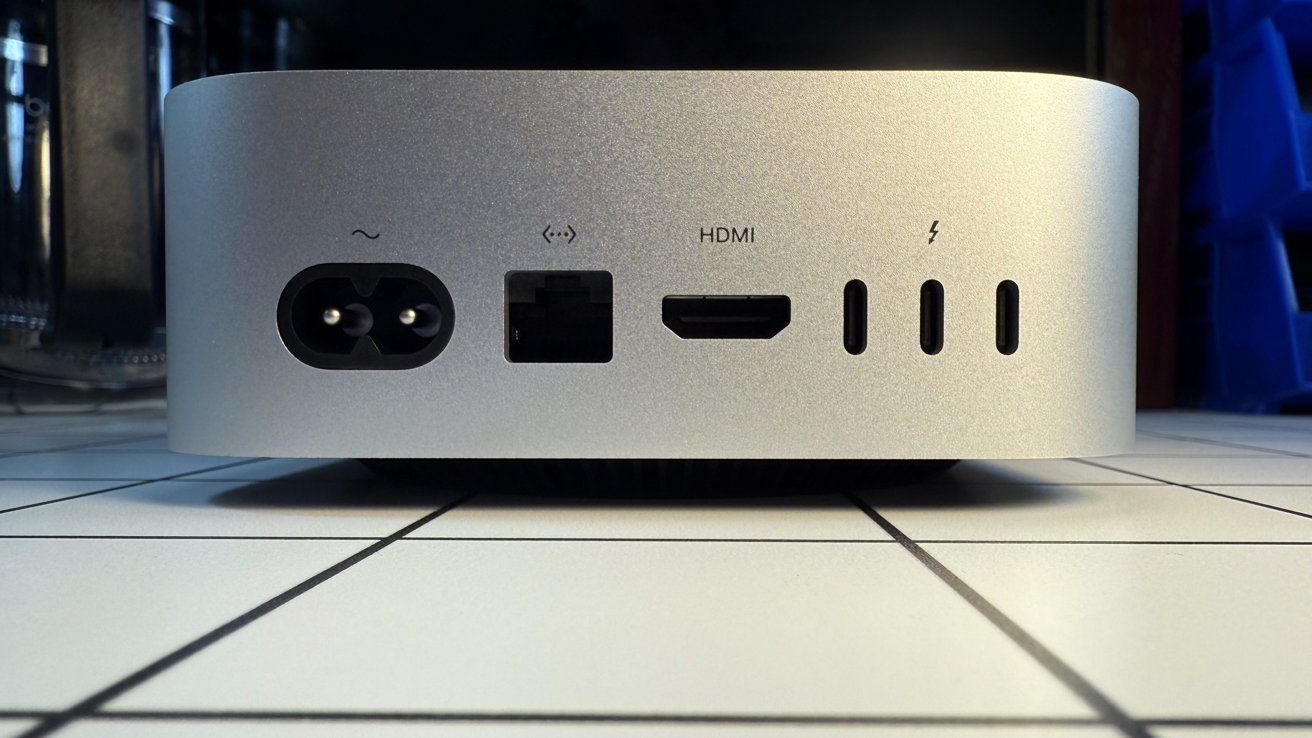
The memory upgrade price remains unchanged: an increase of US$200 is required to upgrade from 16GB to 24GB, and an additional US$200 is required to upgrade to 32GB. The cost of storage upgrades has increased. Upgrading from 256GB to 512GB still costs $200, but upgrading to 1TB costs an additional $300, and upgrading to 2TB costs an additional $500. The 10Gb Ethernet upgrade price is still $100. As for whether the new machine will continue to use a removable SSD design and whether it will be convenient for third-party upgrades, there is currently no clear information.
Generally speaking, the M6 Mac mini is not an appearance-centered update, but an internal upgrade centered around the processor, graphics performance, AI computing power, memory bandwidth and network connection specifications. For users who are buying a Mac mini for the first time or upgrading from an earlier model, the new model is obviously more attractive; even for M4 Mac mini users, if they often run local large models, engage in AI inference, graphics processing, or high-performance computing tasks, the M6 version may constitute an upgrade worth considering. For users who mainly do web browsing, office work, and light creation, the M4 Mac mini still has a high cost performance.
Comments