
Abstract:
A recent total solar eclipse not only brought a shocking observation experience, but also produced a rare visual effect that is scientifically interesting. During a total solar eclipse, the "corona" of the Sun's outer atmosphere usually takes on a white or pearly light hue, and some observers did see this familiar light-colored corona during last week's eclipse. However, in Spain, many observers witnessed a completely different scene - the corona took on a distinct golden color.
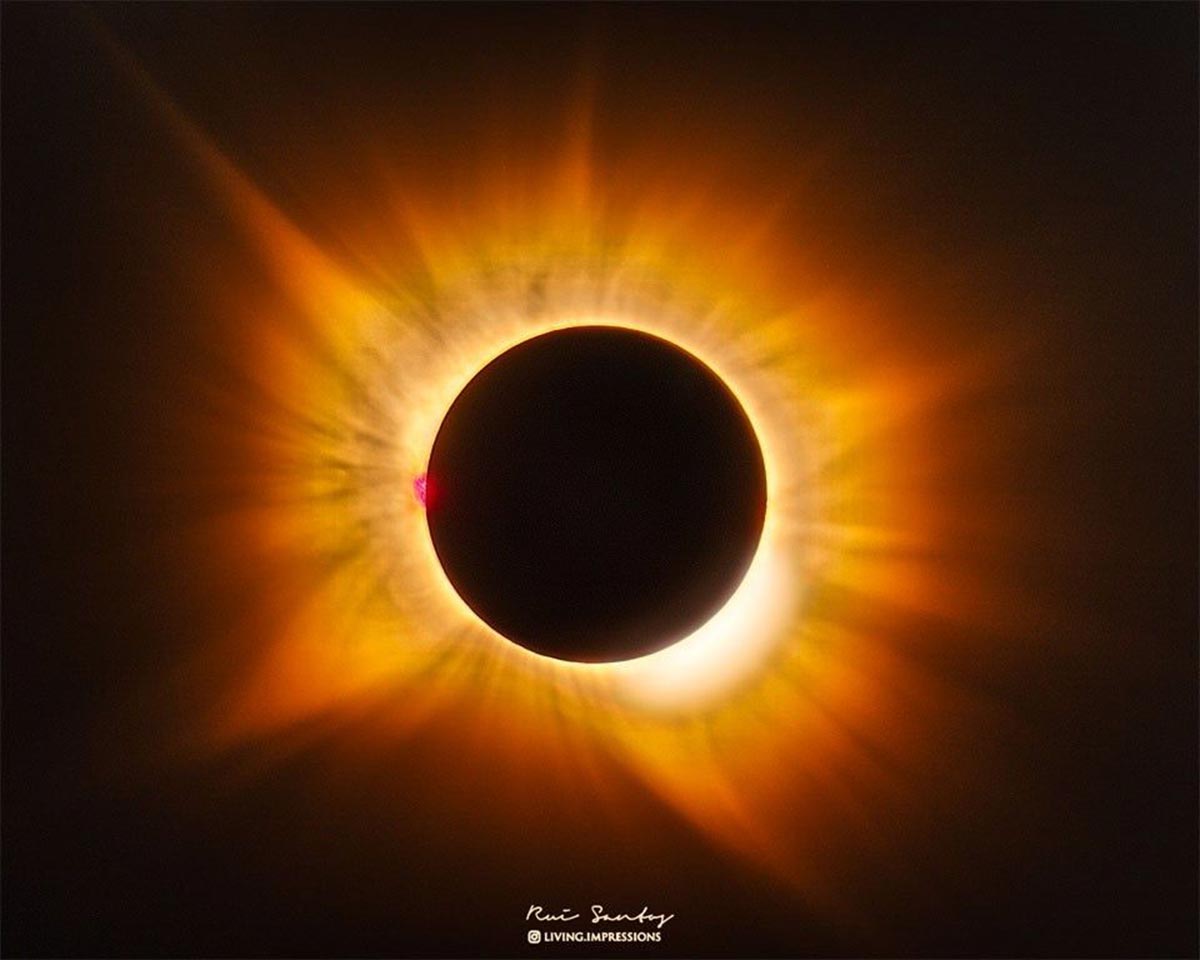
The primary reason for this phenomenon is the position of the sun at that time. In Spain, the total solar eclipse occurs when the sun is close to the horizon and during sunset. When sunlight passes through the atmosphere at such a low angle of incidence, it travels through a much longer path through the air than when the Sun is high in the sky. Molecules in the atmosphere scatter shorter wavelengths of visible light, especially blue light, which is responsible for the reddish-orange hue of the sunset.
In addition, there is another factor exacerbating the effect - the local air is unusually thick with smoke from nearby forest fires, which acts like an extra atmospheric filter. The smoke further scatters the remaining blue wavelengths of light, causing visible light to become increasingly dominated by warm golden tones.
This iconic photo, processed with high dynamic range (HDR) and composed of multiple exposures, was taken last week in Benavente, Spain. HDR imaging technology combines multiple exposure images taken at different brightnesses so that both darker and brighter details in the picture can be clearly presented in the same image.
It is worth noting that not all the scenes surrounding the solar eclipse are tinted with the same golden color. There is a hydrogen-glow prominence suspended on the left edge of the sun - this is a huge high-temperature plasma structure extending outward from the sun's surface. It still maintains its original bright pink color, forming a strong visual contrast with the golden corona.
Comments