
Abstract:
Recently, according to feedback from many users on social media, when updating the DeepSeek mobile application or using the web version, an unprecedented change has appeared in the dialogue interface: after each round of Q&A, the system will generate a details card clearly listing the number of Tokens consumed for this interaction and the corresponding amount estimate. Since the specific tariff is clearly marked on the card, some users interpret it as a signal that DeepSeek is about to start charging.
The personal daily chat service is still free. The essence of this grayscale test is to present the API billing caliber, which was originally only for developers, in the form of cost visualization to ordinary users. Although the meter has been calculated in advance, DeepSeek is not charging for the time being.
A round of dialogue costs 0.02 yuan, and DeepSeek has started "metering"
At first, some users triggered this grayscale function after updating to version 2.10.0 on Android.
After a regular round of Chinese conversation, a button that had not existed before appeared in the lower right corner of the interface. After clicking, the details page that popped up showed: the input part was split into two dimensions: "cache hit" and "cache miss", which listed the unit price, usage and converted amount respectively; the output part was calculated separately according to another unit price. The percentage progress occupied by the current context is also marked at the bottom of the page.
ifeng.com Technology noticed that
the word "free" is still marked in a prominent position on the card
. Taking a round of short Q&A as an example, the estimated amount only appears as a non-zero number in the second decimal place, which is far lower than the smallest unit of account in conventional payment scenarios. This means that the original intention of the design of this function is not to initiate deductions from users, but to make the computing power overhead behind each round of dialogue perceptible.Regarding the amount of money that appears on the interface,
ifeng Technology compared DeepSeek’s official API pricing document and found that its estimation caliber is completely consistent with the V4.1-Flash model price system for developers.
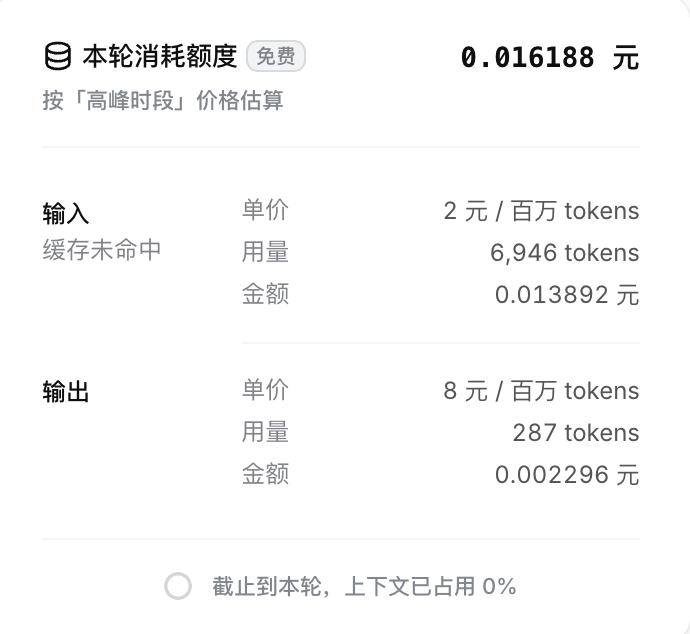
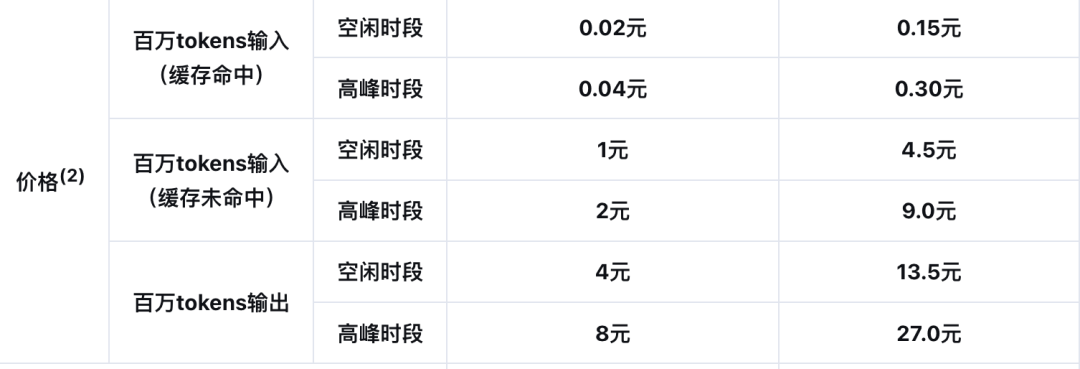
Picture | The left is the usage prompt of the free dialogue interface for ordinary users, and the right is the API price
During peak hours on weekdays, the input cache miss portion is 2 yuan/million Tokens, and the output portion is 8 yuan/million Tokens. A very simple question to DeepSeek shows that it consumes 0.02 yuan.
No charge announcement, limited grayscale range
As of press time, no announcement or recharge entrance has been found on DeepSeek’s official website, developer documents, and public social media accounts regarding the launch of charging for individual user chat services. The billing rules stated on the official API pricing page are still clearly applicable to developer calling scenarios.
The grayscale function has attracted widespread attention, which is not unrelated to the time of its launch. In mid-November, DeepSeek made adjustments to the conversation quota for free users,
including limiting the continuation of extremely long conversations, compressing the upper limit of single input length, and prompting to wait for recovery when daily usage reaches the peak. Some users found that after less than 2 hours of continuous use, they were prompted to use up their quota, and some users found that some conversations that had not been used for more than 7 days could no longer be continued
. The reason given in the official system prompt at that time pointed to the tight supply of computing power.In this context, the resource consumption of each round of dialogue is visually presented in the form of amount, which objectively helps users understand that "there are real costs behind free services."
Comments