
Abstract:
The market atmosphere for Anthropic PBC’s super-large IPO has recovered slightly: Meta announced a US$95 billion share sale, and technology stocks also recovered slightly from their October lows. However, there are still some unfavorable factors: the overall environment of the IPO market is under pressure, Anthropic's financing goals are extremely ambitious, and the success or failure of this IPO will have a major impact on the stock market and credit market.
The company, founded by Dario Amodei, plans to raise funds at least as large as SpaceX’s record-breaking $86 billion IPO in June; Reuters reported that the corporate fundraising cap behind the Claude chatbot is expected to reach $100 billion, surpassing SpaceX.
Meta’s huge share sale at least brings a new signal: investors are willing to invest heavily in the main line of AI. The Facebook parent company sold $38 billion in common and preferred shares, higher than its initial target; it also plans to raise another $60 billion through private placements starting next year. Chip giants Nvidia, AMD, and Broadcom will subscribe for a small part, but most of the pressure will still be borne by the market. Even so, Meta's stock price fell less than 2% after the news came out on Monday.
The credit market has initially taken on the financing needs for AI capital expenditures, and now it is the turn of stock investors to provide funding. Consulting firm Yorkville Ives pointed out that Meta's "debt financing phase has come to an end" and its long-term borrowings increased to US$81 billion in the third quarter, compared with only US$29 billion in the same period last year.
This month also saw the completion of a large-scale technology equity financing: Schneider Electric acquired the US software company PTC for US$23 billion, raising 6 billion euros (equivalent to US$6.7 billion). This transaction is huge for both the French company and the European market. Against the background of significantly higher financing costs in France, it is a remarkable result.
These epic equity deals appear to be a boon for Anthropic. However, the issuance of new shares by mature blue-chip companies is completely different from an IPO. Meta and Schneider are well-known targets in the market. Existing investors have every reason to increase their positions when their favorite companies issue additional shares at a discount. The IPO is the ultimate test of risk appetite. Although Anthropic currently has its own halo as a "must-have asset", the decision to buy or not to buy is still in the hands of investors, and they need to mobilize funds to participate.
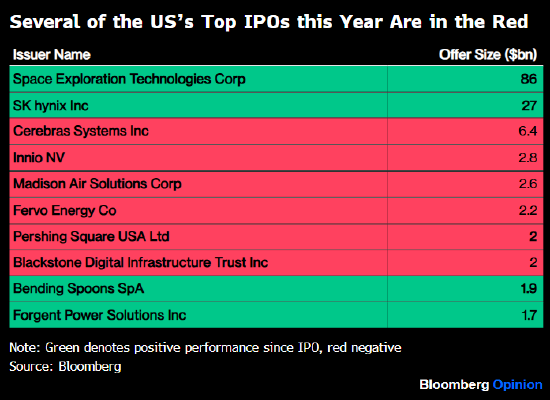
In addition, the IPO market environment has turned worse than when SpaceX went public: the yield on the 10-year U.S. Treasury note rose from 4.5% to 5%. SpaceX's stock price slightly outperformed the market, but most IPOs in the United States this year have not performed as expected, with an average increase of only 2%; the IPO market for data center operators has been particularly dismal.
Anthropic’s revenue is growing rapidly, but its valuation logic is more difficult to grasp than SpaceX. SpaceX has a mature rocket launch business and a profitable Starlink communications business, which are constantly injecting blood into Musk's AI ambitions. Like SpaceX, retail investors’ funds will also support Anthropic’s demand.
The impact of this incident is limited to Anthropic itself, or will it affect the entire market? A reasonable question is: whether stock investors can still handle another huge financing demand. The U.S. capital market is the deepest in the world, but its liquidity is not endless. The funds used by asset management institutions to subscribe for new stocks come either from new investments from clients or from selling existing positions. In June before the launch of SpaceX, almost all of the top ten heavyweight stocks in the S&P 500 weakened slightly, which may be a signal for investors to free up cash.
After sorting out capital flows, some stock strategists remain optimistic about the market's ability to absorb the situation. On the one hand, technology giants such as Meta and Alphabet have switched from repurchasing stocks to issuing additional shares, and have switched from returning cash to the market to draining liquidity. However, corporate repurchases in other industries have offset this impact, and the repurchasing entities are not just the direct beneficiaries of AI capital expenditures such as Nvidia and Micron.
Deutsche Bank strategists believe that this round of equity issuance boom is due to strong buying demand, and the growth rate of new share supply will slow down, but it will not end the stock market rally.
Goldman Sachs research shows that historically large IPOs have only brought short-term pressure to the stock market; over the past 30 years, the S&P 500 has stayed sideways on average in the weeks before and after giant IPOs, and then resumed its upward trend. Goldman Sachs analysts said: "We do not expect new stock supply to end the bull market in the short term," noting that the scale of corporate equity financing this year only accounts for 1% of the total market capitalization of the U.S. stock market.
Theoretically, the market has the ability to digest this huge supply of new shares. But Anthropic is an IPO after all, and the market is affected by emotions and variables. Everyone needs to pay attention to it, because this transaction has become a symbol of the main line of AI trading-and the main line of AI is the core of the current market.
Comments