
Abstract:
Apple plans to officially advance its repeatedly delayed smart home business on October 13, a crucial product line expansion for the company under new CEO John Ternus. According to people familiar with the matter, the core of this strategy is a smart home hub device code-named J490. Apple also plans to release the HomePod mini's first update since its launch in 2020, as well as its first new TV set-top box since 2022.
For Ternus, who took over the company on September 1, this was a major test in the early days of taking office. Apple sees the smart home as a lucrative opportunity and the "next big thing" the company has been looking for. However, the technology giant has been unable to make big breakthroughs in this area before, lagging behind Amazon and Alphabet Inc. Owned by Google.
These products will also become an important vehicle for Apple to showcase the new version of its Siri AI assistant, a technology developed by Apple over many years. The revamped Siri has endured multiple delays, and these smart home devices are expected to help Apple highlight its efforts to finally catch up in artificial intelligence.
According to people familiar with the matter, this home hub device will use a square display of approximately 6 inches and will be available in different versions that can be mounted on the wall or placed on the countertop. People familiar with the matter requested anonymity because the products have not yet been released.
Informed sources said that at the same time, the new HomePod mini and Apple TV will continue to use the existing design, but will be equipped with faster processors to support Siri’s more powerful AI model.
The new HomePod mini will also be launched in new colors including green and pink. Apple also plans to eventually update the HomePod speaker to a larger size. These new devices and their connection to Siri AI have been previously reported.
One of the key features of this home hub device is its ability to be used by multiple family members. It can identify people who are talking to or approaching the device and display personalized content and responses based on that user's data and account.
For example, when a user walks closer, the device displays that person's contacts, messages, calendar entries, notes, and preferred app layouts. The interface can automatically switch when another recognized family member approaches. The device will also offer a guest mode to hide personal information.
The device can identify users through voice or facial recognition systems, although the latter is not as reliable as Face ID on the iPhone. If users don't want to rely entirely on voice or face recognition, they can require two-factor authentication through their iPhone. If the home hub cannot correctly identify someone, identity confirmation can also be done via the iPhone.
In a dark room, a white ring fill light will light up around the screen to illuminate the surrounding area and help the camera identify the user.
Apple envisions consumers placing multiple such display devices in different locations around the home. They can be used to control thermostats, door locks and other Internet-connected devices, as well as for video calls, walkie-talkie-like communications, playing music, and viewing photo slideshows stored in Apple's iCloud service.
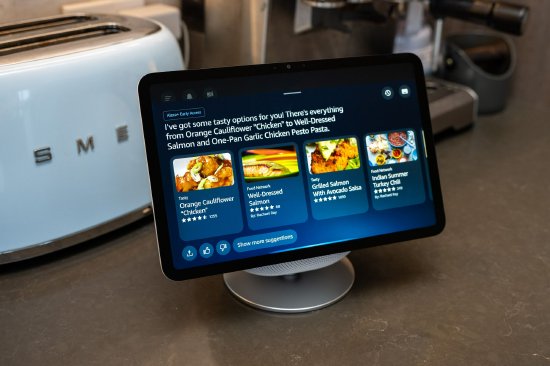
Apple also positions the device as a communications and information hub in the kitchen. Users can use their voice to look up recipes, watch videos or make FaceTime calls while preparing food.
Because the device is designed to be stationary, it only has a FaceTime camera on the front and no rear camera. A microphone and speaker are built into the base that connects to the display.
Comments