
Abstract:
Unable to open source, parts companies can only be forced to cut costs. Recently, a story about mass layoffs of recent graduates was a hot topic and caused a stir. Finally, after an official investigation, the laid-off fresh graduates who were new to society got a decent outcome. What has attracted even more attention is that this company, Changzhou Xingyu Auto Lighting Co., Ltd., as a leading listed auto parts company, is using such disgraceful means to bully these workers who are new to the society.
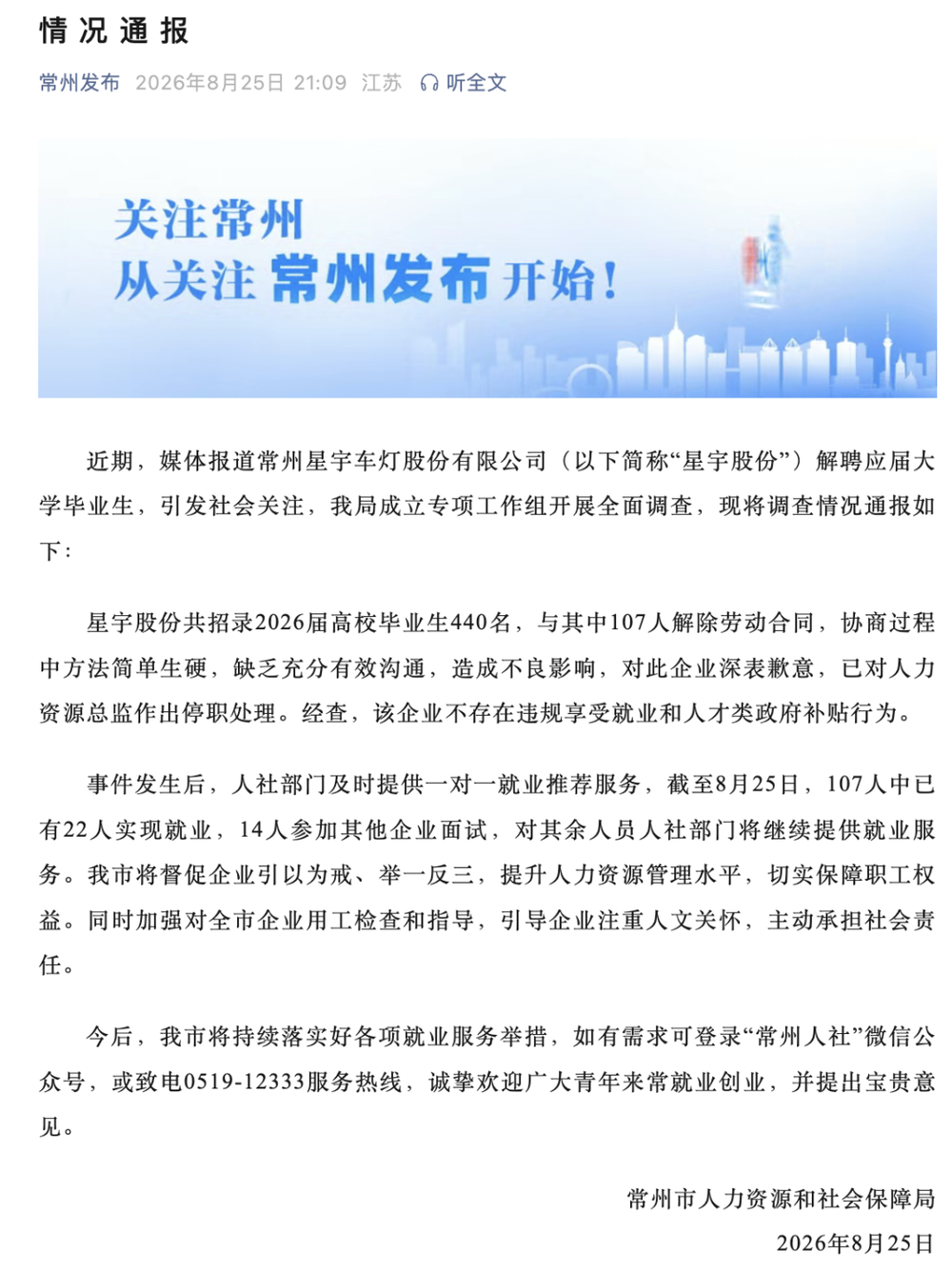
At the same time, it was discovered by interested parties that this is not the company's first large-scale layoffs. As early as 2025, the total number of employees of Xingyu Co., Ltd. plummeted from 10,426 to 7,532, a net decrease of 2,894 employees, a reduction of 27.76%, of which production personnel dropped from 7,911 to 4,729.
As a representative of the new three products and Made in China, the automobile industry, especially the new energy automobile industry, has developed rapidly in recent years. Logically speaking, a leading manufacturer of automobile parts and accessories should be operating quite well. Why did it use layoffs to control costs in the past two years when automobile sales have increased?
This seemingly unreasonable fact is actually the real dilemma of the automobile industry.
Leading Financial Report
Xingyu Co., Ltd., as the company involved, is the leader in the domestic automotive lighting industry, ranking first in China and seventh in the world in terms of sales revenue in 2025.
According to the report, the company focuses on the design, development, manufacturing and sales of automobile (mainly passenger car) lamps and is one of the leading lamp assembly manufacturers and comprehensive solution providers in my country.
The company's products mainly include front car lights, rear car lights, other car lights and controllers, etc. Its customers include many domestic car companies and a well-known international new energy car company and many domestic and foreign vehicle manufacturing companies.
In terms of customer scope, Xingyu Co., Ltd. is definitely the leading company in the field of automotive lighting, and the financial report also shows that Xingyu Co., Ltd. has no operating difficulties.
From the perspective of financial data, Xingyu Shares has continued to grow in recent years, with revenue of 10.248 billion yuan, 13.253 billion yuan and 15.257 billion yuan respectively from 2023 to 2025, and net profits of 1.102 billion yuan, 1.408 billion yuan and 1.624 billion yuan respectively.
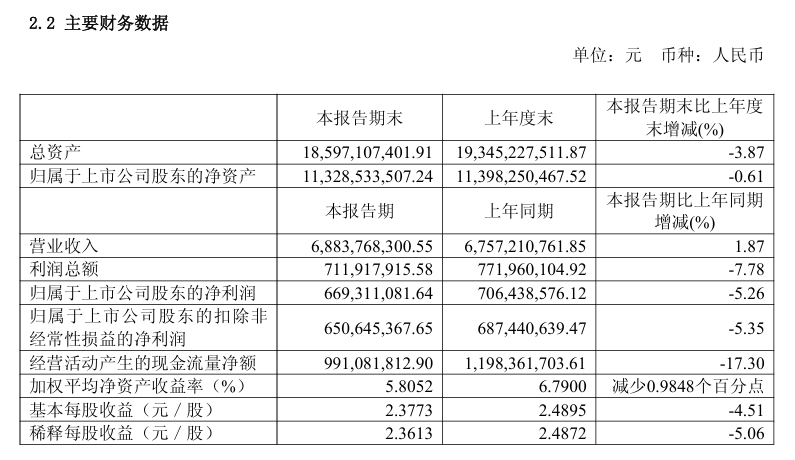
Even the latest half-year financial report shows that the company's revenue was 6.884 billion yuan, a slight increase of 1.87% year-on-year, and its net profit was approximately 669 million yuan, a year-on-year decrease of 5.26%. What is more noteworthy is that the employee compensation payable during the reporting period was 90.2385 million yuan, a significant decrease of 45.9% compared with the same period last year.
This significant drop in compensation expenses is directly related to layoffs. In July 2026, just one week after Xingyu Co., Ltd. submitted its listing application to the Hong Kong Stock Exchange, it launched a centralized campaign to persuade fresh graduates to quit. Citing "the company's operating conditions" and "organizational structure adjustment and job downsizing" as reasons, HR requires graduates to choose between "voluntarily resigning and receiving half a month's salary compensation" or "transferring to a front-line production operation position."
From an analysis point of view, Xingyu Co., Ltd. laid off employees in order to obtain a better valuation when it was listed on the Hong Kong stock market. Therefore, it reduced the proportion of labor costs through layoffs and improved key financial indicators such as gross profit margin and per capita efficiency.
At the same time, by increasing labor outsourcing, fixed labor costs are converted into variable costs and financial flexibility is improved.
However, the core is still the sluggish domestic sales of used vehicles and the lower than expected sales of some supporting models. This, combined with rising raw material prices, has put pressure on profits.
From the data point of view, domestic car sales in 2025 will be 27.302 million units, a year-on-year increase of 6.7%, but total retail sales will decline by 1.5%, and profit margins will drop to 4.1%; in the first half of 2026, sales will increase by 7.3% year-on-year, but profits will drop by 20% year-on-year, and profit margins will fall to 3.8%.
The pressure from the terminal is eventually transmitted to the upstream parts industry. Parts insiders complained that the production cycle of a new model is generally three years, but car companies often invite bids once a year, and change suppliers every year within three years. They also adopt the lowest bid to win the bid. It is difficult for parts manufacturers to amortize the initial mold opening and other costs within a year. In order to retain orders, they can only fall into endless low-price bidding.
And low prices will bring risks. Xingyu adopts the method of reducing labor costs, but when labor costs cannot be reduced, it can only find ways to reduce costs from the manufacturing side.
Consistency risk
When parts manufacturers are faced with the situation of annual replacement, the direct impact is the product itself. The first batch of products has no problems, but subsequent products have problems because of substandard consistency.
This seemingly unrelated risk is becoming a shoal affecting the quality of domestic automobiles.
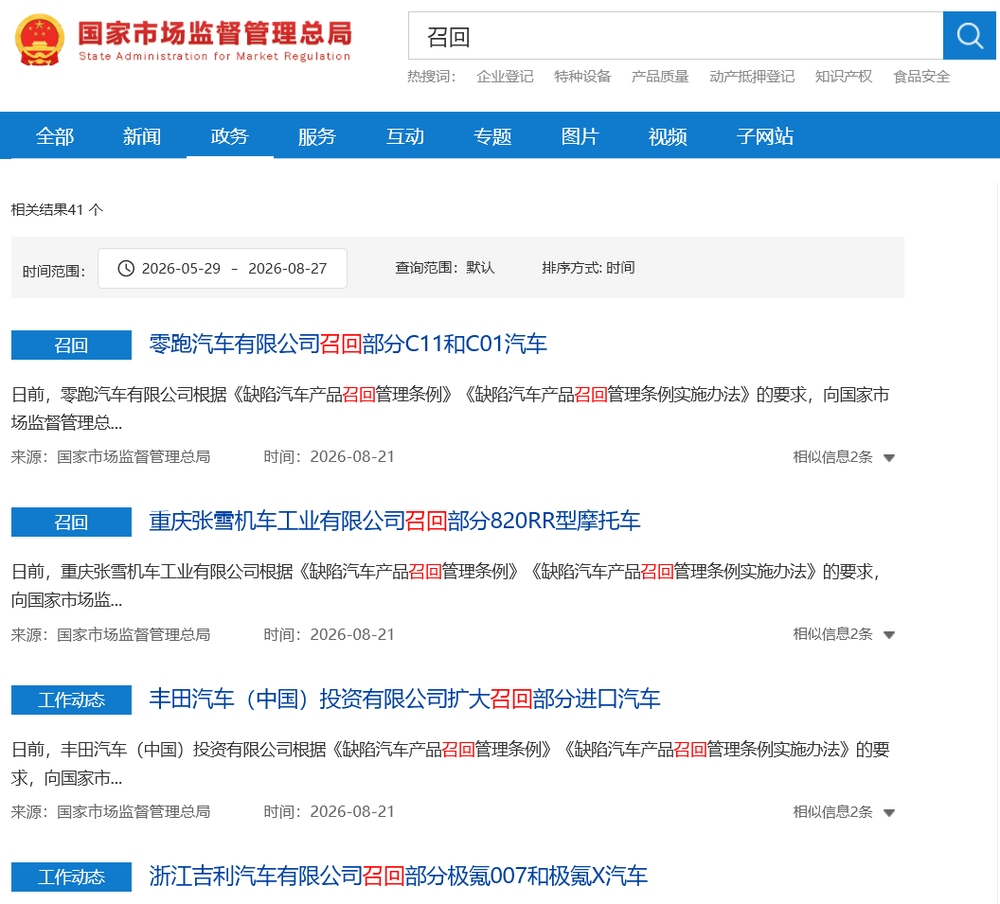
According to statistics, in the first half of 2026, the State Administration for Market Regulation issued a total of 50 vehicle recall announcements, involving 26 brands, with a total recall of approximately 1.65 million vehicles. Among them, about 308,000 self-owned brand cars were recalled, a year-on-year surge of 681.2%, an increase that far exceeded the overall industry level.
Among the recalled models, new energy vehicles accounted for 62%. The main defects are concentrated in battery systems, electronic control systems and automatic driving assistance systems.
In addition to the factors of the car companies themselves, supply chain management also plays a large role behind this.
例如,2026年7月初,大量小鹏X9车主在社交平台集中反映,高温天气下车辆空气悬架突发失效,车身单侧或整体塌陷,在快速路上直接"趴窝"无法行驶。
Afterwards, Xpeng Motors officially filed a recall with the State Administration for Market Regulation, recalling a total of 33,473 Xpeng X9s produced between August 8, 2023 and August 11, 2025.
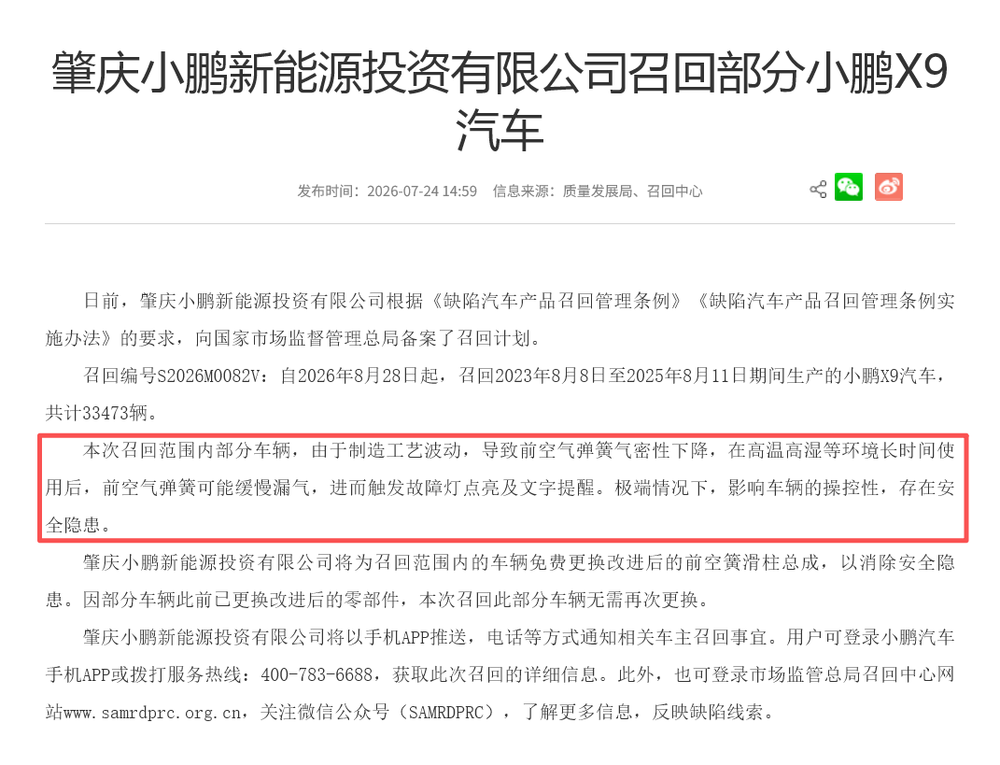
The official reason is that due to fluctuations in the manufacturing process, the air tightness of the front air spring is reduced. After long-term use in high temperature and high humidity environments, the front air spring may slowly leak air, triggering the fault light to light up and the text reminder. In extreme cases, it affects vehicle controllability and poses safety risks.
The manufacturing process fluctuates, which seems to be a reasonable explanation, but no one can give a specific explanation as to why it fluctuates.
Regarding this incident, industry experts analyzed that similar faults may be due to insufficient actual vehicle verification in extreme environments such as high temperature and cold. At present, the development cycle of some car companies has been greatly compressed, and process verification and reliability testing of new parts have been transferred to suppliers. Some suppliers have relaxed their quality control in order to control costs.
In addition to the recall of the Xpeng X9, the lawsuit between Jikrypton and Sunwanda ended in a settlement at the beginning of the year. The reason behind this was that Jikrypton recalled 38,000 001 models due to a new consistency defect in Sunwanda’s e-commerce.
In addition, in the largest new energy recall last week, in addition to the door mechanical unlocking device, Lynk & Co's lidar was also recalled. The reason was also due to fluctuations in the manufacturing process.
A source from the quality department of a car company revealed that although parts factories will provide warranty certificates when delivering products, "usually it is just a formality." Changing different suppliers every year, "How to ensure the consistency of product quality?"
Regarding these issues, Xin Guobin, Vice Minister of the Ministry of Industry and Information Technology, clearly pointed out at the press conference that there are a series of problems and challenges in the current industrial development. "The problem of irrational competition is still prominent. Some 'radical' innovative designs are installed in vehicles without sufficient experimental verification. There have also been individual incidents such as automobile product quality and autonomous driving safety that have attracted social attention."
In this regard, the competent authorities have also launched actions. On August 27, the Ministry of Industry and Information Technology, the Ministry of Public Security, the Ministry of Ecology and Environment, and the State Administration for Market Regulation jointly issued a notice to launch a one-year nationwide special action to improve the production consistency and quality of road motor vehicle products.
More importantly, in addition to vehicle manufacturers and products, and vehicle inspection and testing institutions, parts suppliers and dealers’ 4S stores will also be subject to related inspections.
However, facing the gradual compression of industry profitability, apart from using "wrong ideas", is there any other way for the automobile manufacturing industry to balance the balance between quality and profitability?
This industry-wide inspection is to answer this question. Through special actions on production consistency and access review, it sets a quality bottom line to prevent "bad money from driving out good money" and creates a fair competition environment for law-abiding and compliant enterprises.
At the same time, it also supports key enterprises to increase technological research and reduce costs and increase efficiency through technological progress rather than cutting corners. Real competitiveness comes from technological leadership, not price involution.
In the context of tightened industry supervision and heightened consumer awareness of rights protection, whether it is through unfair means such as layoffs or cost reduction at the expense of quality, all will be punished by the market. Legal operations are a red line that cannot be touched.
Comments