
Abstract:
The Chinese film market in the first half of 2026 has handed over a mid-term answer that is heavy for both inside and outside the industry. According to data from Maoyan Professional Edition and Beacon Professional Edition, from January 1 to June 30, 2026, the cumulative box office revenue of national movies was 17.354 billion yuan, and the number of moviegoers was 421 million. In the same period in 2025, these two figures were 29.231 billion yuan and 641 million yuan respectively. The box office evaporated by more than 11.8 billion yuan year-on-year, a drop of 40.4%, and the number of moviegoers dropped by 34%.
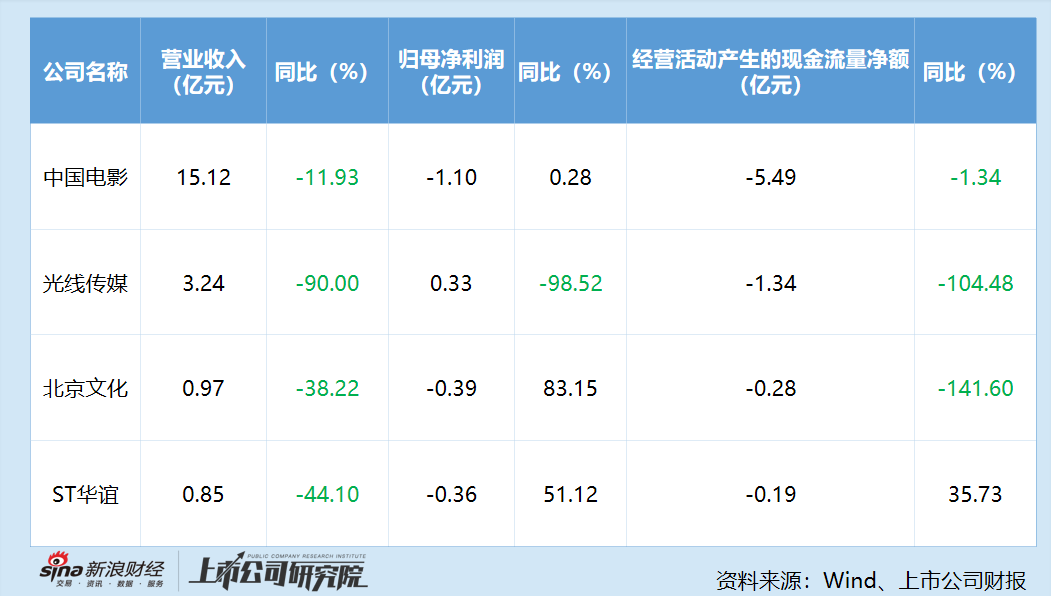
The semi-annual reports of four listed companies are the most realistic slice of this industry change. Chinese films have shown relative risk resistance by virtue of their entire industry chain layout; Enlight Media has encountered a performance cliff after the popularity ebbs; Beijing Culture has struggled to reduce losses in consecutive years; ST Huayi is struggling to survive despite being insolvent. Their common dilemma is: over-reliance on single-film hits, over-reliance on schedule windows, and over-reliance on the traditional "production-distribution-exhibition" linear model.
The overall market volume is stalling and the structure is unbalanced
The core characteristics of the Chinese film market in the first half of 2026 are the coexistence of "total stalling" and "structural imbalance".
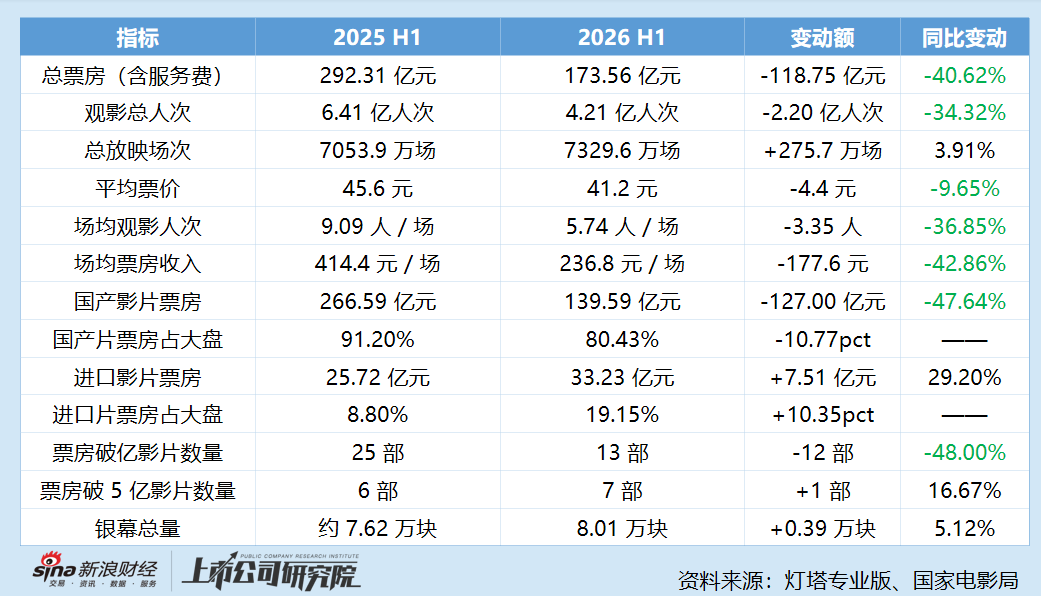
From a total perspective, the half-year box office of 17.354 billion yuan has fallen back to close to the level of 2014. The "China Film Market Research Report for the First Half of 2026" released by Top Data pointed out that due to the absence of billion-rated films and the weak size of many new films, their limited contribution to the market has led to a year-on-year decline of 40.6% in the total box office. In the first half of the year, only 7 films had a box office exceeding 500 million yuan. "Flying Life 3" took the top spot with 4.42 billion yuan, followed by "A Love Letter to Grandma" (over 1.9 billion yuan) and "The Good Samaritan: The Wind Rises in the Desert". There is almost a vacuum in the "waist range" between 500 million and 1 billion yuan in box office. Only "The Vanishing Man" is in the 500 million to 1 billion yuan range, and the box office volume of subsequent films has plummeted.
From a structural perspective, the market’s dependence on schedules has further intensified. The holiday box office in the first half of the year was 7.96 billion yuan, accounting for 45.9% of the total movie box office, an increase of about 6 percentage points year-on-year. Among them, the box office of the Spring Festival period was 5.752 billion yuan, and a single period contributed 33.1% of the box office in the first half of the year, becoming the core support of the market. The non-scheduled box office has been significantly compressed, and the market has shown an extremely differentiated pattern of "carnival during schedules and deserted on weekdays".
The pressure on the projection side is equally shocking. In the first half of the year, the average number of visitors per game was only 6, a year-on-year decrease of 34.1%, the lowest level in recent years; the average revenue per game was 236 yuan, a year-on-year decrease of 43.1%. Cinemas with box office revenue of less than 500,000 yuan accounted for about 30%, a year-on-year increase of 15%. In terms of ticket prices, the average ticket price dropped from 45.6 yuan in the first half of 2025 to 41.1 yuan - theaters tried to attract audiences through price cuts, but with little success.
Audiences have not disappeared, but their answers to "why they go to the cinema" are becoming more and more demanding.
Chinese movies: The “national team” cannot escape the cold winter of film and television
As the industry's "national team", China Film achieved operating income of 1.512 billion yuan in the first half of 2026, a year-on-year decrease of 11.93%; net profit loss attributable to parent companies was 110 million yuan, basically the same as the same period last year; net cash flow generated from operating activities was -549 million yuan, a slight year-on-year decrease of 1.34%.
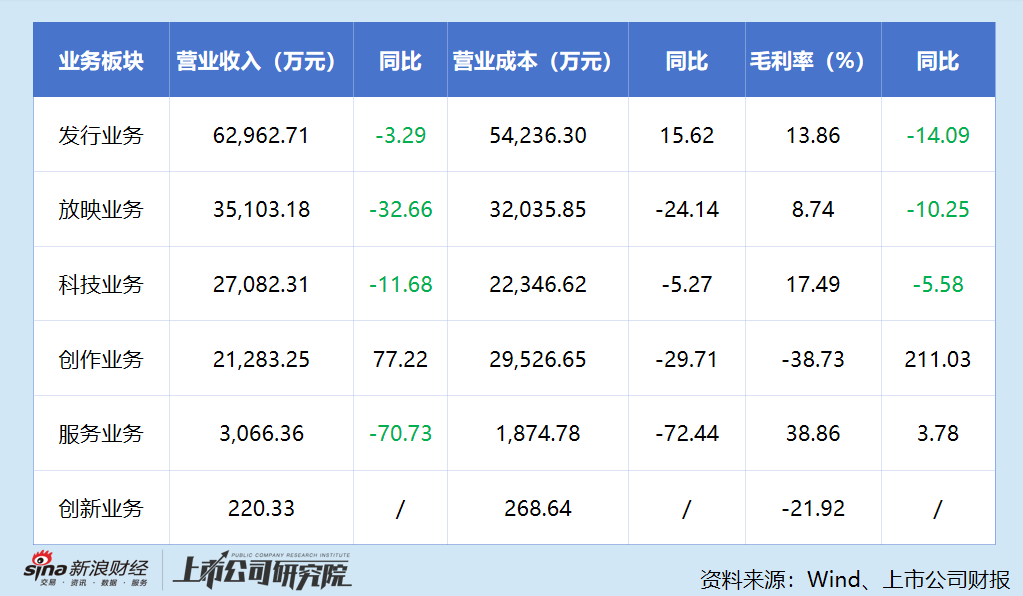
From the revenue side, the decline in revenue is mainly due to the year-on-year decline in box office of the 2026 Spring Festival movies, resulting in a 32.7% year-on-year drop in projection business revenue. In the first quarter, the company's operating income was 852 million yuan, a year-on-year decrease of 14.3%, operating costs were as high as 848 million yuan, and the gross profit margin was only 0.43%. The weakness in the screening business directly dragged down the overall performance.
But from the production side, the market share of Chinese films is increasing. In the first half of the year, the company led or participated in the production of 18 films, with a cumulative box office of 9.357 billion yuan, accounting for 67.03% of the total domestic film box office in the same period. This means that amid the overall industry downturn, the concentration of Chinese films as the leading producer is actually increasing. However, the increase in production share has not been effectively converted into profits - a high proportion of production participation means greater investment risk exposure, and the shrinkage of the market has put pressure on single-chip returns.
From the perspective of quarterly rhythm, the second quarter has been in a balanced range between small profits and slight losses. The net profit attributable to the parent company was 3.9397 million yuan, a year-on-year decrease of 87.03% and a month-on-month increase of 103.46%. The company has nearly 80 projects under creation and development, and the performance of key projects such as "The Wandering Earth 3" (scheduled for New Year's Day in 2027) will become a key variable in the turning point of performance.
Guangguang Media: After the hot trend subsided, "I returned to before liberation overnight"
Enlight Media is the one with the most dramatic performance fluctuations among the four companies. In the first half of 2026, operating income was approximately 324 million yuan, a year-on-year decrease of 90%; net profit attributable to the parent company was approximately 33.01 million yuan, a year-on-year decrease of 98.52%. In the same period in 2025, the net profit attributable to the parent company will be 2.229 billion yuan - in one year, the profit dropped from 2.2 billion to 33 million yuan.
The direct reason for this sharp drop in performance is the fading of the hit effect of "Nezha: The Devil Boy in the Sea" in 2025. In the first half of 2026, films invested, distributed and included in the box office of this reporting period by Enlight Media include "Just Going to Work", "Flying Life 3", "Silent", "Return to the Wolves" (re-release), "Big Fish and Begonia" (re-release), etc. As of the end of the reporting period, the total box office was approximately 5.821 billion yuan, compared with 15.463 billion yuan in the same period last year, a year-on-year decrease of 62.36%.
What is more noteworthy is that the net cash flow generated by Enlight Media’s operating activities in the first half of the year was -134 million yuan, a year-on-year decrease of 104.48%. The sharp turn negative of this indicator means that the company's ability to withdraw cash from its main business has deteriorated sharply after losing the support of hot sales. The non-net profit after deducting was only 4.6368 million yuan, further confirming the fragility of the profitability of the main business.
The case of Enlight Media shows that in the film industry, "dependence on hits" is a double-edged sword - when hits come, performance skyrockets, but when hits fade, they may "return to before liberation overnight."
Beijing Culture: Loss reduction is only because last year’s loss was too abnormal
Beijing Culture achieved operating income of 97.4686 million yuan in the first half of 2026, a year-on-year decrease of 38.22%; a net profit loss attributable to the parent company was 39.2048 million yuan, a decrease of 83.15% from a loss of 233 million yuan in the same period last year; a net profit loss after deducting non-attribution to the parent company was 41.8317 million yuan, a year-on-year decrease of 82.85%. From the data point of view, this is the only sample among the four companies that achieved "significant improvement".
But the quality of loss reduction needs to be carefully analyzed. The company stated that the loss reduction was mainly due to the fact that the box office of the movies released in the same period last year was less than expected, resulting in larger losses - in other words, the huge loss in the same period in 2025 itself was an outlier, and the loss reduction in 2026 was more of a return to "normal losses" rather than an improvement in profitability.
From a business perspective, Beijing Culture launched "Fengshen Part 2: War of Xiqi" in the first half of the year, with a box office of 1.238 billion yuan, which fell short of expectations. The company also participated in "The Annual Meeting Cannot Stop!" 2" and "Welcome to Dragon Restaurant", but the participation ratio is low and will not have a significant impact on the performance in 2026.
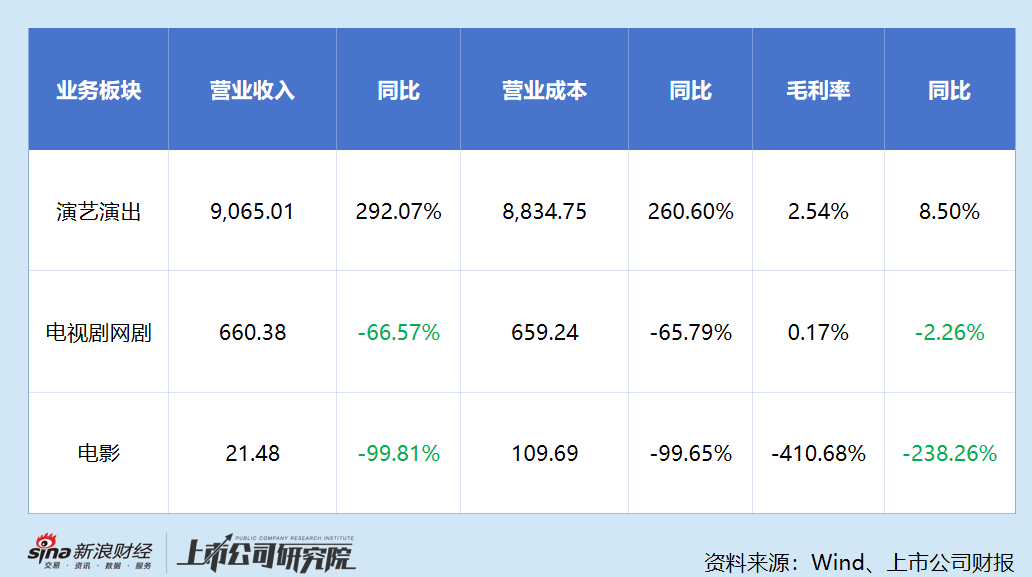
In the first half of the year, the company's film business achieved revenue of 214,800 yuan, a year-on-year drop of 99.81%, and its proportion of total revenue plummeted to 0.22%; the gross profit margin was -410.68%, compared with -172.42% in the same period last year, a year-on-year decrease of 238.26 percentage points. At the same time, more than 90% of the company's revenue relies on the entertainment performance business, but the gross profit margin of this business is only 2.54%, which is difficult to provide substantial support for performance.
The fundamental problem facing Beijing Culture is the cumulative effect of continuous losses. The company has been losing money for seven consecutive years, and one of its reserve projects, "Fengshen Part 3," is still in post-production. In the absence of sustained and stable content production capabilities, it is difficult to reverse the fundamental decline with just one or two participating films.
ST Huayi: Struggling to survive despite insolvency
ST Huayi is in the most dangerous situation among the four companies. In the first half of 2026, operating income was 85.4477 million yuan, a year-on-year decrease of 44.10%; net profit loss attributable to the parent company was 36.3851 million yuan, a year-on-year decrease of 51.12%.
From the perspective of business structure, film and television entertainment is still the absolute main business. In the first half of the year, the main business income was 85.3553 million yuan, accounting for 99.89% of operating income, a year-on-year decrease of 43.77%; the gross profit margin was 18.79%, a year-on-year decrease of 15.77 percentage points. Although the company has reserved projects such as "Mermaid 2", due to financial constraints and pre-restructuring, project development and release progress may slow down. However, the revenue from brand licensing and live entertainment is only 92,400 yuan, and the diversified transformation that once had high hopes has almost stalled.
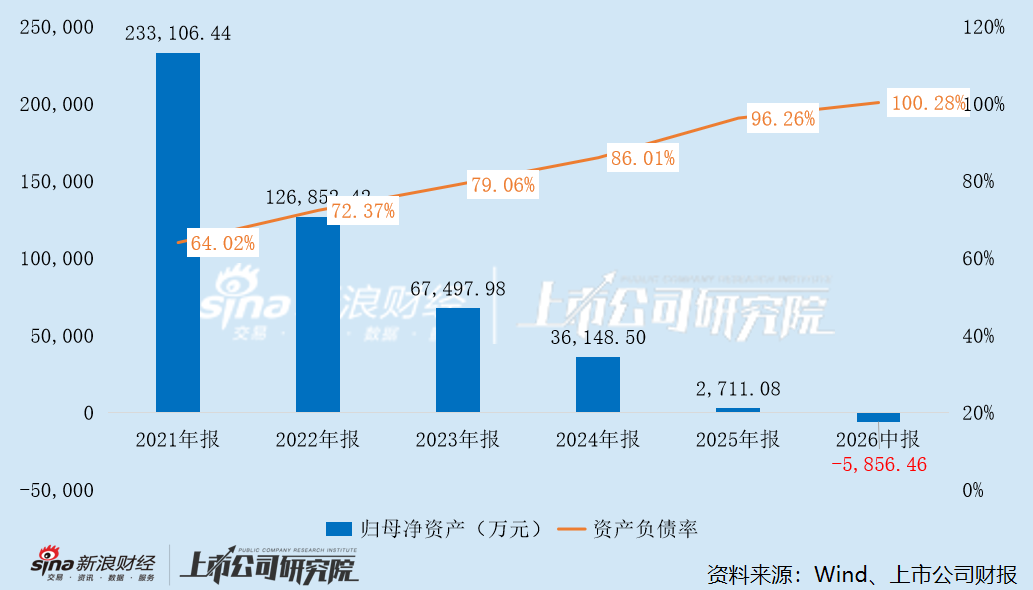
The biggest risk currently faced by the company is the debt crisis and uncertainty of restructuring. As of the end of June 2026, the company's total assets were 2.13 billion yuan, total liabilities were as high as 2.136 billion yuan, and net assets attributable to the parent were -58.5646 million yuan, making it officially insolvent. The asset-liability ratio climbed to 100.28%, further deteriorating from 96.26% at the end of 2025.
From the liability side, short-term borrowings are 184 million yuan, and non-current liabilities due within one year are 304 million yuan. The short-term interest-bearing debt totals nearly 500 million yuan, while the company's book monetary funds are only 14.0739 million yuan, of which 3.3907 million yuan has been frozen by the judiciary. The liquidity exposure is shocking.
In April 2026, ST Huayi disclosed that it had entered the pre-reorganization process, but there was still significant uncertainty as to whether it could successfully complete the reorganization and introduce powerful investors. If the reorganization fails, the company will face the risk of delisting or even bankruptcy liquidation.
When will the ice-breaking moment come in the winter of film and television?
Although the semi-annual reports of the four listed companies are different, they all point to several deep-seated problems in the Chinese film industry in the first half of 2026.
First, it relies on popular products but its output is unstable. The film industry’s “hit-driven” business model exposed its fragility in the first half of 2026. The case of Enlight Media is the most typical - it only took one year to go from a profit of 2.2 billion to a profit of 33 million. Even Chinese films with a full industrial chain layout have not been immune to the impact of the shrinking market.
The deeper problem lies in the lack of stability in the output of hit movies in the Chinese film market. In 2025, there will be phenomenal works like "Nezha 2", but in 2026, only "Flying Life 3" will stand out, and the box office volume of 4.4 billion yuan is far less than the top hit in 2025. The absence of head films directly caused the market to stall.
Second, schedule dependence and hollow content. In the first half of the year, the holiday period’s box office share rose to 45.9%, and the Spring Festival period contributed 33.1%. These two data reveal a worrying trend: movie consumption is being compressed into a few time windows, and daily movie viewing demand is seriously insufficient.
Behind schedule dependence is the "hollowing out" of content supply. A large number of small and medium-cost films act as "fillers" for schedules rather than real "engines". Audiences lack attractive enough movie-watching options during non-scheduled periods, and over time have formed the consumption habit of "only watching movies during holidays." Once this habit solidifies, it will pose a fundamental threat to the long-term healthy development of the industry.
Third, structural mismatch on the supply side. The number of screenings hit a new high (73.312 million) and the number of moviegoers reached a new low (421 million). Behind these contradictory data is a serious mismatch between supply and demand. Theaters are increasing the number of shows, but audiences are not buying it.
From the perspective of audience structure, the trend of differentiation is increasingly obvious. Action movies attract male viewers (65.3% of male viewers of "Fire Covers Eyes"), female themes attract female viewers (74.7% of female viewers of "I Permit"), and young viewers prefer thrillers and suspense (54.1% of viewers under the age of 24 in "The Vanishing Man"). The market is no longer a "mass market" but a "niche market" composed of multiple segments. However, the supply side of the industry has not yet completed the transformation from "casting a wide net" to "precise delivery."
The darkest moments of an industry are often the starting point for change. The Chinese film industry needs a systematic reconstruction from the supply side to the demand side, and from content to channels. For listed companies, whoever can take the lead in completing the transformation from "dependence on hot hits" to "stable output", from "schedule thinking" to "normalized supply", and from "single box office" to "diversified realization" will be able to take the initiative in the next cycle.
Comments