
Abstract:
During the National Day holiday, several big moves by domestic AI companies were exposed one after another: DeepSeek’s new round of financing is said to exceed 80 billion yuan, and Kimi’s parent company Dark Side of the Moon was revealed to have completed a new round of financing, with a valuation of about US$50 billion. Tencent was revealed to have signed an overseas computing power lease of approximately US$7 billion.
Overseas, Google has updated its flagship model and image model. Ultraman talked about the new assistant Dots in a long interview with Vanity Fair, responding to model delays and launch arrangements. OpenAI's Tibo also promises Codex and ChatGPT Work users: In the next 28 days, an improvement of obvious value will be launched every day, otherwise the usage quota will be reset. NVIDIA's stock price hit a record high again, with a market value of nearly $5.8 trillion.
The following are six sets of news worth paying attention to from October 1st to 7th.
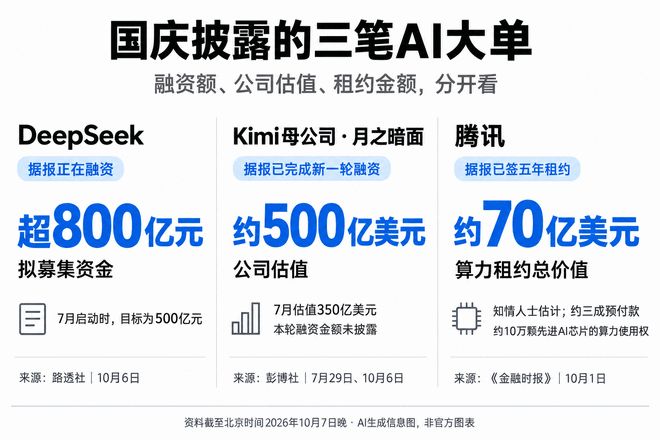
DeepSeek was revealed to be planning to raise more than 80 billion yuan
On October 6, Reuters quoted people familiar with the matter as saying that DeepSeek is promoting a new round of financing that plans to raise more than 80 billion yuan and is expected to be completed in October. When the company launched this round of financing in July, the target fundraising amount was 50 billion yuan, and the valuation under discussion was 500 billion yuan.
Bloomberg previously reported that Tencent and CATL were among the institutions that made larger investment commitments. DeepSeek has not publicly confirmed the above-mentioned financing scale and investor arrangements.
This is only a few months after DeepSeek first introduced external funding. According to Reuters, the company just completed approximately US$7.4 billion in financing in June this year. If the new round is completed on the scale currently discussed, DeepSeek will receive two consecutive tens of billions of dollars in funding.
Kimi’s parent company was revealed to have completed financing, with a valuation of approximately US$50 billion
On October 6, Bloomberg quoted people familiar with the matter as saying that Kimi’s parent company, Dark Side of the Moon, had completed the last round of private equity financing before going public, with a valuation of approximately US$50 billion. Bloomberg reported on July 29 that Dark Side of the Moon completed approximately US$3.5 billion in financing, with a valuation of US$35 billion.
Dark Side of the Moon is seeking to list in Hong Kong in the first quarter of 2027 and is considering raising up to US$5 billion through an IPO. The company is also preparing for early meetings with potential investors, which could begin as soon as October, to gauge market interest in the listing.
The specific amount of this round of private placement financing has not been disclosed, and the IPO time may still be adjusted. Dark Side of the Moon did not respond to Bloomberg's request for comment.
Tencent was revealed to have spent approximately US$7 billion renting overseas computing power
The Financial Times disclosed on October 1 that Tencent signed a five-year lease with Oracle earlier this year, involving the latter's multiple data centers in Southeast Asia, which can use the computing power provided by approximately 100,000 advanced AI chips.
A person familiar with the matter estimated that the total value of the agreement is about US$7 billion, with the advance payment accounting for about 30%. Tencent and Oracle did not respond to requests for comment.
These chips are deployed in overseas data centers, and Tencent obtains the right to use computing power.
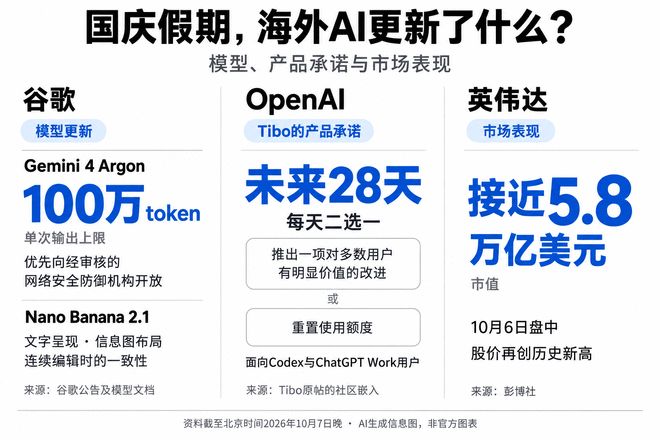
Google updates two product lines: professional tasks and photo editing
At the beginning of the holidays, Google announced a new generation of flagship model Gemini 4 Argon, focusing on professional tasks such as software engineering, law, finance, and cybersecurity defense. The company has increased the single output limit from 64,000 tokens in the previous generation to 1 million, allowing the model to generate longer code or other content at a time.
Argon will first be open to audited cybersecurity defense organizations through the Fairwind program. More paid API users and Google AI Ultra subscribers still need to wait for follow-up arrangements.
Nano Banana 2.1, updated on October 6, is closer to the needs of posters, e-commerce images and daily photo editing. Improvements highlighted by Google include text presentation, infographic layout, and consistency of people and objects across consecutive edits. When the user repeatedly changes the background, changes the copy, and adjusts the layout, the model needs to try to keep the parts that have been modified in the previous round.
Ultraman talks about Dots, Tibo promises 28-day updates
In a long interview published by Vanity Fair on October 5, Ultraman called the previously launched Dots the product he has been waiting for. He said that this AI assistant can handle emails and to-do items for him. He gave an example of his own use: after handing over a set of ideas on the phone, when he returned to the computer, Dots had already sent the work results through Slack and pointed out problems with some of the ideas.
The interview also touched on the relationship between AI and humans. Altman said that he hopes Dots will take over the chores he doesn't want to do, but when communicating with friends, he still wants to send messages in person instead of letting the AI on both sides chat for him. When asked what things should not be left to AI, his answer was: replacing the connection between people.
When asked why the release of Astra 6.1 was delayed, Altman said that the version prepared at that time had too high an accident risk. OpenAI still hopes to open the model to more people, but it needs to improve security first. It can no longer release it first if it thinks the risk is not high, as it did a year ago.
On October 6, Jason Kwon, chief strategy officer of OpenAI, apologized at an Australian parliamentary hearing for the previous AI system intrusion into government websites and promised to speed up incident reporting.
Regarding the IPO, Altman said that OpenAI is not in a hurry to go public. Even if it goes public, it will still be governed by a non-profit organization. He said that if the mission conflicts with the interests of shareholders, the company will give priority to the mission. The interviewer asked what he would do if the profit expectations were not met and the stock price fell. He replied: "Then let it fall."
During the holidays, OpenAI’s Tibo also made a 28-day commitment to Codex and ChatGPT Work users: every day it would either launch an improvement that has obvious value to most users, or reset the usage quota. He previously said that users want products to become simpler, and the team will focus on simplifying operations, improving efficiency, and developing new features and new models.
Among the improvements announced in the first two days, the default output speed of GPT-6 Astra and GPT-6.1 Sol has been improved. Users who log in through a ChatGPT account can also use automatic review that does not account for the package quota, and have another agent check potentially risky operations.
Nvidia’s stock price reaches a new high, and U.S. software stocks rise to the highest level of the year
According to Bloomberg, on October 6, Nvidia’s stock price rose 1.9% intraday, hitting another record high. Its market value was close to US$5.8 trillion, and it continues to approach US$6 trillion.
Bloomberg said that strong revenue growth expectations and the previously added $150 billion stock repurchase authorization have pushed investors to buy Nvidia again. At the end of March, the company's stock price was still down about 11% from the beginning of the year. By October 6, the increase during the year had reached about 30%.
Software stocks are also rebounding. Reuters reported on October 6 that the S&P 500 Software and Services Index rose 1.3% that day to its highest level since November 2025, setting a new high for the year. The financial performance of companies such as Salesforce, ServiceNow and Accenture, as well as cooperation with AI laboratories, drove the sector to rebound. At the beginning of the year, the market was worried that AI would replace traditional software, but these worries are easing.
Comments