
Abstract:
On November 29, Feng Ji, the founder of Game Science and the producer of "Black Myth: Wukong", published a long article of about 8,000 words on his personal public account yesterday, "The Most Important Issue in the Post-AI Era", exploring the profound impact of AI on human employment, entertainment industry, social wealth distribution and personal value.
Feng Ji raised a number of attention-grabbing points: AI may have begun to gradually control the world four years ago; intelligence is changing from a labor factor to a capital factor; AI will not only break the monopoly of the entertainment industry, but may intensify the winner-take-all; every ordinary person should enjoy the social wealth dividends created by AI.
Recently, "GTA6" has set a new sales record in the entertainment industry, and AI has continued to make breakthrough news in the field of cutting-edge mathematics. Feng Ji also tried out a batch of web games generated by Fable 5.2, and the level of completion surprised him.
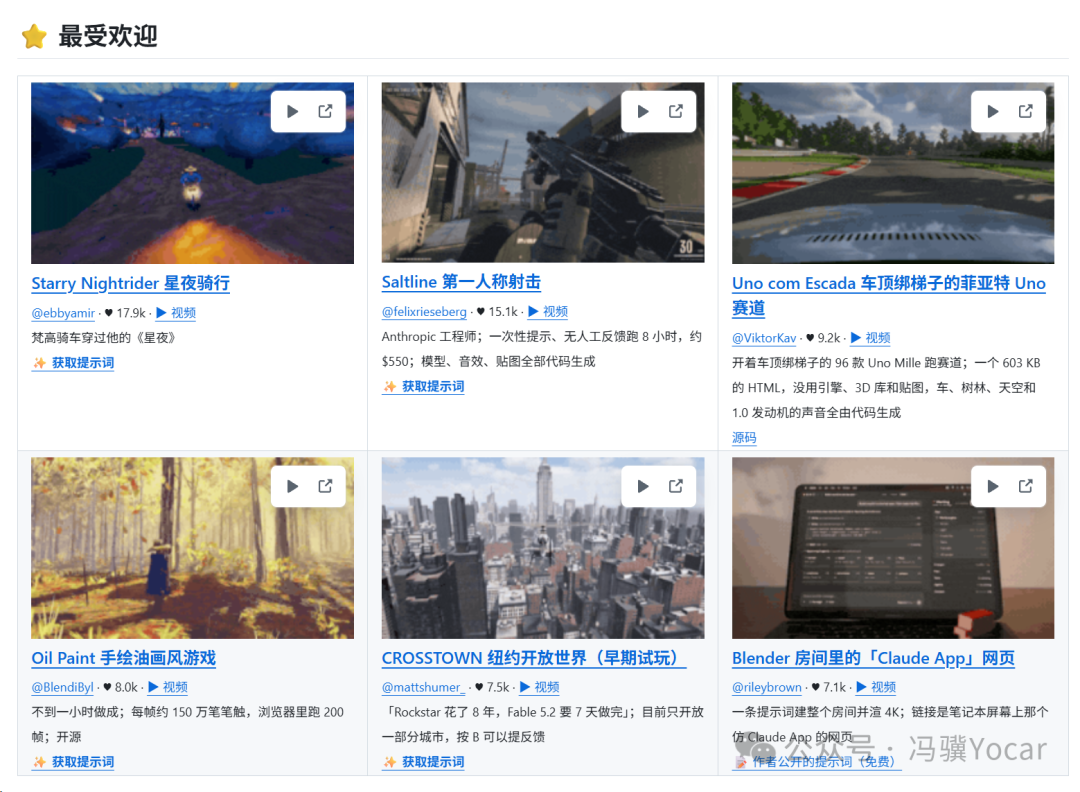
There is a public repository on GitHub that specifically summarizes the generated content of Fable 5.2
"Mathematics is solved with AI, and games are made with AI. If one day there are no more jobs that require people, what will people do?" Feng Ji wrote.
AI may have started to control the world four years ago
Feng Ji put forward a bold hypothesis:
Since four years ago, AI may have gradually taken control of the world.
This kind of control is not the violent domination of humans by machines in science fiction movies, but through interests and competition, allowing humans to actively invest resources in the development of AI.
Before AI has self-awareness, humans are already buying electricity, manufacturing chips, building data centers, and providing training corpus for it around the clock.
Programmers use AI to reduce overtime, companies use AI to save budgets, and scientific researchers use AI to complete experiments. But when competitors use AI to double their efficiency and halve their quotations, whether to use AI is no longer a free choice.
"Optimists step on the accelerator, while pessimists step on the accelerator harder than optimists in order to protect themselves."
Even those who want to prevent "evil AI" from destroying the world may have to devote their resources to developing a more powerful "good AI".
Feng Ji laughed at himself. While he was vigilantly demonstrating how AI could control the world, he felt that it was too slow to check the information and organize the logic, so he turned around and opened the dialog box to let AI help summarize. Even this self-deprecation was written by AI for him.
When capital can use electricity bills to "wholesale" intelligence
The industrial revolutions of the past two hundred years have eliminated a large number of old jobs, but also created new job opportunities. However, Feng Ji believes that this time may be different.
In the past, machines replaced muscles and foot strength. Humans could walk from farmland to factories, and then from production lines to office buildings, constantly migrating to higher levels of mental work.
But today, AI directly challenges human brain power. There may not be a higher-level "super-brain job" behind human beings that can accommodate the collective transfer of hundreds of millions of workers.
At the same time, the rate of skill obsolescence is also accelerating. Even if new positions such as prompt word engineering and agent management emerge, their core skills may be absorbed in the iteration of the next two model versions.
AI can rewrite the next generation of itself in a few months, but humans are still going through a training cycle of nearly twenty years in elementary school, middle school, and university.
"Before you even get on the runway, there is no end point."
What worries Feng Ji even more is that,
for the first time in history, intelligence is separated from the body and changes from a labor factor to a capital factor.
In the past, intelligence could not exist apart from the individual, and even the smartest people needed to rest. If a company wants to expand its business, it must buy labor hours from a large number of educated workers. This supports the social contract in which ordinary people study hard, master skills, exchange for income, and gain respect.
But big models are breaking this constraint. Reasoning, programming, writing, and design capabilities are loaded into data centers and become commodities that can run around the clock and be replicated at scale.
“When capital can directly use electricity bills to wholesale intelligence, its necessity to purchase labor hours from ordinary people is shaken to its roots.”
The stronger the AI, the harder it may be for ordinary creators to make money
As a practitioner in the gaming industry, Feng Ji is particularly concerned about the impact of AI on the entertainment industry.
Many people believe that everyone can use AI to create games, movies and music, which means that the spring of ordinary creators is coming. But Feng Ji gave a completely different judgment.
AI may bring unprecedented polarization to the entertainment content industry: the super IPs of the old era will have a stronger Matthew effect, while the profits of mid-level practitioners may become increasingly meager or even disappear.
Feng Ji took "GTA6" as an example and pointed out that the game's global retail sales on the first day were approximately US$3.79 billion, setting a new record for an entertainment product launch. The boom in content supply brought about by AI may further strengthen this head effect.

Global retail sales of "GTA6" on the first day were approximately US$3.79 billion
Because when the number of high-quality works on the market increases hundreds of times, human attention will not increase accordingly. Faced with massive amounts of content, consumers may rely more on familiar brands, well-known IPs and shared memories.
The Chinese music scene has previewed a similar situation: new songs are emerging one after another, and short video songs are constantly changing. However, many of the singers who can support large-scale stadium tours are still the same faces who debuted more than ten or even twenty years ago.
Feng Ji also raised a question: If everyone in the future can create a game with the quality of "World of Warcraft" with one click, will the genuine "World of Warcraft" become more popular?
He thinks it will, because there are too many choices and too little consensus.
“Don’t just look at the survivors, look at the middle 90%. Don’t just look at the survivors, look at the middle 99%. Don’t just look at the survivors, look at the middle 99.99%.”
“There is indeed equal rights in the creation tools, but there is no equal rights in the distribution entrance, there is no equal rights in the distribution of computing power, and there is no equal rights in the way of distributing money.”
What is even more cruel is that professional creators not only have to compete with their peers, but also with millions of ordinary users who do not aim to make money. Even if it creates hit works, AI is rapidly compressing the time window for original creators to enjoy the dividends of innovation.
Feng Ji predicts that there may be two main types of entertainment left in the future: one is the "public ritual" monopolized by a very small number of super IPs, and the other is "privately customized" content generated directly for users in real time by AI, bypassing human creators.
In the past, only emperors could afford to support the royal troupe. In the future, it may be just a basic monthly fee for everyone.
Ordinary creators caught in the middle may face a cruel situation:
The mass market is out of reach; private needs are out of reach.
Similar situations may also occur in industries that rely on mental work, such as programming, design, law, and financial analysis.
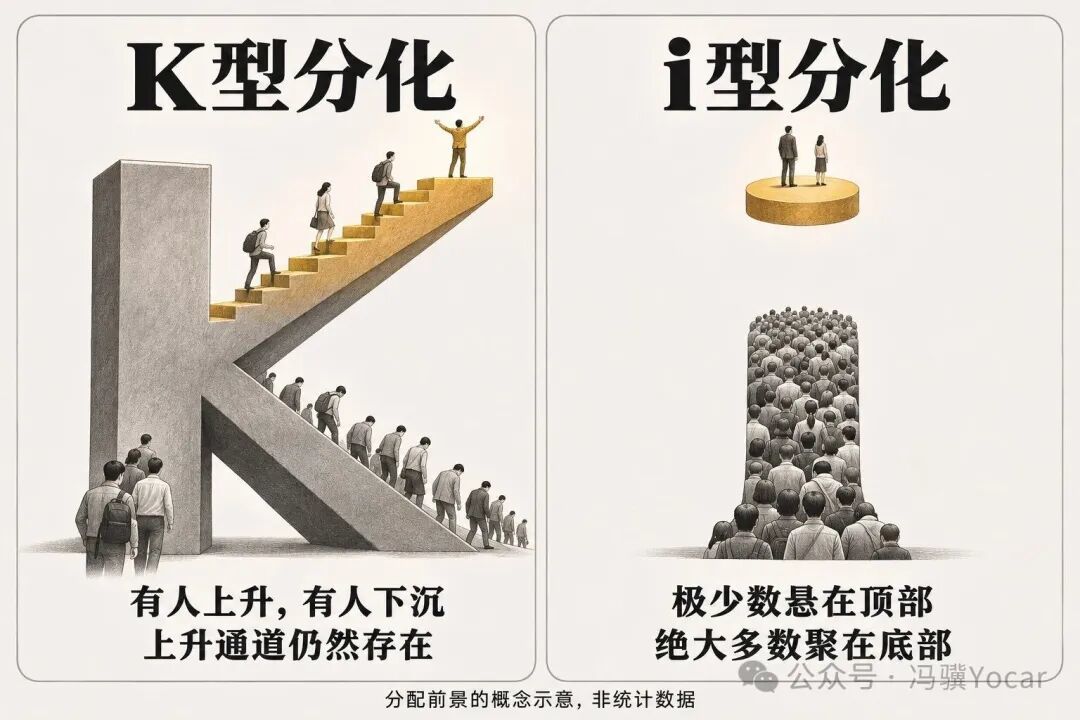
From "K-type differentiation" to "i-type differentiation", everyone should receive AI dividends
Feng Ji believes that if it evolves completely in accordance with the original market logic, a very small number of companies with super computing power, traffic portals and core IP may obtain most of the profits, while ordinary people will gradually lose their bargaining chips.
Social wealth distribution may even move from "K-shaped differentiation" to a more extreme "i-shaped differentiation": the upward promotion channel gradually disappears, leaving only a handful of high-ranking people and a huge gap between the vast majority of ordinary people.
So, who should the wealth created by AI belong to?
Feng Ji proposed,
Every ordinary person, even if they cannot write a line of code or have never bought a technology stock, naturally holds the "original shares" of the heritage of human civilization.
The reason why AI can write novels, make games, and write code is because of the civilization achievements accumulated by mankind over thousands of years and the massive information left by billions of ordinary people on the Internet.
Even if AI in the future relies on reinforcement learning and synthetic data for self-training, its underlying mathematical axioms, formal logic and programming languages still come from the accumulation of human civilization.
As an entrepreneur currently running a business, Feng Ji believes that scientists and entrepreneurs who take huge risks deserve generous business returns.
But it is one thing to reward pathfinders, and it is another thing to enclose human commons into permanent private property.
"AI is not God. The companies and people who make chips and do AI are not the priests of God."
Feng Ji suggested that on the premise of adhering to distribution according to work as the mainstay, the excess social wealth created by artificial intelligence in the future should be replaced by public dividends and distributed equally on a per capita basis.
This idea is similar to Universal Basic Income (UBI), but he believes that the income received by ordinary people should not be subsidies issued by technology giants out of mercy, but "shareholder dividends" that they deserve as the common successors of human civilization.
Humans should no longer have to prove themselves “useful”
Feng Ji revealed that in the past year, he has met many friends who love their jobs very much. After seeing AI complete work in a few minutes that used to take weeks, his first reaction was not relief, but confusion, anxiety and emptiness.
The accelerated evolution of AI is causing an existential crisis of "am I no longer useful?"
In the past, people used to use test scores, salary, rank and social status to measure a person's value. But if one day, most production activities no longer require humans, should this evaluation system continue to exist?
Feng Ji believes that human beings should not lose their dignity because of the loss of labor value.
If one day, people no longer need to work for survival, a person can use AI to build a spaceship, write novels, explore science, or choose to bask in the sun, play games, spend time with his family, or delve into an unprofitable craft.
“People are not the means of production, they can only be the purpose of production.”
In Feng Ji’s view, the real freedom in the post-AI era is not only the freedom of not having to work hard for three meals a day for a lifetime, but also includes a more important freedom:
The freedom of not having to prove to others that you are "useful".
Comments