
Abstract:
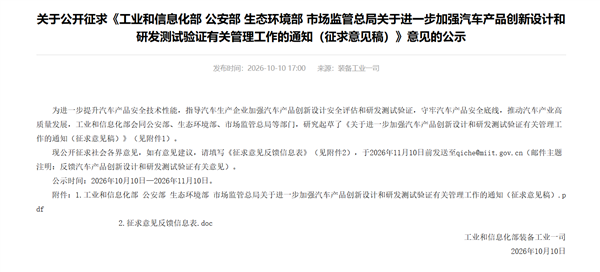
On October 10, the Ministry of Industry and Information Technology, together with the Ministry of Public Security, the Ministry of Ecology and Environment, the State Administration for Market Regulation and other departments,
study drafted and published the "Notice on Further Strengthening the Management of Innovative Design and R&D Testing and Verification of Automotive Products (Draft for Comments)", with the publicity period until November 10.
Today,
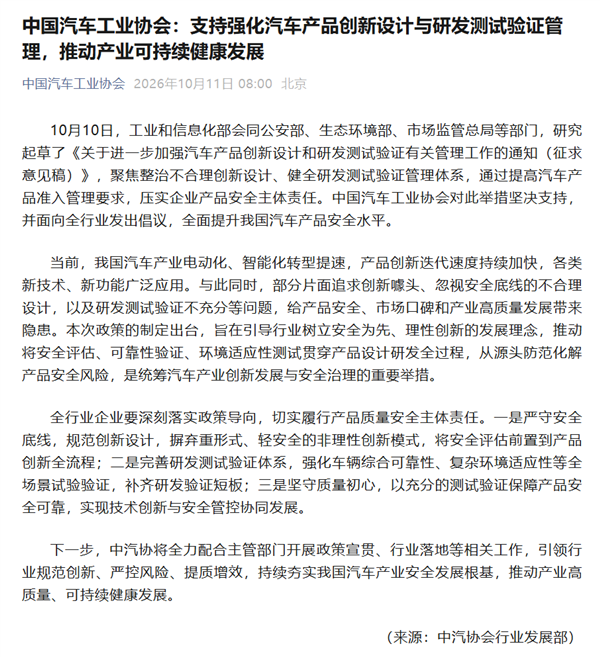
China Association of Automobile Manufacturers issued a document expressing firm support for this measure and launching an initiative for the entire industry to comprehensively improve the safety level of my country's automobile products.
The China Association of Automobile Manufacturers put forward three requirements in the initiative. First, strictly adhere to the bottom line of safety, standardize innovative design, abandon the irrational innovation model that emphasizes form over safety, and place safety assessment in the entire product innovation process;
The second is to improve the R&D test verification system and strengthen the full-scenario test verification of vehicle comprehensive reliability and complex environmental adaptability; the third is to adhere to the original intention of quality and ensure the safety and reliability of products through sufficient testing and verification. The China Automobile Association said that in the next step, it will fully cooperate with the competent authorities to carry out policy promotion and industry implementation.
It is understood that
the most attention-grabbing aspect of this draft is the hard red line drawn on a number of popular “gimmick designs”.
Products using innovative door handle designs must fully verify functional stability in extreme environments and operability in emergencies in accordance with the "Technical Requirements for Safety Technology of Automobile Door Handles" and other standards.
Have mechanical redundant design and hand operation space, and are expressly prohibited from being equipped with fully hidden door handles.
In terms of screens, products that use central entertainment screens, large-area displays, and complex heads-up displays must evaluate the impact of information presentation on driving safety and functional reliability in extreme environments, and conduct collision safety assessments.
Folding displays and flexible displays are not allowed.
The consultation draft also adds 51 main technical parameters of vehicle products, covering whether it is equipped with only electronic rearview mirrors, whether it is equipped with combined driving auxiliary signal lights, whether the roof-mounted cockpit function can be used while driving, whether it has external light language function, etc.
Electric suction doors must have an anti-pinch function and can be opened manually under abnormal conditions such as power outages and malfunctions. Enterprises must use technical means to limit seat usage scenarios. Zero-gravity seats, rotating seats, or seats that can be folded into beds cannot be used while driving. Configurations such as special-shaped steering wheels, virtual touch controls, and electric regenerative braking are also included in the scope of safety assessment and actual vehicle verification.
In addition, starting from January 1, 2027, new declared products involving innovative designs should add innovative design technical parameters. If they are not tested and verified as required, the verification is insufficient, or false materials are provided, they will not be announced;
Products that have been notified should be submitted additionally before July 1, 2027. If they are overdue and have safety hazards, they should immediately stop production and file a recall with the State Administration for Market Regulation.
In terms of R&D testing and verification, newly applied products must complete verification of comprehensive reliability and durability, structural reliability, software functional reliability, and environmental adaptability.
The environmental adaptability verification period shall be no less than 1 year, and the reliability verification test shall be no less than 30,000 kilometers.
Comments