
Abstract:
According to Business Insider and other media reports citing internal sources and official information, Google has recently adjusted its internal policies and opened up access to Anthropic's top coding large model Opus 5 to all engineers through its self-developed internal development platform Antigravity.
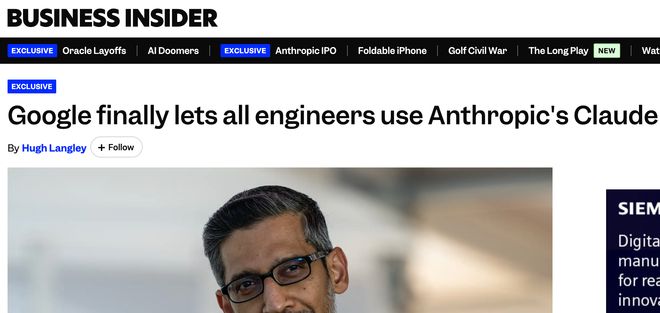
This change breaks Google's long-standing rules. Previously, the company generally prohibited most employees from using external third-party coding tools such as Claude Code and OpenAI Codex, and required internal development work to prioritize the use of its own Gemini large model.
Before this policy adjustment, Claude’s access rights were only open to a few specific teams within Google. Among them, many core R&D teams under DeepMind have had this access for some time, and many engineers have already applied it in the development process of multiple high-priority engineering projects.
According to the new rules, all Google engineers can access the Opus 5 model in the internal version of the Antigravity platform. All usage behaviors will be completed under the unified control of the platform, and there will be no data overflow. As one of Anthropic's core investors, Google announced earlier this year that it plans to invest up to US$40 billion in total in Anthropic. This opening of permissions is also the latest concrete move to implement in-depth cooperation between the two parties.
In response to this adjustment, a Google official spokesperson said that engineers can use selected third-party models in the internal Antigravity platform. This design logic is completely consistent with Google’s commercial version of Antigravity products for external companies. Gemini remains the core and main basic model for Google's internal development work. All third-party models will be controlled according to user quotas and will only be used to support specific segmented usage scenarios that Gemini cannot cover. The spokesperson also made it clear that Claude's positioning in the internal system has always been a supplementary tool for Gemini, not a replacement option. The core goal of opening access to all employees is to further improve the development efficiency of the engineer group.
Foreign media said that Google’s policy adjustment this time confirmed that the current competition in the global AI programming track has entered a fierce stage. Although Google has invested billions of dollars in resources to continue iterating the Gemini large model, and recently launched the Gemini Flash 3.8 version with upgraded performance, multiple internal engineers have reported that the model still has a significant gap in terms of code writing capabilities compared to products of the same level as Anthropic and OpenAI.
Google is not the first technology giant to make similar adjustments. Earlier this year, Amazon also officially opened permissions after receiving a large number of employee feedback, allowing internal engineers to use Claude and OpenAI Codex as development aids.
Comments