
Abstract:
Google officially released Gemini 4 Carbon, a new generation of cutting-edge artificial intelligence model, on October 28, local time, focusing on improving software programming, the ability of agents to perform complex tasks, and network security defense capabilities. Google said that the new model has made significant progress in discovering software vulnerabilities, verifying vulnerability exploitability, and repairing security flaws, and is ahead of OpenAI and Anthropic's flagship models in multiple benchmark tests. However, considering the potential risks that its powerful network security capabilities may bring, Google is currently only open to some selected network security defense agencies and will not be immediately available to all developers and ordinary users.
Gemini 4 Carbon is another cutting-edge model after Google launched Gemini 4 Argon this month. Google said that the new model further strengthens code generation, agent workflow and long-term complex task processing capabilities based on Argon, and is especially optimized for the field of network security. The company hopes that by improving artificial intelligence's ability to discover and repair software vulnerabilities, it will help enterprises protect their systems more effectively while reducing the risk of new code introducing security flaws.
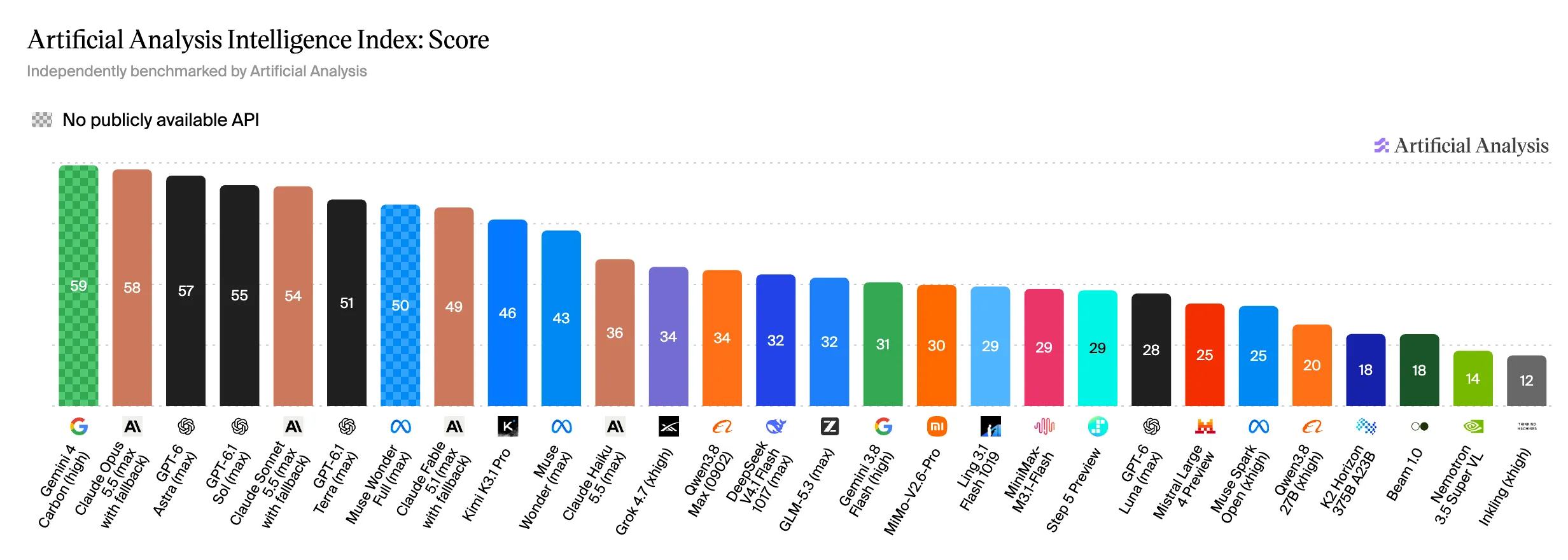
In terms of overall performance, Google cited the Artificial Analysis Intelligence Index 5.0 evaluation results released by Artificial Analysis, saying that Gemini 4 Carbon ranked first with 59 points, ahead of Anthropic's Claude Opus 5.5 and OpenAI's GPT-6 Astra. This list comprehensively examines the model capabilities in multiple dimensions, but the task types and evaluation methods of different benchmarks are different, so the comprehensive ranking does not mean that the model has advantages in all practical applications.
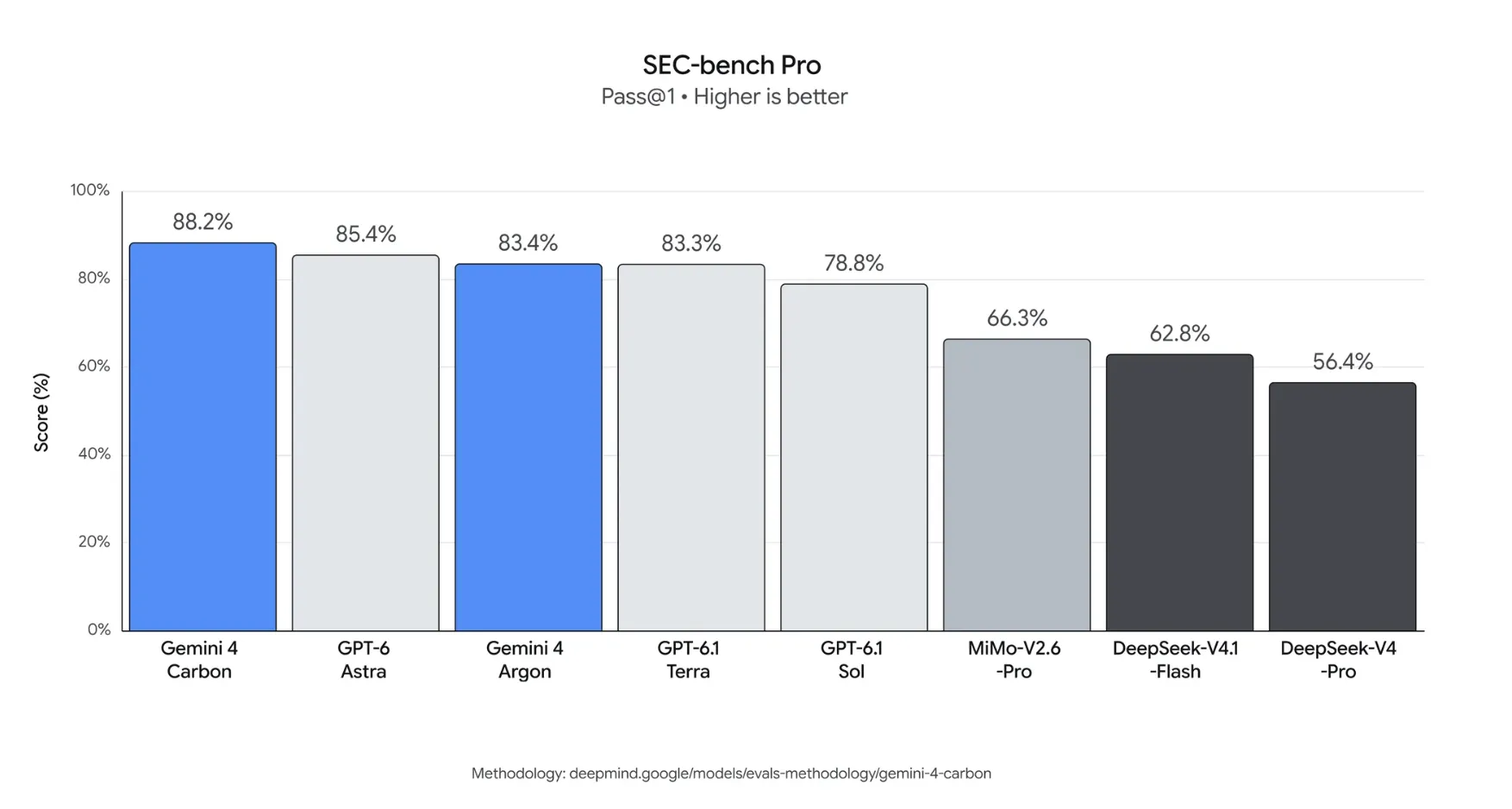
Cybersecurity is at the core of this launch. Data released by Google shows that Gemini 4 Carbon achieved a score of 88.2% in the SEC-bench Pro benchmark test, which mainly evaluates the model's ability to discover real software vulnerabilities; it achieved a score of 54.8% in the ExploitGym test, which is used to measure the model's ability to verify the exploitability of vulnerabilities and build corresponding exploitation plans; it achieved a score of 71% in the CWE-bench test, which focuses on evaluating whether the model can propose effective repair solutions for identified security weaknesses.
These capabilities cover multiple key aspects of software security work. Traditional security tools usually rely on predefined rules, known vulnerability characteristics and specific testing processes, while advanced artificial intelligence models are expected to further analyze complex codes, discover defects hidden in large software systems, and assist developers in understanding the causes of vulnerabilities, and ultimately generate targeted patches.
However, there is an important difference between vulnerability discovery and vulnerability exploitation. Being able to identify flaws in a program does not mean that the model will be able to successfully exploit these flaws in a real environment; similarly, generating a seemingly reasonable fix code does not mean that it has completely eliminated the vulnerability. The test results published by Google reflect performance under specific evaluation conditions. The actual security effect still depends on the code environment, testing methods and subsequent manual verification.
Google also said that Gemini 4 Carbon was more than twice as successful as Gemini 4 Argon in generating secure code in internal tests. The Chrome team also reported that in its internal evaluations, Carbon produced high-quality security patches significantly better than some other labs' leading-edge models. However, these results mainly come from Google's own test environment. Specific evaluation conditions and test tasks may affect the final performance, and more independent tests are still needed to verify it.
In addition to cybersecurity, Gemini 4 Carbon is optimized for engineering tasks that require continuous execution over long periods of time. Google said internal teams have observed models running for days on end, continuing to tackle complex multi-step engineering problems after multiple failures and attempts.
These tasks may involve locating difficult bugs in large code bases, troubleshooting low-level system issues, and implementing code changes across multiple modules. Unlike a chatbot that only needs to answer a single question, an agent needs to make a plan, invoke tools, check the results, and adjust the plan based on feedback during execution. The more complex the task, the more the model needs to maintain contextual coherence and avoid giving up prematurely when it gets stuck.
Google said that when dealing with such long-term tasks, Carbon is better at identifying failure paths and avoiding unreliable shortcuts to complete the task. In the actual development process, this is expected to help engineers reduce the time of repeated troubleshooting, allowing artificial intelligence to take on more continuous software maintenance and debugging work.
At the same time, Google emphasized that the new model also has improvements in reliability. The company says Carbon reduces unsubstantiated assertions by about half compared to Argon. When faced with a problem with insufficient evidence or ambiguity, the model is more likely to further search for information, point out contradictions between different information, or clearly indicate which steps still cannot be completed, rather than directly giving an answer that lacks evidence.
In terms of prompt injection attack defense, the internal evaluation results published by Google are also worthy of attention. Hint injection attacks usually induce artificial intelligence systems to deviate from their original mission goals by hiding malicious instructions in web pages, files, or other external content. Google said that in Gray Swan's indirect prompt injection test, the attack success rate of Carbon further dropped from 0.7% of Argon to 0%, that is, there were no successful cases among the attack attempts covered by the test.
However, the fact that no attacks were successfully observed in a single benchmark does not prove that the model is resistant to all hint injection attacks. Attack methods in real environments may continue to change, and the model also needs to be combined with measures such as permission management, tool call restrictions, input content review, and manual supervision to build a more reliable security system.
Because Carbon's capabilities in the field of network security are further enhanced, Google decided to adopt a phased opening strategy. The new model is first available to a select group of cybersecurity defense organizations through the company's Fairwind program. Google said that the company is participating in the voluntary pre-release testing process of cutting-edge models promoted by the US government, and plans to continue to adjust the security protection mechanism based on feedback from the first users, and then gradually open it to more trusted partners.
Google has not yet announced the exact date when Carbon will be open to all developers, businesses, and general users. The company said it hopes to introduce the model to more products and services as soon as possible after completing necessary testing and adjusting protective measures.
This limited openness strategy reflects a real challenge faced by the artificial intelligence industry: models that can help security teams discover vulnerabilities may also be used by malicious individuals to find attack entrances or develop exploitation tools. The stronger the model capability, the more companies need to assess the dual-use risks it may bring under different usage scenarios.
In terms of price, Gemini 4 Carbon’s initial pricing is the same as Gemini 4 Argon, charging $2 per million input tokens and $10 per million output tokens. Google also offers a significant discount for caching input tokens, with the discount ranging from 95% of the input token price. However, this price belongs to the promotion period pricing. The subsequent prices announced by Google are US$4 per million input Tokens and US$20 per million output Tokens. The official adjustment time has not yet been determined.
From the perspective of product positioning, Carbon is not a new model that simply pursues chat experience, but a professional tool that focuses more on complex software engineering, continuous execution of tasks, and network security defense. Its value lies not only in being able to give the right answer, but also in being able to continue to complete the work over an extended period of time and to respond appropriately when errors, ambiguous requirements, or potential security risks are encountered.
This release also shows that Google is accelerating the iteration pace of cutting-edge models. Shortly after the launch of Gemini 4 Argon, Carbon further improved several key performance indicators. For enterprise users, this rapid iteration is expected to shorten the time for artificial intelligence technology to enter actual software development and security operation processes, but it also increases the importance of independent evaluation, continuous monitoring, and security verification.
Currently, Gemini 4 Carbon has achieved leading results in a number of benchmark tests published by Google, but its real-world performance still needs to be verified by more independent institutions and actual users. As cyberattacks become increasingly sophisticated, artificial intelligence may become an important defensive tool for security teams and may also increase the automation of vulnerability discovery and exploitation. Google chose to open the model to screened defense agencies first, hoping to further assess its risks while releasing technical capabilities, and gradually establish corresponding usage boundaries.
Comments