
Abstract:
Google officially launched the new Gemini Agent at the "Gemini at Work 2026" event and defined it as a "universal work agent" for enterprise users. Unlike traditional AI chatbots that are mainly responsible for answering questions, Gemini Agent is designed as an intelligent agent that can autonomously plan tasks, call tools, connect to enterprise systems, and directly deliver results, marking Google's attempt to upgrade artificial intelligence from an auxiliary tool to a digital employee capable of undertaking actual work.
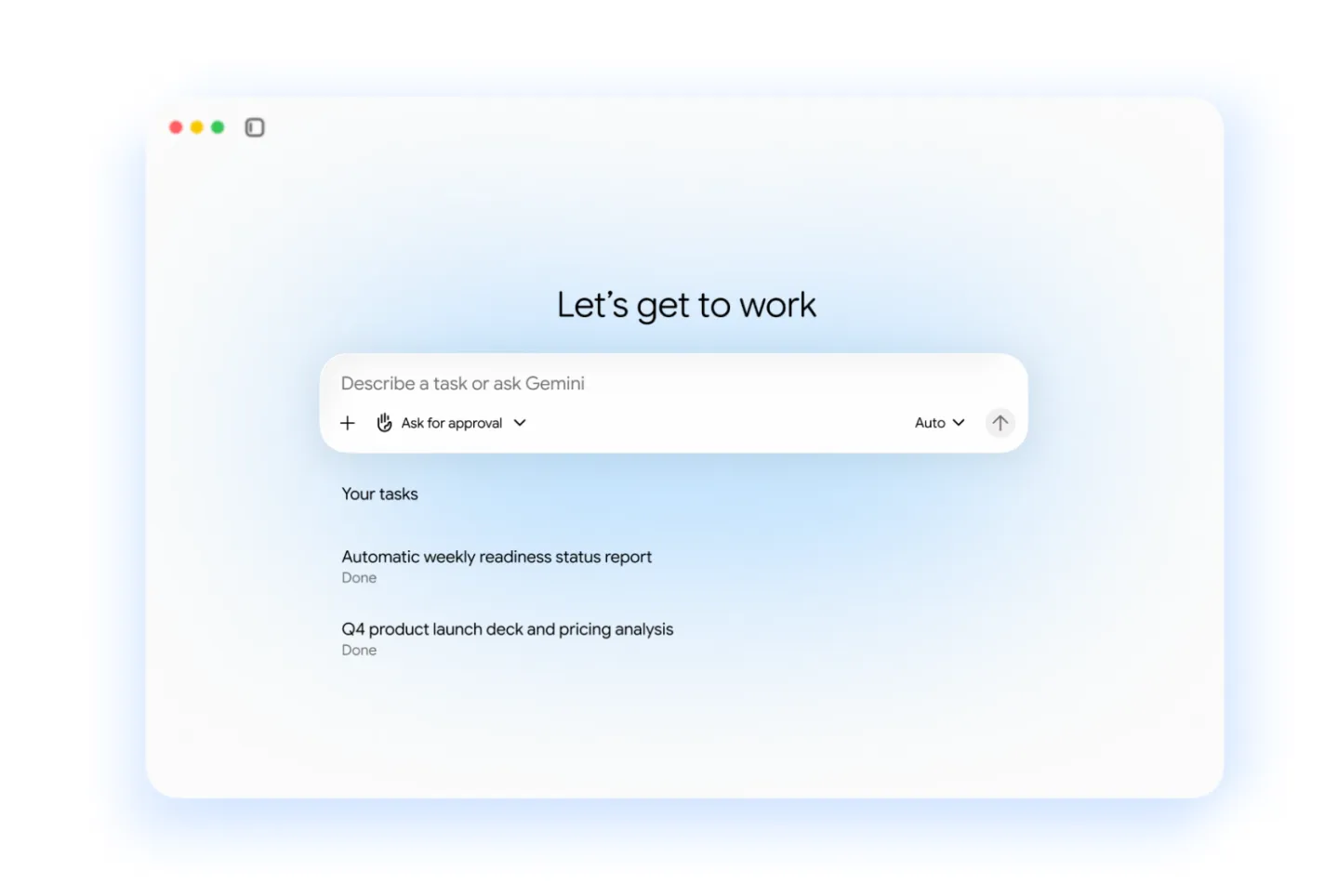
According to Google's vision, in the future employees will no longer need to switch between multiple AI products for different tasks. Gemini Agent is built as a unified work portal that can handle various tasks such as knowledge retrieval, document writing, content creation, image generation, media production, and software development. Users only need to describe what they want to achieve, rather than step-by-step instructions.
Google said that the biggest feature of Gemini Agent is that it "accepts goals rather than instructions." Traditional AI usually requires users to clearly explain each step, but Gemini Agent will formulate an execution plan on its own, decide which tools need to be called, which data should be accessed, and what workflow should be adopted, and finally return the completed results directly to the user.
The system is deeply integrated into the Google Workspace ecosystem and can work together among applications such as Gmail, Docs, Sheets, Slides, Drive, Chat and Calendar. The user's information, tasks and context in different applications can be understood uniformly, allowing AI to gain a more complete working context.
For example, when a manager sends an email requesting the production of a project report presentation, Gemini Agent can automatically collect project-related information, organize the data and generate slides, without the need for users to manually search for files and summarize information. The entire process is closer to assigning tasks to colleagues than interacting with traditional software.
In terms of meeting scheduling, the system can identify team members, analyze historical records, check calendar free time and automatically initiate coordination processes. Even when external partners are involved, Gemini Agent can help with communication and scheduling, thereby reducing significant administrative costs.
Google also proposed the concept of "AI team members". In addition to serving as a personal assistant, Gemini Agent can also work on behalf of the entire team, assuming responsibilities such as project managers, financial analysts, operations specialists, etc., and continuously performing cross-department tasks.
In order to handle complex tasks, Gemini Agent adopts a multi-agent collaboration architecture. The system can automatically dismantle large tasks and coordinate multiple sub-agents to complete different links. Some tasks can be performed in parallel, others in sequence, and the entire process can last hours or even days.
In terms of underlying technology, Google does not limit Gemini Agent to running on a single model. The system automatically selects the most appropriate model based on the specific task. Currently, both Gemini series models and Claude series models can be used. In the future, it is planned to integrate more open source and commercial models to balance performance and cost.
In order to achieve long-term collaboration capabilities, Google has also built a four-layer memory system for Gemini Agent, including current task memory, knowledge memory, process memory and historical experience memory. As work continues to progress, the system can gradually accumulate experience and learn the organization's internal knowledge and business processes, thereby continuously improving work efficiency.
Security is an important aspect of enterprise applications. Google said that Gemini Agent provides enterprise-level governance mechanisms such as authentication, permission management, security isolation, network control and audit capabilities. At the same time, cost management and model orchestration functions are also introduced to help enterprises control AI resource expenditures.
Data disclosed by Google shows that about 80% of Google Cloud customers are currently using its artificial intelligence products, and about 90% of the Fortune 100 companies have deployed Gemini Enterprise services. On this basis, Gemini Agent is regarded as the core product of Google's next stage of enterprise AI strategy.
Industry insiders believe that as Microsoft, OpenAI, Anthropic and Google have successively launched AI agent systems with autonomous execution capabilities, enterprise-level artificial intelligence competition is shifting from "whose model is smarter" to "who can actually get the job done." The release of Gemini Agent also means that the AI industry is gradually moving from the chat era to the agent era, and the collaboration between enterprise employees and artificial intelligence may undergo fundamental changes in the future.
Comments