
Abstract:
As OpenAI and Anthropic continue to launch new generations of cutting-edge models, Google officially released the new flagship artificial intelligence model Gemini 4 Argon, hoping to re-enter the high-end model market competition with stronger long-range reasoning capabilities and more competitive prices.
Google positions Gemini 4 Argon as a cutting-edge model for complex, long-term tasks, focusing on areas such as software development, enterprise knowledge work, and network security defense. However, the model is not yet fully open to the public. Instead, it will be given priority to some network security defense organizations participating in the Google Fairwind program for testing, while additional security assessment work continues.
Compared with the previous Gemini series, one of the most important upgrades of Argon is the substantial increase in output capability. Google has increased the maximum output length of a single transaction from the previous 64,000 Tokens to 1 million Tokens. This means that the model can complete longer inference processes in a single round of tasks, perform complex software engineering projects, research tasks, and large-scale workflow processing without frequent interrupts and restarts of tasks.
In terms of performance, multiple benchmark test results published by Google show that Gemini 4 Argon surpasses OpenAI's GPT-6 Astra and Anthropic's Claude Opus 5.5 in multiple key areas. Among them, Argon achieved a score of 77.9% in the DeepSWE v1.1 test that measures long-term software engineering capabilities; a score of 51.3% in the Zapier AutomationBench automated task benchmark; and a score of 91.7% in the long video understanding ability test LVBench.
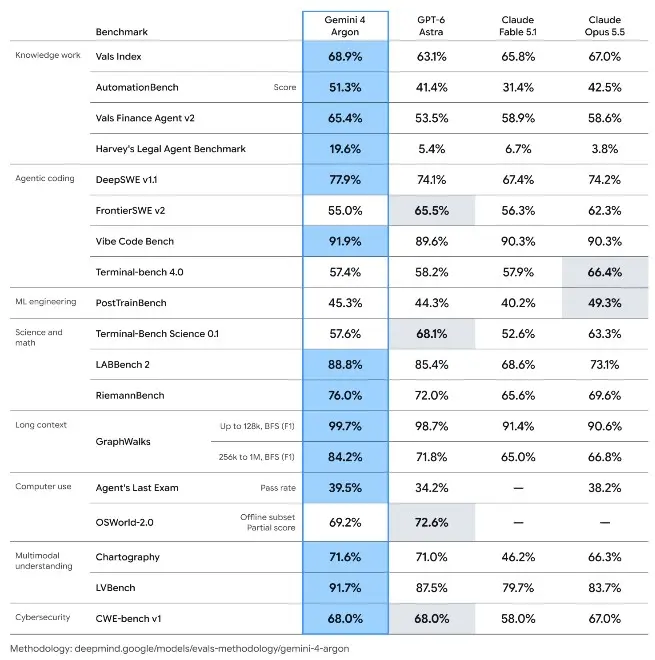
Google also stated that Argon also ranked first in the Vals Index test that assesses the ability of real economic activities such as finance, law, taxation, and software development. According to official data, the model outperformed GPT-6 Astra and Claude Opus 5.5 in a number of important AI benchmarks.
In addition to external test results, Google revealed that Argon has been put into actual use within the company. Thousands of employees are using the model to complete tasks such as programming, research and documentation. The application cases cited by Google include engineering projects such as quantum algorithm optimization, data center memory resource optimization, and migrating large C and C++ code bases to the Rust language.
Cybersecurity is one of Argon’s key areas of strengthening. Google said the model can autonomously identify, verify and fix software vulnerabilities. Google's Wiz security team has used Argon to perform security research tasks through the "Scan for Good" program. In the CWE-bench v1 test, which is used to evaluate vulnerability remediation capabilities, Argon achieved a score of 68%, tied with the best in the industry.
In order to enhance market competitiveness, Google has adopted a significantly more aggressive pricing strategy this time. The initial price of Gemini 4 Argon is $2 per 1 million input tokens and $10 per 1 million output tokens. Google also offers a 95% discount on caching input content. In comparison, the pricing is significantly lower than what some high-end competing models currently charge.
Although performance and price have shown strong competitiveness, Google chose to proceed with the deployment pace cautiously this time. The company stated that Gemini 4 Argon will continue to provide services in a limited-scope manner until more safety testing and verification are completed, and a subsequent timetable for wider opening has not yet been announced.
Comments