
Abstract:
If you have seen the 2008 movie "The Incredible Hulk", you probably still remember those sonic cannons that used powerful sound waves to suppress the green giant. Now, scientists from the University of Helsinki in Finland, in collaboration with researchers from the Public University of Navarra in Spain and the University of Michigan in the United States, have given this idea a realistic prototype: a "pipeline" composed entirely of ultrasonic waves that can physically constrain and guide the flow of materials in the air.
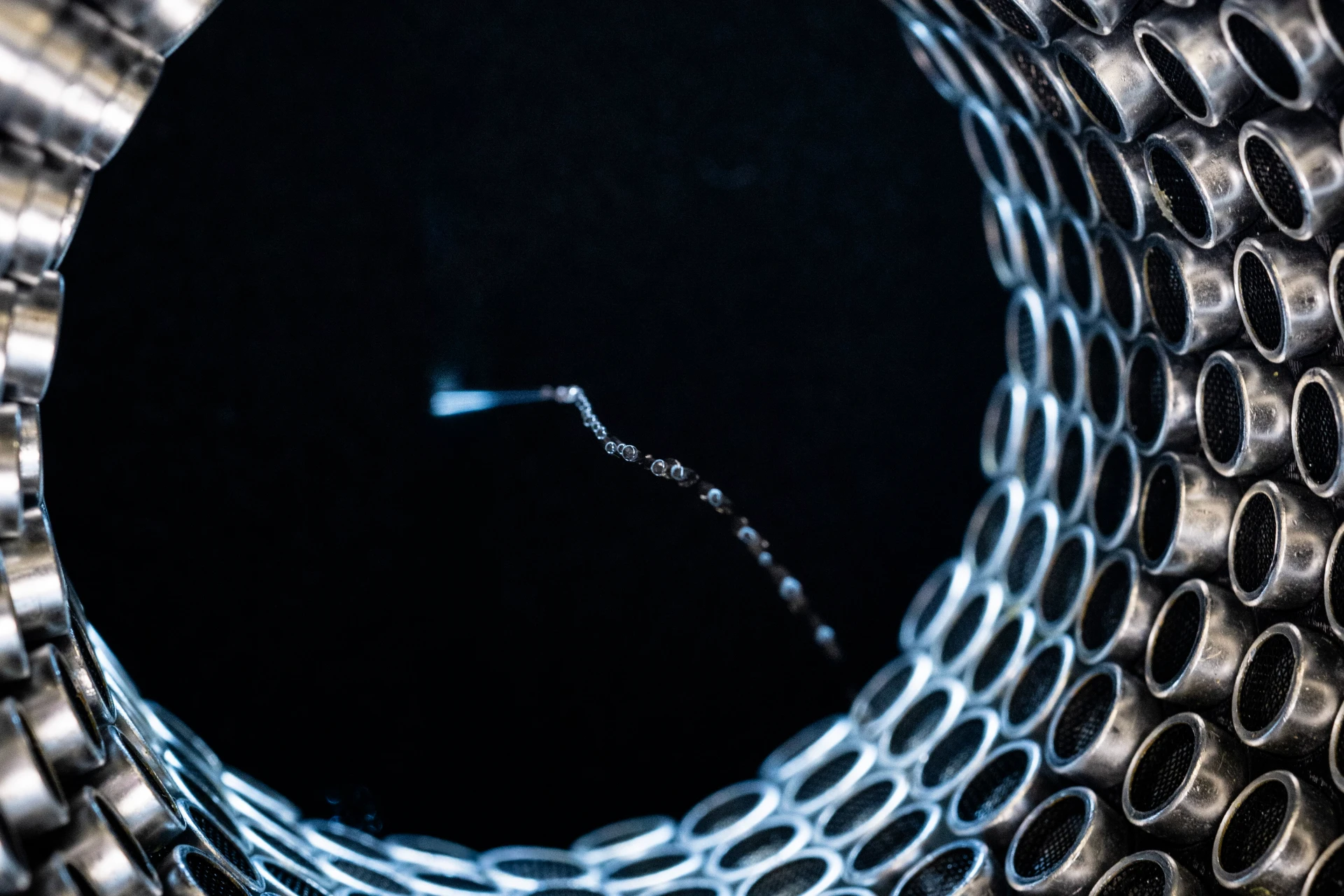
This invisible, massless pipe is "built" by ultrasonic waves emitted by 256 micro-speakers. It can guide liquids, gases, powders and even plasmas, making it look like these materials are suspended in the air out of thin air and moving forward slowly. No audible sound was heard during the entire process. To change the direction of flow, you don't have to move any physical parts; you just have to adjust the way the speakers operate and reshape the invisible pipe.
“Of all the experimental devices I have ever seen, this one can be said to be the closest to magic.” Ali Salmi, the project leader and professor of electronics at the University of Helsinki, commented.
The origin of this idea is a previous project of the research team: they used ultrasonic waves to clean materials attached to the inner walls of pipes. Following this idea, they further imagined that if the physical wall of the pipe was simply removed, so that there was no place for substances to attach, wouldn't the problem disappear from the root?
To turn the idea into reality, the researchers conducted multiple rounds of trial and error around different speaker layouts. The final prototype has 256 tiny ultrasound transducers arranged around a cylindrical structure, emitting sound waves at a frequency of about 40 kilohertz. By precisely controlling the timing of these sound waves, they form a sound field when they intersect, exerting force on the passing material and constraining it to a specific path. Adjusting the sound field allows this path to bend or redirect, while the physical pipe remains still. The prototype pipe is only 8 centimeters long and consumes about 50 watts of electricity, roughly equivalent to an old-fashioned incandescent light bulb.
This is still just a prototype, but research has proven that sound alone is enough to continuously guide different forms of matter through the air. While most previous acoustic manipulation systems could only levitate and move individual particles or droplets, the new system can handle a continuous flow of material. In the experiment, the researchers successfully guided the flowing water, sent the powder into different containers, manipulated the mist and airflow, and even controlled the path of the discharge.
In terms of application prospects, the team envisions the non-contact transportation of materials, especially those corrosive and sticky materials that will corrode conventional pipelines or easily accumulate on the inner wall. This technology may also be suitable for handling sensitive materials that are highly susceptible to contamination. The ability to electronically change the flow direction in real time also provides new possibilities for delivering materials accurately to the desired location.
However, there is still a long way to go from prototype to real ultrasonic pipeline. An obvious limitation is the disparity in size and cost: In order to create a "pipe" only 8 centimeters long, 256 speakers are required, and the hardware overhead is considerable. The researchers believe that similar modules can be strung together to create much longer pipelines.
Another problem is sound intensity. According to the researchers, the ultrasound intensity at the center of the pipe is equivalent to someone firing a gun continuously in your ear; even outside the device, the acoustic intensity is comparable to standing next to a jet engine. Fortunately, 40 kilohertz is beyond the normal range of human hearing. You can't actually hear those roars at all, but it's best to make sure there are no dogs nearby.
Relevant research results have been published in the Proceedings of the National Academy of Sciences (PNAS) of the United States.
Comments