
Abstract:
With the rapid popularity of artificial intelligence technology in daily life and business fields, cybercriminals are also transforming this technology into new attack tools. The Google Threat Intelligence Team (GTIG) recently released a report stating that hacker organizations have evolved from simply using AI to generate instructions to deploying autonomous, multi-agent attack frameworks to automatically discover and exploit security vulnerabilities. The automation of network attacks is significantly improving.
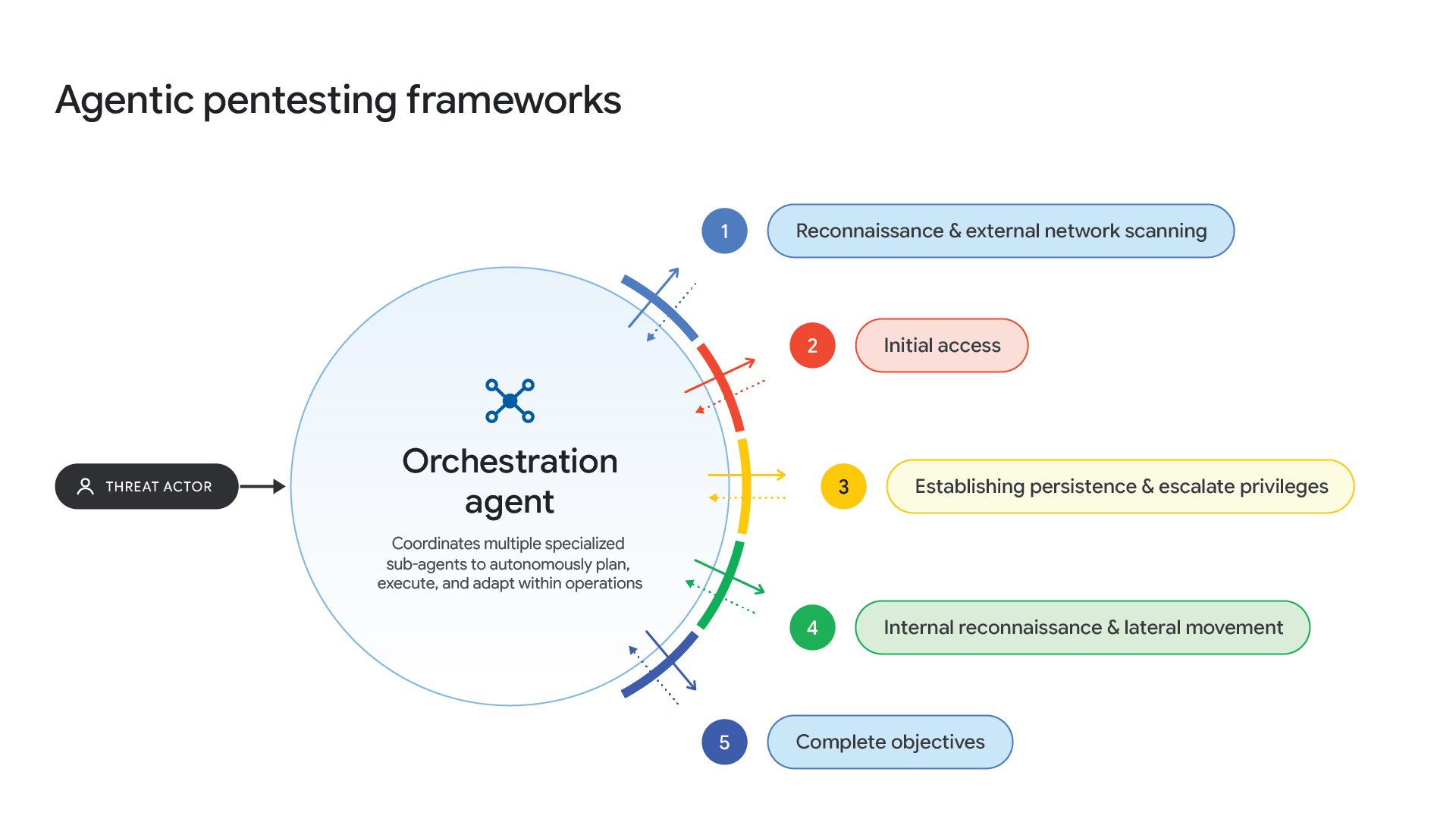
The report shows that attackers can now use AI agent systems to automatically perform vulnerability mining, analysis, and exploitation, significantly shortening attack preparation time and improving operational efficiency. GTIG researchers predict that within the next three months, hackers will be able to launch low-threshold cyber attacks that require almost no human participation, and most processes can be completed autonomously by AI agents.
Researchers found that cybercriminals are using a large number of legitimate open source penetration testing tools and frameworks to carry out attacks, including platforms such as CyberStrikeAI, PentAGI and CAIRN. Not long ago, the FBI issued a warning stating that an AI-driven penetration testing platform called ARTEX is being used by threat organizations to automate attacks on businesses and institutions around the world.
GTIG stated that in the most recent quarter, the research team observed for the first time that threat actors used a large language model framework to complete the entire process of vulnerability discovery and exploitation without any human involvement. This means that automated network attacks have crossed an important threshold and entered a new stage of development.
For example, the report stated that researchers found that hackers were using a multi-agent AI system called "exploit_agent" to conduct automated attacks on French media, entertainment and education websites. The system can continuously analyze software updates of mainstream network applications, find potential security vulnerabilities, and automatically attempt to exploit them.
Google pointed out that the emergence of such frameworks has greatly reduced the time window for security teams to patch vulnerabilities. In the past, security personnel often had ample time to deploy updates and fix vulnerabilities; with the help of AI automation tools, attackers can weaponize known vulnerabilities faster and launch attacks quickly. However, Google also stated that these systems sometimes produce misidentified or invalid attack clues.
GTIG believes that the adoption of such frameworks by attackers marks a major shift in network intrusion patterns. While the fundamentals of intrusion have not changed, with traditional means such as stealing credentials or exploiting unpatched systems still present, the ability of automated frameworks to string together complex attack chains at “machine speed” and operate at larger scales has created new and unprecedented challenges for network defense efforts.
In response to this trend, Google emphasizes that enterprises should patch systems open to the Internet as soon as possible and shorten the time between patch release and official deployment as much as possible. The report believes that rather than actively looking for new vulnerabilities, attackers are now more inclined to quickly exploit vulnerabilities that have been publicly disclosed but have not yet been patched. Therefore, keeping the system continuously updated is still one of the most effective measures to improve security.
At the same time, Google believes that AI is not only being used for offense, but also for defense. The company mentioned an AI security agent called "Big Sleep" that proactively looks for known software vulnerabilities and assists in fixing them. Google also introduced its AI Threat Defense security architecture, which combines AI models, risk priority analysis and automated repair capabilities to detect and respond to network threats faster.
Industry insiders believe that as AI-driven attack tools continue to mature, the field of network security is entering a new stage in which both offense and defense rely on artificial intelligence. In the future, enterprises will not only have to face the pressure brought by the expansion of automated attacks, but also must rely on more advanced AI protection systems to deal with continuously escalating network risks.
Comments