
Abstract:
Most of Huang’s $140 billion worth of Nvidia shares are held in a trust he owns with his wife, Lori Huang, according to lawyer analysis and U.S. Securities and Exchange Commission (SEC) filings. The arrangement adds more uncertainty to Nvidia stock and his personal financial future as Huang steps down from the company.
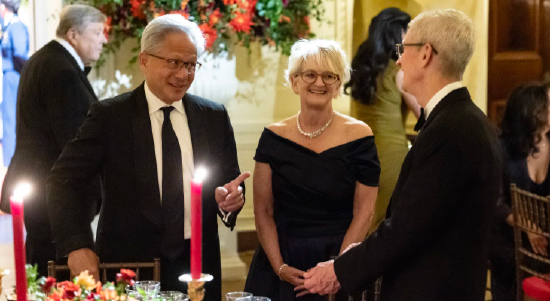
According to SEC filings, Huang and his wife jointly hold about 800 million Nvidia shares, worth about $135 billion, through a complex network of trusts and limited liability companies (LLCs) set up for tax and estate planning. Huang Renxun himself also directly holds about 70 million shares, worth about $12 billion.
Tax experts say it is common for tech company founders and CEOs to hold company stock through trusts, but it is relatively rare for founders and spouses to have equal ownership. The arrangement complicates matters following Huang's sudden departure, but could also be a stabilizing factor in the stock price because the trust structure makes it difficult for both Huang and his wife to sell their shares quickly.
An SEC filing stated: "Both Mr. Huang and his wife may be deemed to jointly own beneficial ownership of the relevant shares and jointly share voting rights and investment decision-making rights."
According to the filing, Huang and Lori Huang, as co-trustees of the "Jen-Hsun and Lori Huang Living Trust" established in 1995, hold approximately 530 million Nvidia shares.
The two also jointly serve as trustees of the Huang 2012 Irrevocable Trust, which holds 31.4 million shares, and the Huang Irrevocable Remainder Trust, which holds 109 million shares. Another approximately 135 million shares are held by a limited liability company with a living trust as its sole member, according to the filing.
Lori Huang also serves as president of the Jen-Hsun and Lori Huang Foundation. The foundation holds 69 million Nvidia shares and reported net assets of $9 billion in 2024, according to IRS filings.
Trust and estate planning attorneys say each trust structure serves a different tax or estate planning purpose.
The living trust is likely a revocable joint trust because it was established 10 years after Huang and his wife married and two years after Nvidia was founded in 1993.
While the specific rules for each living trust vary, attorneys say shares in a living trust can often be sold or divided relatively easily if a couple divorces.
"It's like a joint checking account," said Kathleen Martone, a partner at law firm Varnum LLP.
While revocable trusts typically allow spouses to sell their respective shares, attorneys say it's common for corporate executives or their trusts to enter into agreements with their companies to restrict the sale or transfer of stock in an effort to prevent large-scale selloffs.
Leslie Evans, a partner at law firm Withers, said: "If they divide the shares in the revocable trust, they are likely to be subject to transfer restrictions. He may have to continue to hold the shares for the benefit of his wife, who can get the financial benefits of the shares but not voting or management rights."
"Huang Jen-Hsun can also keep the stock, while Luo Li will receive other assets or a compensation payment to balance the value of both parties' properties."
The more complex structure used by Jen-Hsun Huang and his wife, which also has more significant tax advantages, is an irrevocable trust.
SEC filings show that "Mr. Huang and his wife are co-trustees of these two trusts."
In an irrevocable trust, the grantor transfers ownership of assets to the trust, and the terms of the trust cannot be changed without the consent of the beneficiaries or the court.
The lawyer said that the irrevocable trust established in 2012 is likely to be an "Intentionally Defective Grantor Trust" (IDGT). This is an irrevocable trust in which the grantor gifts assets to the trust, but the IRS still treats the grantor as the owner of the underlying property for income tax purposes.
This structure allows the grantor to lend money to the trust to purchase stock and pay income taxes on the trust's income as it generates it. The result is equivalent to a transfer of wealth to the trust that is not subject to gift tax limits and is not included in the scope of inheritance tax.
In addition, the trust avoids paying capital gains taxes on the appreciation of the shares held by the trust.
“The principal of the trust is maintained at a high level, and I pay the taxes out of my personal taxable assets, allowing me to continually transfer more funds to the trust,” said Azriel Baer, a partner in the trusts and estates practice at Farrell Fritz LLP in New York.
Another irrevocable trust owned by Jen-Hsun Huang and his wife, the "Huang Irrevocable Remaining Interest Trust," is likely to be established for the benefit of their children.
As the name suggests, the trustee arrangement and trust terms of an irrevocable trust are difficult to modify. Experts say that because Huang and Lori Huang are co-trustees, it is likely that neither party alone will be able to transfer or sell Nvidia shares held in the trust.
Mattone said: "An irrevocable trust is an independent entity with its own operating rules, so it has certain estate planning and asset protection functions. In theory, an irrevocable trust can prevent trust assets from being pursued by a divorced spouse who is a creditor."
Of course, attorneys point out, all of these protections depend on the specific terms of the trust. Whether an irrevocable trust can be modified, or adjusted through what is legally known as decanting, depends in part on state law. California, where Huang and his wife live, has strict regulations on modifying irrevocable trusts.
For Nvidia shareholders, an irrevocable trust may help stabilize the company's stock price, because it would be difficult for either Huang or Lori Huang to take their shares out of the trust and sell them.
Lawyers say it is unlikely that Huang and his wife will amend the trust established for the benefit of their children.
If these trusts were set up for the benefit of the children, there would be no reason to re-include the underlying assets into their own estates, said Rochelle Schultz, a shareholder attorney at Weinstock Manion.
Comments