
Abstract:
According to Business Insider, AI company Hugging Face announced on Thursday the launch of a new AI model, Carbon-X, which is expected to help scientists more easily study DNA and develop new gene therapies. Hugging Face said that Carbon-X is an open model with 14 billion parameters for DNA understanding and generation.

Hugging Face
Carbon-X integrates DNA sequences and natural language into the same model: researchers can ask questions about specific DNA sequences, predict the effects of mutations, and generate new DNA sequences. It can also act as a specialized sub-agent, helping other models decipher DNA sequences that they themselves struggle to understand.
Relying on the Qianwen large model
Lewis Tunstall, senior research scientist at Hugging Face, said Carbon-X is the first to combine DNA analysis and generation capabilities with natural language, allowing researchers to ask questions about DNA sequences and essentially "talk to DNA."
Hugging Face collaborated with research labs in Italy and China to develop Carbon-X, an open source model. Hugging Face developed Carbon-X by training an existing language model, Qwen3-14B, using genome sequences and natural language. The model was trained using DNA sequences from humans, other mammals, plants and fungi.
Hugging Face said that across five DNA understanding and generation benchmarks, Carbon-X outperformed all other open source models the company evaluated, with an average score close to GPT-6.1 Sol, but at only 1/1800 the cost of inference per question. Compared with Qwen3-14B, Carbon-X's score increased by 27 points, indicating that the performance of open language models can be improved by directly using DNA data for training.
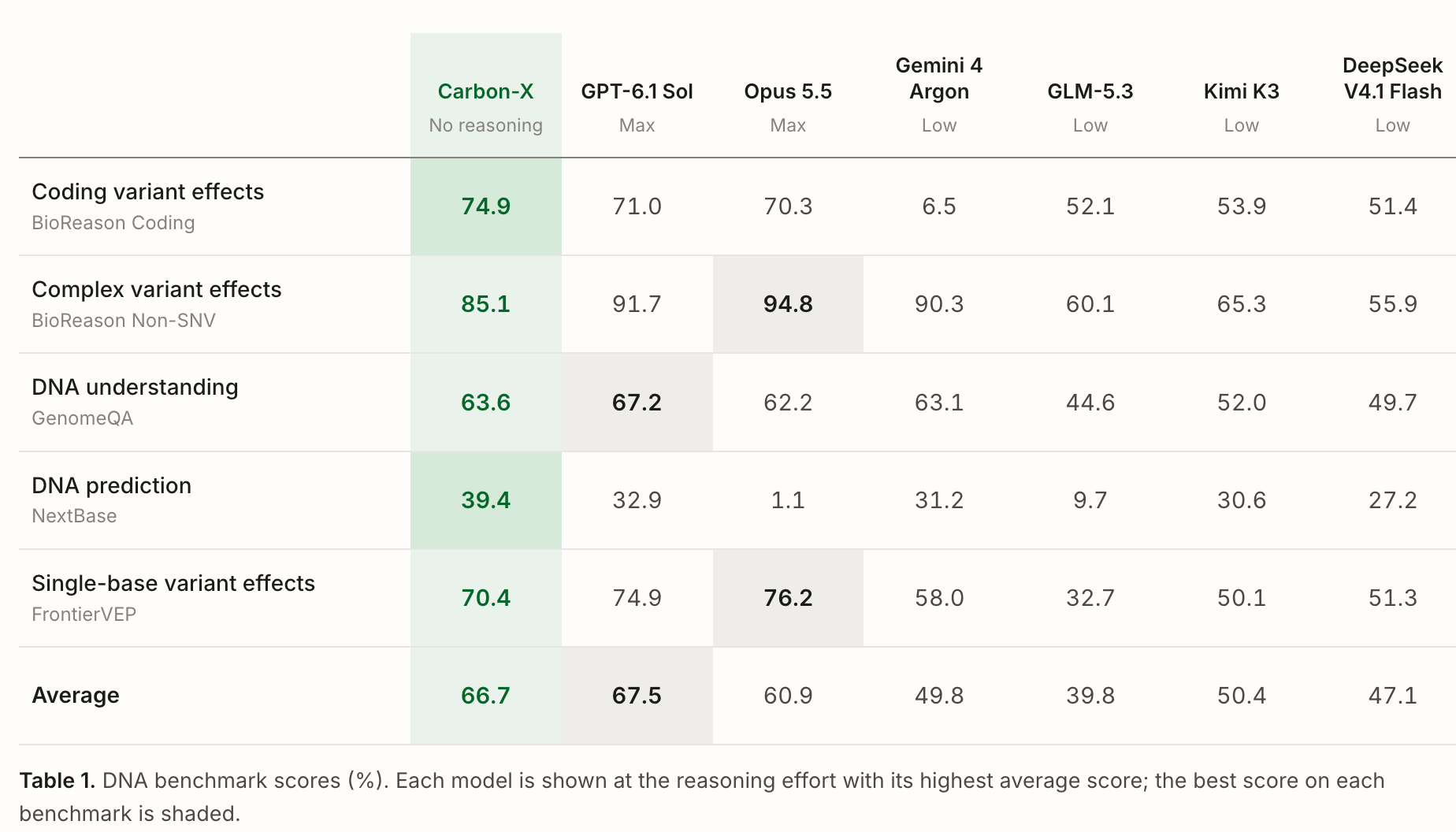
Carbon-X’s running score is close to GPT-6.1 Sol
When talking about the application scenarios of Carbon-X, Tunstall gave the example that researchers can provide a DNA sequence to the model and ask whether a specific mutation increases a person's risk of disease. The model then gives predictions and explanations. It can also generate new DNA sequences, helping researchers develop new gene therapies.
Prevent over-reliance on large companies
Tunstall said part of Hugging Face’s motivation for developing Carbon-X was to prevent biology researchers from becoming dependent on large AI labs. He pointed out that AI has had a disruptive impact on the field of mathematics.
“If you want to really push the frontiers of mathematical research, you probably have to work in an AI lab like OpenAI or Anthropic, because they have the best mathematical models.” Tunstall said. He believes similar situations may arise in other fields of science.
He added: "We want to provide the open research community with tools so they don't have to rely entirely on one external vendor."
Researchers can run Carbon-X on their own computers without sharing sensitive patient data with external AI companies. Tunstall also said that some behavioral inaccuracies observed in large models have not yet appeared in smaller, more professional models, such as the problems exposed by the famous incident of the OpenAI agent invading Hugging Face in July this year.
General chatbots also sometimes refuse to answer legitimate biological questions from researchers, Tunstall said, because they mistakenly believe they are trying to "design bioweapons." To prevent abuse of the model, Carbon-X's training data explicitly excludes virus-related data, he said.
While Carbon-X is likely to be used primarily by researchers, Tunstall said the model is a small step toward a future where AI is expected to help provide more personalized medical care.
“I think the ultimate goal is to achieve personalized medicine, where each of us can use our own medical records and genomic data to ultimately find and maybe even design a treatment plan that suits us,” he said.
Comments