
Abstract:
The British "Guardian" reported on October 22 that a few months ago, before the arrival of Google, there were an estimated 250,000 trees in the 330 hectares (3.3 square kilometers) of forest near the town of Muhos in the northern countryside of Finland. Today, they are all gone. The tech company illegally cleared an entire area, even the topsoil, to build a data center. Residents say brown, muddy water from the site is flowing into a stream that eventually joins the Olujoki River.
“There is no end to the felling, it goes on and on,” says Marie Anara, an ecologist with the Finnish Society for Conservation of Nature (SLL), standing at the fence and looking at drone footage of the former forest.
Finland currently has 145 new data centers in various stages of planning, putting the country at the forefront of the latest round of expansion by technology companies. In addition to a relatively favorable geopolitical environment, stable geological conditions and abundant land, the cool climate is particularly conducive to saving energy costs.
Earlier this month, Finland's Licensing and Supervision Authority (LVV) ordered Google to suspend construction at the Muhos site and another site in the village of Otanmaki, about 100 kilometers southeast, because the company did not complete the necessary environmental impact assessment before clearing the forest land.
Last week, Google Finland manager Antti Järvinen apologized for the deforestation but claimed the company acted "based on our best understanding of the law at the time."
The construction sites in Muhos and Otanmaki are part of Google’s €13 billion AI infrastructure project. The project has been criticized by U.S. President Trump; he would prefer the data centers to be built in the United States and has publicly called on Google to reconsider. This is the largest project of its kind ever undertaken in Finland.
The Finnish government has been pursuing a policy of deep spending cuts while encouraging this investment. When Google announced the plan last month, Finnish Prime Minister Petri Orpo said attracting investment was a "top priority" and that "the value of the data economy goes far beyond direct investment." He said the Google deal would bring "lasting benefits to both parties."
But revelations of Google’s wrongdoing have raised public concerns about what the deals will mean for nearby communities, energy prices for Finnish households and the country’s proud natural environment. The data center construction boom is likely to become a key issue in Finland's general election in April.
In addition to the 250,000 trees cut down in Mujos, Anara estimates that 150,000 trees were cut down in Otanmaki. She said the wood from the two sites could not be sold to wood processing plants because the trees were felled illegally.
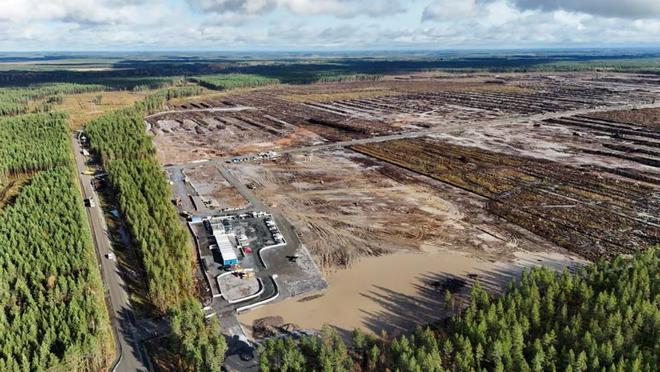
AFP on-site aerial photo of Google data center planned to be built in Mujos
The move also raises questions: Why should Finnish renewable energy be used to power international companies?
More than 93,000 people have signed a petition calling for greater data center regulation and fees to compensate local communities for environmental damage.
Jussi Kangasharju, head of the computer science department at the University of Helsinki, said that the limited number of jobs created by data centers may boost the local economy, but the benefits at the national level are minimal. "Realistically, there is little benefit to Finland," he said. "They are international companies serving international customers, and very little corporate tax flows to Finland. In the end, the data center is of little benefit to anyone other than the operator."
Google said it is working to protect water quality at the Mujos site and plans to plant trees on 130 hectares (1.3 square kilometers) of land there. Environmentalists say that number is too low compared with the damage caused by logging to have any real impact.
A spokesperson said: "We have been operating in Finland for 15 years and have always strived to meet or exceed zoning, environmental, health and safety requirements.
“After receiving the letter from LVV on October 6, we stopped the preparation work in Mujos and Kayani (the location of the Otamaki construction site) and have submitted a formal reply to LVV to confirm it.
"We will fully comply with LVV's requirements in this matter. We look forward to maintaining an active and open dialogue with all authorities to strengthen our partnership with Finnish and local organizations."
Comments