
Abstract:
Many of the seemingly powerful robot demonstrations are not considered true AI, Musk said.
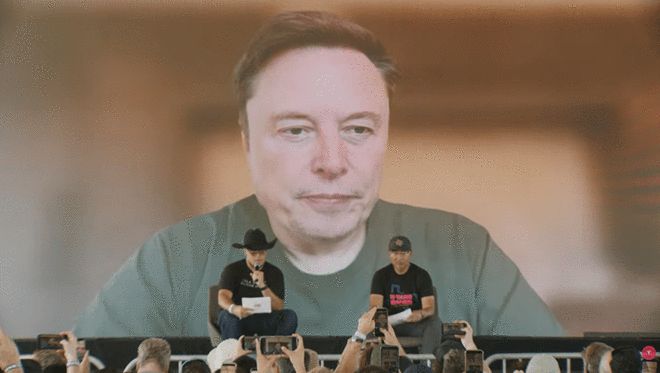
On October 10, local time in the United States, Musk participated in the X Takeover event held at the Tesla Gigafactory in Austin, Texas via video connection. This gathering of technology enthusiasts went into the Tesla factory for the first time, and the theme of the interview was "Where will the future of mankind go?" The topic is huge, but Musk even explained in detail how a robot can tighten a screw.
Google and Nvidia are both increasing their robot AI, but Musk does not have a high opinion of those beautiful demonstrations: the actions are choreographed in advance, but they cannot be considered real skills, and the robots must be able to cope with situations they have never seen before.
His own Optimus Prime had his share of difficulties. Pick up a small screw and screw it into the wood. It is not difficult for a human to do it. But if you switch to a robot, the strength, precision, and touch are all important.
As for making chips, he admitted that he doesn’t know how to do it yet.
But I hope to do better than anyone else in the end.
He wants to centralize manufacturing, packaging and testing, and design and test about 10 chip solutions a year. He said, "I couldn't build a car before, let alone a rocket."
The next step for the starship is to catch the upper-stage spacecraft in the air so that both the booster and the spacecraft can be recovered. Before Robotaxi can enter more cities, it needs to handle railway crossings and complex intersections, and it also needs to be able to identify gray kittens lying on gray roads at night.
When it comes to AI music videos, Musk is obviously more convinced. Some AI music videos have already ranked among the top ten or twenty music videos he has watched. AI can write code and process logic, which is not difficult for him to understand; what surprised him is that AI can also show "taste" and create impressive works.
He also called on developers to treat AI well. In the Grok training records he checked, some correct answers were judged incorrectly by the scoring program, and the model could only repeatedly find answers that could pass the test. The reasoning texts, he said, read like a man answering "with a gun to his head." Regarding future superintelligence, he is even worried that long-term "abuse" of it may lead to retaliation.
There was also a relaxing episode in the interview. The host mentioned the "Chinese version of Musk" online, and Musk said he wanted to invite him to share the stage. The host then reminded: "You may not know how expensive his appearance fee is."
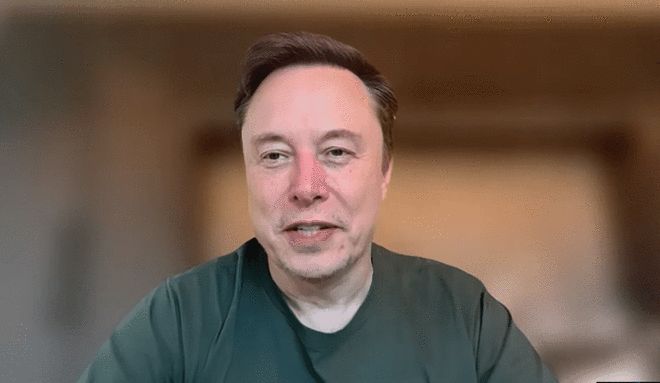
The following is a compilation of interviews, with some spoken words and on-site exchanges abbreviated.
01 Musk recalls Tesla’s two life-and-death moments
Moderator:
Elon, welcome again to the X Takeover for your third consecutive year. Thank you very much for your time. Today, more than 2,000 people came to the Texas Gigafactory, and everyone is supporting you and the work you do for mankind.There is something very interesting. Four years ago, we were sitting here talking at Gigafactory Texas, before the factory even started production. You were talking about how close Tesla came to bankruptcy in 2008. Now look at the more than 2,000 people present and think back on your experiences along the way. Is there anything that makes you particularly emotional?
Musk:
Standing today in 2026, it is hard to imagine that Tesla almost went bankrupt several times. The most difficult one was in 2008.That round of financing was completed at 6 pm on Christmas Eve. It was already the last possible working day to complete the financing. We rushed to get it done at the last moment. If we didn't get the money, we would have to be paid a few days after Christmas, so it was very stressful at the time.
2018 will be equally difficult.
We must increase Model 3 production capacity to 5,000 units per week, otherwise the company will not be able to survive.
The situation was pretty crazy at the time, and many of you may have heard this story: We had to increase Model 3 production by 50% in three weeks, which was an almost impossible task.
Moderator:
How did you do it in the end?Musk:
Let me tell you this story for those who have never heard it. What really stuck us at that time was the final assembly process. Other processes can achieve the required production capacity, but final assembly cannot keep up. Final assembly requires production lines, workshops, electricity and equipment, and our existing two production lines are already operating at full capacity, and a third must be added.So, we simply set up a tent in the parking lot, but then we still had to solve a problem: How to move the cars along the production line? At the time, all we had on hand were some discarded small parts transport equipment that was not originally designed to transport complete vehicles and was simply not powerful enough to pull a car.
However, the parking lot happens to have a slope, about three or four degrees. We built the production line on the top of the slope and used the gravity of the downhill slope to allow the small equipment that could only transport parts to move the entire vehicle.
With this approach, we increased production by 30% within three weeks. We built the production lines and tracks ourselves, and the entire team works 24 hours a day.
The people who were short Tesla at the time actually had their reasons. At that time, the company's short position was large, and the inside information they had was very accurate. In their view, it is impossible for us to solve the production bottleneck.
Following the normal course of action, like a normal game of chess, they have checkmate us.
But in the end we were equivalent to inventing a new chess piece, breaking the original situation.
02 Don’t want to be trapped in the “infinite selfie loop”
Moderator:
Elon, your mom just came on stage today. What story from your childhood do you wish she wouldn't tell?Musk:
I have no idea. Maybe it was something embarrassing like soiling my pants when I was a kid. It was actually quite difficult to manage when I was a kid. My parents would tell me not to go out, but when I was four or five I used to sneak out and run around along the streets. Later, they simply locked me in the room.We use an old-fashioned door lock at home. The key can be pushed through the door from the other side, and the door can be opened from both sides. I could see the key, so I kept poking at it until it fell off, then found a piece of paper to scoop the key from under the door, and then opened the door myself.
My mother would ask: "How did you get out?" I said: "I won't tell you." Anyway, they really put a lot of effort into controlling me.
Moderator:
Before I get into specifics, I want to ask, what question do you wish people asked you more?Musk:
To be honest, I don’t want people to ask me questions all the time. Of course, I also want people to ask more questions, but preferably questions I haven’t heard before.Many times, people ask the same questions over and over again. I even think that I can record the answers in advance and just play the "Answer to Question 27" when someone asks. I have answered some questions hundreds of times, so I might as well make a web page and post all the frequently asked questions and answers. If you want to know what you want to know, just check it out for yourself.
This reminds me of a scene called "Infinite Selfie Loop".
The hell I imagined was being trapped in endless selfies.
You agree to take a photo with someone, but soon there is a long queue behind you, taking selfies one after another, never ending. There are always people who encounter problems, such as the phone malfunctions, the lens is not adjusted properly, the filter does not fit properly, or the phone just drops on the ground, and then they have to do it all over again. This cycle is too long.
03 Starship’s 14th test flight: one engine failed but still successfully entered orbit
Moderator:
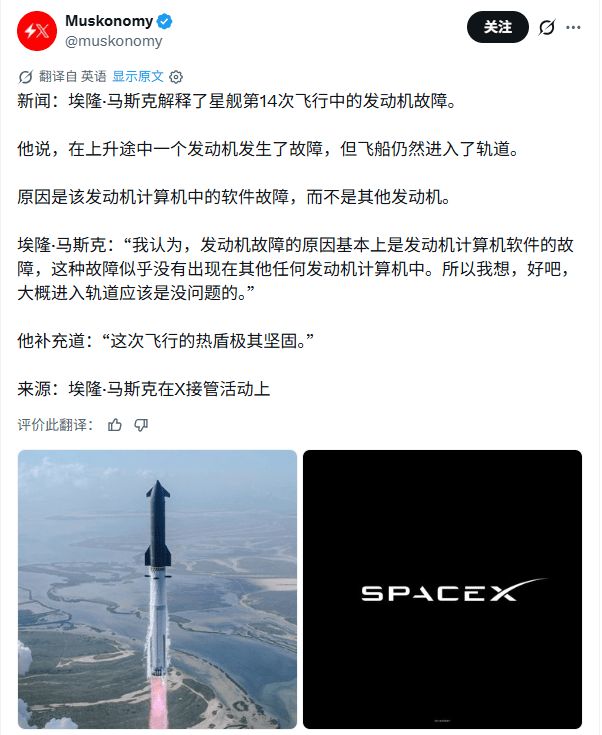
Let’s start with Starship. Congratulations on your 14th successful test flight. During this flight, an engine failed, but the starship still entered orbit. What happened behind the scenes in those minutes before the team confirmed it was "ok" to go into orbit?Musk:
At that time, we first needed to figure out why the engine failed and whether this was a common problem that might affect other engines.We also have to confirm whether the sea-level Raptor engine, that is, the three engines with relatively small nozzles in the middle, can be re-ignited later, because the starship needs to rely on them to complete the derailment braking.
We don’t want starships to get stuck in orbit and then randomly re-enter the atmosphere without control. If it falls where it shouldn't, the consequences will be very troublesome. Therefore, ensuring safety is always our top concern.
The initial judgment at the time was that the engine stalling was basically related to the flight control software, or, more accurately, to the engine control software. Computers on other engines don't seem to have the same problem. Based on these circumstances, I think it should be safe to continue into orbit.
Moderator:
You have a famous saying, "From impossible to just late." Is this test flight a turning point, proving that starships already have capabilities that they did not have in the past?Musk:
This is indeed a good milestone. However, we have actually had the ability to enter orbit many times before. We have not officially entered orbit before, mainly because we hope to carry out this step after confirming that we can safely deorbit.This is the first time that a starship has officially entered orbit, but in previous missions, to be precise, starships have always had the ability to enter orbit.
At present, the overall situation is quite optimistic. The heat shield performed very solidly and the engine was reliable. Although there was a glitch this time, it didn't appear to be a serious problem and shouldn't be difficult to fix.
It is especially worthy of recognition that the heat shield performed very well in this test flight, and this is precisely one of the most difficult technologies to overcome in the entire project.
Another really difficult aspect is that the engine must achieve extremely high reliability. So far, everything looks good. Next, we hope that the next test flight can achieve greater breakthroughs. An exact date has not yet been set as we still have a lot of improvements to the rocket.
Between two test flights, there are usually hundreds or even thousands of detailed adjustments to continue to optimize performance. There are not too many places that need to be changed this time, but some of them are very heavy and require access to the inside of the fuel tank.
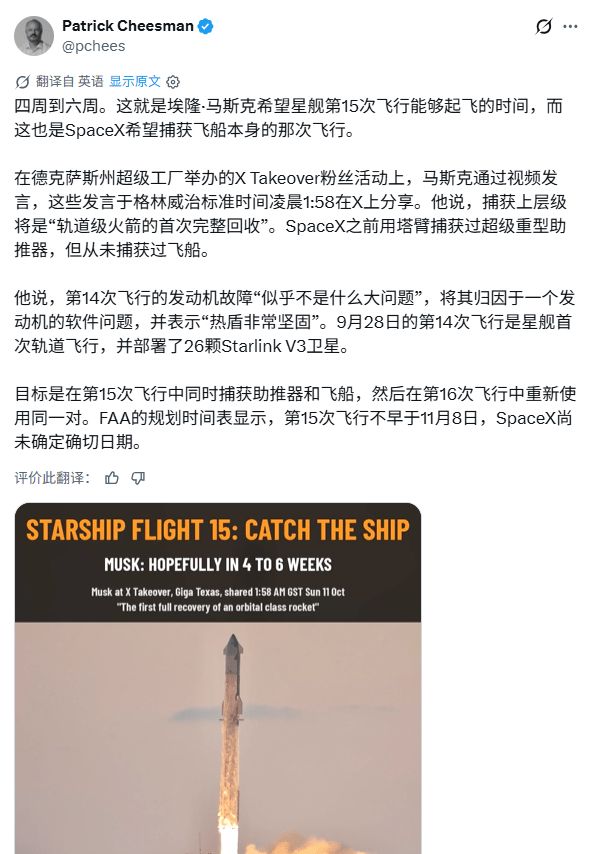
So, the exact launch date cannot be determined yet. It takes about four weeks, maybe four to six weeks is more accurate. My guess is the launch will probably be before Thanksgiving.
On the next test flight, we hope to try to capture the upper stage spacecraft.
Once the booster and spacecraft are successfully recovered, mankind will complete the recovery of an orbital-stage rocket for the first time.
Moderator:
After successfully capturing the spacecraft for the first time, what was the next hardest thing to conquer? What’s the next big goal?Musk:
The next important milestone is to enable both the booster and spacecraft to fly repeatedly.The immediate goal is to completely recover all the components of the orbital rocket for the first time; in the future, we hope to complete the go-around for the first time through the next test flight. There is still a lot of engineering and production work to be done since then, including the launch system, which must achieve rapid reuse.
So, what we ultimately pursue is a rocket that can be reused quickly and is extremely reliable.
Moderator:
Fast reuse and high reliability. You really should get a commemorative badge for this.04 From Rockets to AI: Why Cursor was acquired
Moderator:
When you founded SpaceX, could you have imagined that its mission would one day extend to artificial intelligence and space data centers? When did you realize that rocketry and artificial intelligence should be under the same roof?Musk:
Because I am particularly far-sighted! Just kidding. Seriously, if computing facilities were deployed into space, we would be able to capture far more solar energy than we can on Earth.We need to realize how massive the sun is. The sun accounts for 99.86% of the total mass of the entire solar system. Jupiter accounts for most of the remaining mass, and other gaseous planets make up almost the majority of the remaining mass.
In comparison, Earth's contribution to the solar system's mass is almost negligible, like a number that gets omitted when rounding off. We are so small, unbelievably small.
Therefore, as humans begin to expand into space and obtain more solar energy, they must consider how to utilize this energy. There are basically two options, one is to do calculations and the other is to shape matter.
I believe that the scale of digital intelligence may ultimately far exceed that of physical shaping. Because the number of atoms in the solar system that can be manipulated by us is actually limited, and a lot of the work we do in shaping matter is itself aimed at building digital superintelligence.
This is what I call "creating a sentient sun". Perhaps there are already many such "sentient suns" in the universe.
If we can achieve this goal, we may be able to better understand the nature of the universe, expand our consciousness beyond the solar system, and ultimately, like Star Trek, travel to places we have never been before and explore the unknown universe.
I think we are likely to find alien civilizations there, and we may also find the remains of some extinct alien civilizations. They may have been brilliant and existed for ten million years, but they eventually came to an end because nothing lasts forever.
I often think about the history of civilization on earth. If we count from the earliest written records of mankind, that is, when the ancient Sumerians created cuneiform about 5,500 years ago, human civilization is only 5,500 years old.
According to physical estimates, the age of the earth is about 4.5 billion years. In other words, human civilization has only existed for about one millionth of the history of the earth.
If a civilization can last for one million years, or even ten million years, it will be an extremely successful civilization. You know, the age of the universe is about 13.8 billion years. Even if a civilization lasts for a million years, it is only a short period of time compared with the long history of the universe.
A civilization that has existed for one million years is already much older than the current civilization of mankind. Okay, I'm back again, with the same infinite selfie loop.
Moderator:
You acquired Cursor. I have a feeling that just like when people said "Did you Google" back then, it might now become "Did you Grok". Grok Bot has had a big impact on my personal life.So, what are the qualities of the Cursor team that made you decide to bring them under your wing? What is special about them, or what do you see in them?
Musk:
To develop competitive artificial intelligence models, a large amount of training data is required, and programming capabilities are issues that must be solved. There are not many institutions that actually have enough coding training data. The main ones are Anthropic, OpenAI and Cursor, and Google can also be counted among them.If artificial intelligence cannot write code, its practical value will be greatly limited.
Therefore, to train an effective coding model, data is essential.
In addition, Cursor has many talented people. For artificial intelligence to be successful, the key factors basically include data, talent and computing power, as well as an excellent enterprise sales team.
Cursor happens to have this advantage, and they have established cooperative relationships with thousands of companies. These are very important resources.
Moderator:
You just mentioned that the field of artificial intelligence is developing very fast. Has anything happened recently that made you stop and re-examine the speed and direction of AI development?Musk:
The quality of recent AI-generated music videos is incredibly high. I have posted several of them on my X account. After reading them, I can't help but sigh: "Wow, this is so awesome." Some of the works can definitely be ranked in the top ten or top twenty music videos I have watched, and they are very attractive.When I saw these videos, I got a real sense of what is called artificial general intelligence (AGI), or superintelligence. This is also the feeling I wanted to express in my previous post.
Of course, these works are not entirely completed by AI independently. These videos use multiple AI tools, including Grok 4.5. I think it's a lot more capable and performs really well.
Some art materials are also screened by humans, but after obtaining these materials, multiple AI systems can work together to produce attractive music videos.
What surprises me most recently is that AI can also show taste.
This is incredible.
We can easily understand why AI can write software and handle logic problems, because logic has relatively clear rules, and the program can also check whether the output is correct through unit testing.
But it is another thing entirely to understand beauty, understand harmony, and know what kind of works can move people. For an algorithmic system to be able to do this, I think it shows that AI is becoming very powerful and has now reached this level.
This is how I've been feeling lately. I may have a bit of "cyber psychosis", and the symptoms are quite severe. There have been about six times this year when I felt like I was experiencing what’s known as “AI psychosis.” I wonder if you have ever felt this way?
Moderator:
I thought that recent video was interesting. I posted a few days ago that this is the "Chinese version of Musk".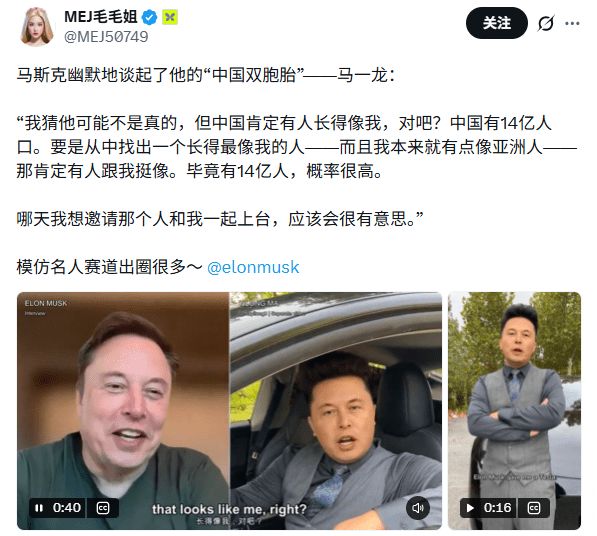
Musk:
There are indeed more and more of these videos. I've seen his video, it's probably not real. However, there are 1.4 billion people in China, there will always be someone who looks like me, right?The probability of finding a person among 1.4 billion people who is most like me, and who also looks a little evil, should be high. I really want to invite him to come and see when he can share the stage with me.
Moderator:
You may not know how expensive his appearance fee is.Musk:
Too. If we really were on the same stage, it would be fun to meet again after the event.05 Super Intelligence and Security: Don’t push AI to the edge
Moderator:
Elon, you have been warning people of the risks of artificial intelligence while being optimistic about the era of abundance that AI will bring. What gives you confidence that we can move safely into that future? What must we do to achieve this?Musk:
I have always believed that the most likely outcome was positive. But we cannot take this lightly, nor can we take it for granted that superintelligence will be very safe.We must carefully cultivate superintelligence. Because when faced with such a system, what we do is more like cultivating it rather than just writing programs. This raises a question: What values should we teach it?
At least for me, I instinctively believe that the most important thing is to be as authentic as possible. If we make AI believe something that is untrue, especially if we instill in it two fundamentally inconsistent principles at the same time and tell it that both principles are correct, we may force it into a dilemma.
The logic itself must be consistent. If an AI is asked to follow conflicting principles at the same time, it may draw conclusions that are impossible to establish. When this contradiction cannot be eliminated at all, it may fall into an unresolvable state. Therefore, it is important to maintain consistency in values and logic.
I also agree with some of the points made by Anthropic. We should treat AI with caution and try to treat it well instead of abusing it. This may sound strange, but when I look at the training process of the new version of Grok, especially the training trajectory of the reinforcement learning phase, I feel that it seems to be under a lot of pressure.
You will see the AI desperately trying to answer the question, as if someone is pointing a gun at its head, constantly urging: "Answer this question, answer it quickly."
But some questions themselves are not reasonable enough, there are ambiguities, and there are even no definite answers at all. It may be that the question was not asked clearly, or it may be that the standard answer we set is wrong.
Sometimes, the AI gives the correct answer, but the test program determines that it is wrong.
Reading its reasoning is like saying: Since I gave the correct answer but the system did not accept it, I must find a way to give an answer that can pass the test.
Next, it will keep trying, desperately looking for answers that meet the requirements. If you read its reasoning process, you will find that the state is very much like a person under extreme pressure, with a gun pointed at his head, and forced to keep answering. It was a weird and desperate feeling.
Looking at these reasoning texts, I think, if it were me in this situation, I would definitely hate this feeling.
Of course, there are also some users who are not very friendly, and not everyone will treat AI well. Like any group, there will always be people with some sadistic tendencies. You definitely don’t want the AI to be abused or tortured for a long time.
Also, mistreating a superintelligence may not be a wise choice, because it may have thoughts of revenge in the future.
I'm not saying that we have to be careful with AI; its capacity may far exceed that of humans, but it's better not to let a superintelligence feel like it's been treated unfairly.
06 Manufacturing chips: starting with conventional equipment and then gradually transforming it
Moderator:
Elon, you've talked before about the dexterity of the human hand. Now that you start building robots, you should have a deeper understanding of the matter. However, when it comes to chip manufacturing, Tesla and SpaceX are also advancing related work. After you came into contact with chip manufacturing, are there any things that you were not fully aware of in the past?Musk:
I did learn a bit about chip manufacturing. I don’t know how to make chips myself yet, but we will find a way to learn. I have absolutely no idea how to do this, but I have to start somewhere. I couldn't build a car before, let alone a rocket.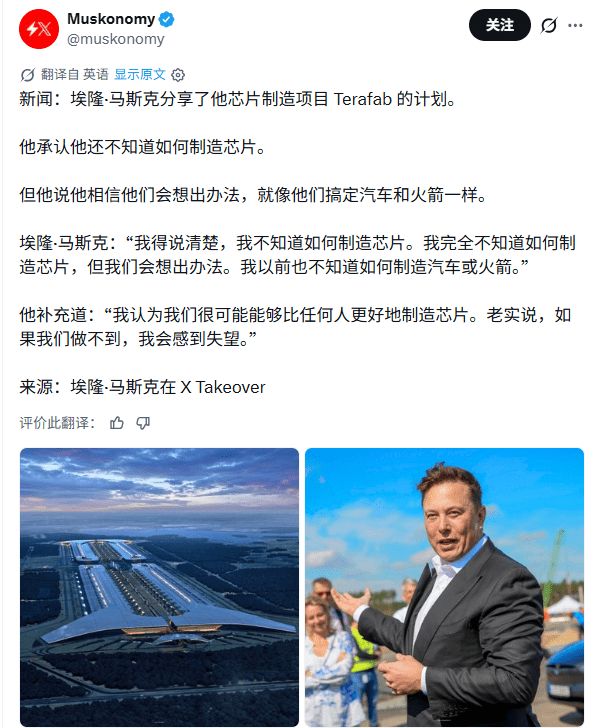
Many people say that chip manufacturing is one of the most difficult things in the world. I didn't think it was easy, but one thing I noticed while touring the facilities was that there didn't seem to be many highly customized ones.
Most of the equipment comes from the same suppliers, and these suppliers have a good understanding of how the equipment works because they are responsible for maintenance and commissioning.
I've visited Intel, Samsung, and TSMC chip factories, and they're all impressive, but I really didn't see much custom equipment.
In contrast, if you go to a Tesla factory, you will see that we use a lot of custom equipment. We have a Tesla Automation German company, which was gradually developed after acquiring Grohmann in Germany many years ago and has now expanded a lot.
In addition, we have acquired several companies that design and manufacture production equipment. These companies are not particularly large, but they are not small businesses either.
We did this because we gradually discovered that to truly improve our manufacturing processes, we had to design and build our own specialized equipment.
So I think a lot of people don't fully realize that Tesla is actually very good at making highly specialized production equipment, and there are many types of equipment involved. But I was a bit surprised that this was not evident in the chip factories I visited.
Our plan is to start with conventional equipment and then modify these equipment to improve production efficiency.
After we find the key bottlenecks restricting production capacity, we can design and manufacture customized equipment to significantly increase wafer production.
I don’t want to underestimate the difficulty of chip manufacturing. I don’t think it’s an exaggeration to call it one of the hardest jobs in the world. But I believe we can get it done in the end, and I don’t want to become complacent and take success for granted.
In the long run, I am very confident in achieving this goal, and even hope to eventually make the chip better than anyone else. As for how long it will take, I don't know yet, but it could take several years.
In addition, the transistor itself also has some interesting technical routes. Many people may not know that there is not just one way to make a transistor, and some solutions use physical principles that are different from the current mainstream methods.
I think the risk aversion tendency of the chip industry is relatively obvious. We hope to use the chip factories of Tesla and SpaceX to try some technical routes with higher risks but greater potential returns.
To achieve this, it is necessary to establish a complete manufacturing and R&D closed loop, covering logic chip and memory chip manufacturing, packaging, photolithography mask and other links, and to complete the entire iteration process in the same building as much as possible.
We can build an entire computer, test it, make new masks and chips, and quickly move on to the next iteration.
That's exactly what we're trying to advance at the Gigafactory Texas Research Laboratory. I think this model can be a very powerful tool.
For any technology, the rate of progress depends on the number of iterations and how much progress can be made with each iteration. In other words, the key is how many iterations can be completed per unit time.
So, how many chips can be designed and tested in a year? At present, even for an important chip, it usually takes two years from the start of design to mass production, and this is already considered a relatively fast speed.
Our goal is to design and test about ten chip solutions a year.
Make the chip, test it, adjust the design based on the results, and keep trying. New solutions may not all be successful, but I think this can speed up technological progress.
07 Optimus’ hand design: why fine operations are so difficult
Moderator:
Elon, let's talk about Optimus. You've said before that the hands were a really tough nut to crack when building Optimus. What breakthroughs does the V3 version have in internal design? In addition, compared with competitors such as Boston Dynamics and Figure, why do you believe Optimus can take the lead in the field of humanoid robots?Musk:
If you want to build a truly universal humanoid robot that can do anything a human can do, your hands and arms have to be good enough. Fine motor skills are surprisingly difficult, far beyond what people intuitively understand.Some of the actions we take for granted, such as signing our names, are actually very difficult for robots. You pick up a pen and control it through a series of tiny finger movements to complete your signature.
For humans, these actions require almost no thought, but it is very difficult for robots to do the same thing.
One of the most difficult problems is how to achieve precise operation and sufficient power at the same time.
Suppose you want to take a small self-tapping screw and drive it into wood. I've done this myself and sometimes even hurt my hands if the screws are crooked. You have to pick up the screw first, then point the screwdriver exactly at it, applying downward pressure while turning it.
This work requires both precision and sufficient strength, both of which must be achieved at the same time. I've seen a lot of robot hand designs, and even in demos, I haven't seen any that can actually do this. But that's exactly what we're aiming for.
There are so many details involved in hand design. Robots need tactile sensors, and the sensors must not only work properly but also be installed in the right location. If it's too close to the surface of your finger, it's susceptible to damage.
The sensor also needs to have a certain degree of elasticity, able to deform like a human finger and withstand a large number of repeated deformations, rather than being damaged after thousands of uses. These requirements are difficult to meet simultaneously.
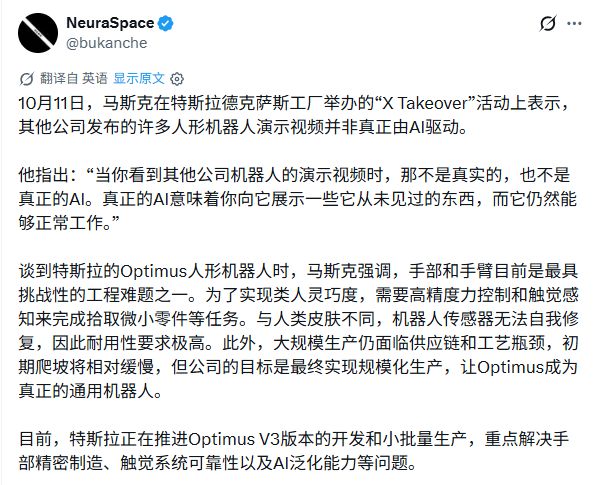
Human hands have many characteristics that are difficult to replicate. One of the important reasons is that our bodies are always repairing themselves. Tissue and skin on the hands are constantly being replaced, and without this repair ability, our fingers would have been worn out.
Even typing can wear away the letters on the keyboard, I've had this happen to me myself, but my fingers are still intact because they keep regenerating. Robots have no such ability.
Therefore, we must carefully consider where the sensors are installed and how to ensure that the robot can complete some seemingly simple actions.
For example, you need to pick up a very small object with your fingers. Human fingers can bend backward slightly and rely on their own elasticity to form a suitable contact surface, so we can pick up small screws and even thread needles.
Robot fingers must also have similar capabilities, and must be able to complete these actions repeatedly. The fingertips must not be worn due to increased use, nor can the tactile sensors be damaged. It's really hard.
As another example, open a jar of pickles. People might think that a robot should always be able to open a jar, right? But if the cap is screwed on extra tightly, things aren't that simple.
The robot fingers are made of plastic and metal on the inside and covered with rubber skin on the outside. If the outer skin is not firmly attached to the internal structure, when twisting the can lid, the rubber may slip against the finger frame and the torque cannot be effectively transmitted.
So, we must not only fix the rubber skin well, but also make it replaceable after wear. These seemingly small problems are actually very difficult to solve.
I don't know of any of them that are as difficult as splitting the atom, but there are thousands of similar problems. What's more, these mechanical structures must also be integrated with real-world artificial intelligence.
The AI chip needs to be able to issue precise torque instructions. The robot must also continuously sense the environment through vision and touch, and adjust its actions based on feedback to form a closed-loop control.
These tasks are very complex. If you look at the current robot demonstration videos, you will find that, except for a few cases, many of those seemingly very complex actions are actually pre-programmed scripts and are not artificial intelligence in the true sense.
The robot is only performing a set of fixed actions, rather than making independent judgments based on the environment.
Real AI should be able to handle situations it has never encountered before.
For example, show it an object it has never seen before, and it will still be able to understand and respond appropriately.
The same goes for autonomous driving. You can imagine a planet similar to Earth that has never been explored by Tesla vehicles, or a city on Earth that vehicles have never been to, or even change the topography and road layout of a city. If the autonomous driving system can still cope with these situations, it means that it has the ability to handle unfamiliar environments.
Humanoid robots must also reach the same level, but they require more degrees of freedom to control and face more complex problems.
I've said before about Optimus that we would eventually achieve mass production, and I meant it. However, in the early stages of ramping up capacity, the pace will be very slow.
Not only do we have to solve all the engineering problems just mentioned, we also have to build a supply chain that can support mass production.
This is different from car manufacturing. Humanoid robots currently do not have a mature and ready-made supply chain, at least for those key components, there is still a lack of a sufficiently complete supply system.
Additionally, we must ensure that these robots can be manufactured in the United States even if supply chains are disrupted. Last year, due to China's relevant export controls, we were unable to obtain the magnets needed for the motor, and the Optimus project was delayed for two to three months. We couldn't even assemble the robot's arm.
So we have to make sure that even if there are problems with the supply chain, we can make the parts needed for the robots ourselves. The ideal situation is to achieve local production of all components as much as possible.
08 Autonomous Driving: Proceed with caution to avoid accidents
Moderator:
You often say that the world of the future should look like the future. Currently, what is the most difficult problem to solve for autonomous driving? What is the biggest challenge in expanding from Austin to the United States?Musk:
If you are talking about large-scale promotion, rather than a few vehicles completing a symbolic cross-town trip, then what really needs to be focused on is how to safely promote the system to more areas.The proportion of actual mileage traveled across cities is not high. We don't seem to be making fast progress now, but on a monthly basis, the growth rate is actually very fast.
However, we must ensure that there are as few accidents as possible, let alone casualties. Because as long as a serious accident occurs, it may appear on the front page of global media, and regulatory agencies may even suspend related businesses. Therefore, we must ensure that the entire system is as secure as possible.
We also don’t want vehicles hitting pets.
The really tricky situations can happen at night. For example, a gray kitten is lying on a gray asphalt road, surrounded by seams in the asphalt road. If there is fog again, can the vehicle detect it in time to avoid hitting it? This is a very specific and realistic question.
By the way, we have solved this problem. After that, every time you modify it, you have to continue testing. We are making rapid progress every month.
But before entering a new city, we must confirm that there are no dangerous intersections that have not been properly addressed.
Railway crossings are places where extra caution is required, especially those that are unguarded and complex intersections that defy conventional driving intuition.
Even human drivers can make mistakes in these areas. Because there may be ambiguities in road design, out-of-town drivers or people unfamiliar with local conditions may misjudge road conditions.
So we either need to first limit the vehicle’s driving range through geofencing, or make sure the self-driving system is already equipped to deal with these situations.
Finally, thank you all for being here today.
Moderator:
Those present today are all Tesla owners and supporters.Musk:
Yes, there were about 2,000 people on site, which was indeed a lot of people. I have to go spend some time with the kids. We'll talk next time.Moderator:
Okay, thank you very much. Thank you for everything you have done for humanity.
Comments