
Abstract:
Researchers at the University of Illinois at Urbana-Champaign have developed a new extraction molecule that can be driven directly by electricity to recover valuable metals from electronic waste, mining logistics and industrial waste, and significantly reduce the reliance of traditional processes on chemical reagents. This research may make the metal recycling process cleaner, simpler and more energy efficient.
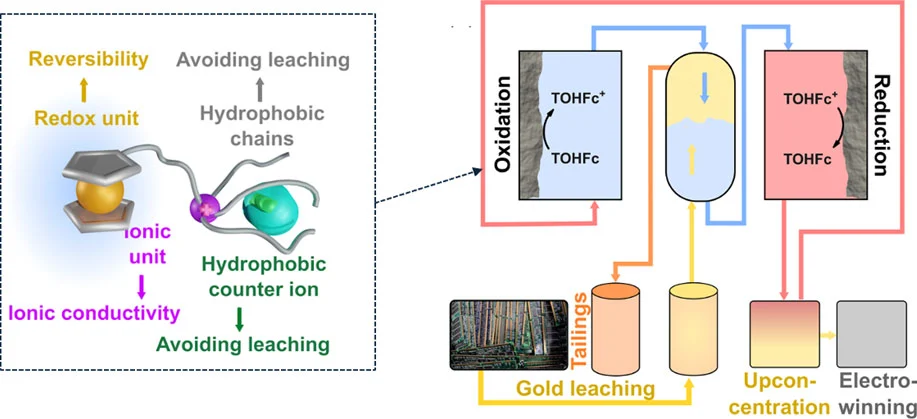
This research result, led by Su Xiao, professor of chemical and biomolecular engineering at the school, has been published in "ACS Energy Letters". The research team previously proposed a continuous electrochemically mediated liquid-liquid extraction technology, e-LLE, in 2024 for recovering gold from electronic waste. The technology demonstrates that electricity can replace the large amounts of acids and bases typically required in liquid-liquid extraction. Liquid-liquid extraction is a technique widely used to separate and purify metals, but systems at the time still required additional chemical reagents to complete the entire extraction cycle.
This time, the researchers eliminated this remaining chemical step by modifying the extraction molecule itself. They designed a multifunctional molecule that selectively binds metal ions, has a permanent charge, and is stable in the organic phase used for extraction. Because the molecule carries its own electric charge, researchers can control its reaction directly with electricity, eliminating the need for intermediate chemical reagents that were previously necessary.
The permanent charge built into the new molecule acts as an electrolyte, making the liquid conductive, said postdoctoral researcher Deborah Schmidt, co-author of the paper. Therefore, redox reactions can be driven by electricity rather than chemicals. She notes that this work enables the complete electrification of an industrial separation process that relies heavily on chemical reagents.

Su Xiao said: "This is the first time we have run electrochemical solvent extraction in the way we once imagined. We charge the molecule, it binds the metal and brings it into the organic phase, and then releases the metal through electricity."
By driving the process directly with electricity, chemical consumption can be reduced by one to two orders of magnitude, while the extraction cycle is also simplified. Replacing intermediate reagents with electricity could theoretically reduce both chemical waste and energy consumption.
In laboratory tests, researchers used the molecule to selectively recover gold from e-waste leachate. The so-called leachate is a solution formed by dissolving precious metals in waste electronic products. Gold is the first demonstration of this research, but the team's larger goal is to establish a set of molecular design principles to develop electroactive extractants for other separation challenges.
Adryjek Aguda, a co-author of the paper and a graduate student, said that this system can be adapted to the selective recovery of a variety of high-value metals, such as the recovery of platinum group metals from spent autocatalysts, and the recovery of multiple key elements from tailings or other complex raw materials. Because the electrochemical platform itself remains essentially unchanged, researchers can adjust the chemical structure of the extractant to target different metals based on different application needs.
Su Xiao said that this research opens up a basic path for understanding and designing such systems. In the next step, the team will focus on promoting the development of this technology to industrial-scale applications, while continuing to develop more molecular design solutions, and seeking cooperation in computational modeling and artificial intelligence to accelerate the screening and discovery of new extraction agents.
Su Xiao said that as critical mineral resources and supply chain issues receive increasing attention, this achievement shows that electrochemistry has the potential to provide scalable, low-waste separation technology and promote people to rethink how to recycle metals in a cleaner, fully electrified way.
The research paper is titled "Direct Electrification of Liquid-Liquid Extraction by Imparting Fixed Charges to Selective Redox Active Compounds" and was published in "ACS Energy Letters" on July 7, 2026. The DOI is 10.1021/acsenergylett.6c01434. The research was funded by the Basic Energy Sciences Division and Separation Sciences Program of the Office of Science of the U.S. Department of Energy, project number DE-SC0025636.
Comments